On March 14, 2022, Kenya Medical Supplies Agency (Kemsa) signed a USD 8.33 million (Sh1 billion) contract with a local pharmaceutical firm, Universal Corporation Limited (UCL), for the supply of life-saving HIV drugs for adults through direct procurement.
The deal, initiated a month earlier, was meant to plug urgent gaps in the country’s HIV treatment programme.
Instead, it ended up being a legal battle with Kemsa denying the procurement and refusing responsibility for the payment, while UCL demanding its dues and a judge ordering Sh1 billion to be lifted from Kemsa’s bank account to pay the supplier.
In the court filings, Kemsa said it "neither called for, invited, nor advertised any tender for the supply of ARV medicines as alleged by the claimant or at any other time."
Three years later, in September 2025, more than $7.92 million (Sh1 billion), out of the total owed $8.33 million, was seized from the agency’s bank account to settle the debt.
The paper trail shows how a rushed emergency purchase, missed legal deadlines and the strict rules of arbitration combined to produce one of the costliest procurement disputes in the health sector.
It listed specific quantities of Tenofovir, Lamivudine and Dolutegravir, with delivery schedules set for June 2022 and payment due within 90 days after delivery and acceptance. It listed two pack sizes, 30s and 90s.
Under the contract, UCL was to supply 213,000 units of the 30-pack at $5.40 each and 495,426 units of the 90-pack at $14.50 each, bringing the total contract value to USD 8,333,877.
The contract also contained an arbitration clause, a detail that would later shape every legal step that followed.
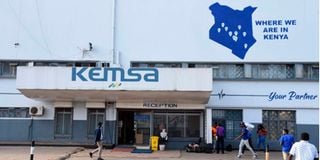
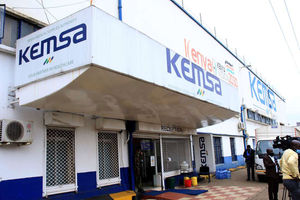
Kenya Medical Supplies Authority offices pictured in Embakasi, Nairobi, on December 10, 2024.
Photo credit: Bonface Bogita | Nation Media Group
By June 2022, UCL says it had delivered the consignments to Kemsa’s warehouse and that Kemsa’s inspection and acceptance processes were triggered.
What did not follow was the money. The 90-day duration expired. Under the contract terms and commercial bank rates, interest began to accrue.
The dispute moved to an arbitration tribunal, as the contract required. On October 16, 2023, the sole arbitrator published a final award in UCL’s favour.
The ruling ordered Kemsa to pay the full USD 8,333,877 and simple interest at prevailing commercial bank lending rates from 90 days after delivery until payment in full. It also directed Kemsa to bear the costs of the arbitration. The award was framed as a “full and final settlement of all claims.”
In its case, UCL narrated that on February 16, 2022, it was invited to bid for the tender and called to submit documents. It made its submissions and two weeks alter, on March 1, 2022, the firm was invited to negotiate the prices, the delivery schedule and the terms of payment. This was before the signing of the contract on March 14, and Kemsa issued 42 purchase orders on diverse dates between March and May of that year.
But Kemsa denied the allegations and reckoned that there was a violation of the principles of public procurement as espoused under the Constitution 2010, read together with the Public Procurement and Asset Disposal Act, 2015 and the regulations.
"There has never been any preliminary, technical or financial evaluation of any tender concerning the supply of ARV medicines, as claimed by the Claimant or at all," stated the State agency, as it also denied inviting the supplier to bid for the tender.
In response to the claim of an invitation to the negotiations committee, the State agency asserted that it was not aware of any negotiation meeting as alleged.
Kemsa further denied the existence of the alleged notification of award dated March 5, 2022.
"Even if such a notification were to exist, it is not compliant with the requirements of the law. No preliminary, technical and financial evaluation reports have been produced to demonstrate that the claimant's bid was determined to be the most responsive and lowest evaluated bid to warrant issuance of notification of award of tender as alleged," it argued.
UCL, on its part, maintained that it had lawfully supplied the ARVs under the contract, that the goods were delivered and accepted, and that Kemsa had simply failed to pay within the agreed timelines, entitling the supplier to the full contract sum plus interest and costs.
The company claimed that direct procurement was the only suitable and lawful method for Kemsa because UCL is the "only Kenyan company pre-qualified by the World Health Organisation to supply the goods in question."
However, the tribunal accepted UCL’s case, found that the contract between the parties was valid and issued a final award in the company's favour.
On February 9, 2024, the tribunal issued a separate award on costs, assessing them at Sh29.5 million.
By then, the interest meter had been running for months. That date also marked the narrowing of Kemsa’s legal options.
Under the Arbitration Act, a party that wants to set aside an award must move the High Court within three months. Kemsa did not.
On the other hand, UCL petitioned the court to adopt the arbitral award as a court judgment capable of enforcement in execution.
The next critical date was April 17, 2025. On that day, the High Court recognised and adopted the arbitral award as a judgment of the court. From that moment, the dispute stopped being a private contractual fight. It became a decree.
The law’s posture is strict at that stage. Once an award is recognised, the court’s role is execution, not re-litigation. Section 10 of the Act provides that no court shall intervene in arbitration matters except as provided under the Act.
Justice Fredah Mugambi would later underline that point, noting that the Arbitration Act allows only narrow interventions: setting aside, recognition, or enforcement. There is no window for rewriting liability after recognition of the award.
"Once an award has been recognised, the Court’s jurisdiction is confined to execution of the decree," said the court.
Still, Kemsa tried. On June 13, 2025, the agency returned to court with an application that sought to change who would pay the sums.
Its advocates asked the court to join the National Treasury and the Attorney-General, compel the Treasury to settle the decretal sum, and indemnify Kemsa against the loss. In effect, it wanted the exchequer to absorb the blow.
UCL opposed the move and raised a preliminary objection anchored on Section 10 of the Arbitration Act, which bars court intervention except as provided in the Act.
The supplier argued that the High Court was 'functus officio' on the substance of the award since the award had been recognised. The only remaining business was execution. Any attempt to add new parties or redistribute liability, UCL said, offended the principle of finality and the doctrine of party autonomy.
The court agreed, ruling that "the attempt to add new parties at the execution stage of an award is legally untenable and that "arbitration cannot be extended to bind non-parties."
Citing the Government Proceedings Act, the court ruled that Kemsa, which is established as a statutory corporation, enjoys a distinct legal personality and is liable for its contractual obligations.
"The award binds Kemsa, not the Treasury,” the court said in the September 26, 2025 ruling, warning that to join non-parties at the execution stage would be “tantamount to amending the award,” something the court had no jurisdiction to do.
"Having participated fully in the arbitral process and with the award duly recognised, Kemsa cannot now seek to be discharged from liability or be indemnified by a non-party. To grant such orders would amount to qualifying and rewriting the award, which this court has no jurisdiction to do," said the judge.
Tracing the structure of arbitration law and principles, the court reiterated that “once an award has been recognised, the court’s jurisdiction is confined to execution of the decree.”
The judge added that there was “no provision empowering the court to review, vary, or redistribute liability under an award that has already been recognised.”
The court also rejected Kemsa’s attempt to shelter behind the Government Proceedings Act. Kemsa, the court noted, is a statutory corporation established with its own legal personality. As a corporate it can contract, sue and be sued.
With that, Kemsa’s application was struck out with costs, clearing the legal path to enforcement.
Milimani Law Courts in Nairobi.
Photo credit: File | Nation Media Group
The same day, September 26, 2025, the court issued garnishee orders against Kemsa’s account at the National Bank of Kenya for Sh1 billion. The currency in the court order was no longer in dollars but in Kenya Shillings.
The court stressed that the Arbitration Act is designed to protect finality. Section 32A states that an arbitral award is final and binding and that “no recourse is available against the award otherwise than in the manner provided by this Act.”
The court cited past decisions warning judges to resist attempts to reopen awards or “dress up factual disputes as legal challenges.”
The court ordered that a sum of Sh1 billion be remitted to the decree holder, subject only to Sh100,000 in garnishee costs, and marked the file closed.
However, through an order dated October 1, 2025, the court granted a stay in the payment of Sh29.5 million in legal fees owed to advocates.
Currently, the parties are entangled in a dispute on the release of the legal fees and permission to appeal and the same is scheduled for ruling on March 6, 2026, at the High Court in Milimani.