Happening Now: NTV KENYA LIVE | Senate Proceedings
Kenya falls short of critical 95 per cent measles vaccination target
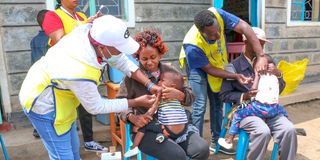
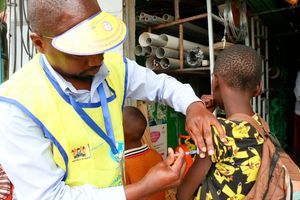
Nurses from Nakuru County Health department administer Typhoid and Measles Rubella vaccine to children in Lanet on July 15, 2025.

What you need to know:
- Only 84 per cent of children worldwide received the first measles dose, and just 74 per cent received the second.
- These disparities fueled outbreaks in over 60 countries last year, resulting in more than 10 million infections and over 100,000 deaths worldwide.
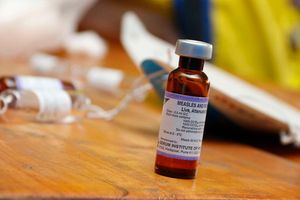
Kenya has not met its 95 per cent immunisation goal, which is needed to end measles transmission and attain community protection. This is despite making considerable progress in regular childhood immunisations, a new report has revealed.
According to the latest National Immunisation Coverage report by the World Health Organisation (WHO) and Unicef, Kenya achieved 91 per cent coverage for the first dose of the measles-containing vaccine (MCV1) by the end of 2024.
However, only 76 per cent of children received the second critical dose (MCV2), which is essential for building full immunity and preventing outbreaks.
Also read: Experts warn of dire consequences as over 100,000 Kenyan children miss key routine vaccines
Despite significant progress in recent years, gaps in vaccine coverage continue to leave thousands of children vulnerable to measles.
The 15 per cent drop in coverage between the first and second doses means that a large proportion of children remain susceptible to a disease that is highly contagious and potentially fatal, particularly in communities where health services are inconsistent or difficult to access.
Measles remains an indicator of immunisation performance. According to the WHO report, only 84 per cent of children worldwide received the first measles dose, and just 74 per cent received the second. These disparities fueled outbreaks in over 60 countries last year, resulting in more than 10 million infections and over 100,000 deaths worldwide.
But all is not doom and gloom.
Measles vaccination averted more than 60 million deaths between 2000 and 2023, according to WHO.
Kenya’s broader immunisation performance remains relatively strong. The country maintains coverage of over 90 per cent for the DTP3, polio and Hib vaccines, and has introduced all of the WHO-recommended childhood vaccines.
“Vaccines save lives, allowing individuals, families, communities, economies and nations to flourish,” said Dr Tedros Adhanom Ghebreyesus, WHO Director-General. “It's encouraging to see a continued increase in the number of children being vaccinated, although we still have a lot of work to do.” However, drastic cuts in aid, coupled with misinformation about the safety of vaccines, threaten to undo decades of progress. WHO is committed to working with our partners to help countries develop local solutions and increase domestic investment so that all children can benefit from the lifesaving power of vaccines."
Continental challenge
Kenya’s MCV2 performance reflects a wider continental challenge. Although MCV1 coverage is improving in many African countries, MCV2 coverage remains uneven and relatively low across the region.
According to the WHO/Unicef estimates, the average across sub-Saharan Africa is just under 50 per cent. Only a few countries such as Algeria, São Tomé and Príncipe have reached or exceeded 90 per cent coverage for both doses.
Kenya’s efforts to improve vaccine uptake include participation in the global 'Big Catch-Up' initiative, which aims to vaccinate millions of children who missed out during the Covid-19 pandemic. These efforts have helped Kenya recover much of the ground lost during pandemic-related disruptions. However, logistical bottlenecks, misinformation, vaccine hesitancy and limitations in tracking and follow-up continue to hinder the completion of the full vaccination schedule.
“The good news is that we have managed to reach more children with life-saving vaccines. But millions of children remain without protection against preventable diseases, and that should worry us all,” said Unicef Executive Director Catherine Russell. “We must act now with determination to overcome barriers such as shrinking health budgets and fragile health systems, as well as misinformation and access constraints due to conflicts. No child should die from a preventable disease.”
Globally, the situation remains mixed. In 2024, DTP3 coverage (which protects against diphtheria, tetanus and pertussis) increased to 85 per cent —an improvement on 2023, but still below pre-pandemic levels. It is estimated that 14.3 million children worldwide received no routine vaccines at all, often due to displacement, fragility or breakdowns in the health system.
Other vaccines also show uneven progress. In Africa, for example, uptake of the HPV vaccine rose from 28 per cent to 40 per cent in 2024, yet many children still miss out on other key vaccines such as those for hepatitis B, polio, rubella and rotavirus.
Meanwhile, funding constraints, weak infrastructure, and rising misinformation continue to hamper vaccine delivery.
To close the gap, experts recommend stronger community-based tracking systems, targeted outreach in underserved regions, improved data management and increased campaigns to counteract vaccine hesitancy.