Kenya gains direct control over Gavi vaccine funds in major policy shift
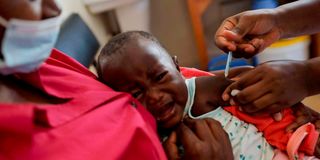
A nurse administers a malaria vaccine to an infant at Lumumba Sub-County Hospital in Kisumu.

What you need to know:
- Since 2001, Gavi has provided Kenya with vaccines and related supplies worth more than $940 million (Sh121.3 billion).
Kenya will now receive direct funding from Gavi to purchase vaccines of its choice, ending a 25-year arrangement under which the global vaccine alliance disbursed money through separate grants tied to individual vaccines.
Under the new model, each country will receive one consolidated budget, disbursed as a single cash grant through a single application and managed on one digital platform.
The shift means that the Ministry of Health will take on more direct responsibility for procurement decisions, not just last-mile distribution. This marks a departure from the previous arrangement in which the United Nations Children's Fund handled purchasing on the country's behalf.
Previously, Gavi financed procurement through Unicef's supply division, which purchased vaccines for recipient countries and arranged their delivery. Once vaccines arrived in Kenya, the Kenya Medical Supplies Authority took responsibility for warehousing and distributing them to counties and health facilities.
Countries also applied separately for each vaccine they sought support for, with each application having its own timeline and administrative requirements.
Gavi Chief Executive Officer Sania Nishtar said the new funding structure is designed to simplify access to financing while ensuring a fairer distribution of resources.
"The introduction of vaccine budgets and other elements of the Gavi Leap reform is the culmination of a 12-month process to completely redesign the way we disburse money to countries. Giving countries advance knowledge of the size of their vaccine budget for the next five years helps national governments plan strategically. It also helps ensure that all of Gavi's available resources are distributed equitably and predictably on the basis of need, rather than on a first-come, first-served basis," said Ms Nishtar.
She noted that allocations will be calculated based on health needs such as the number of children under five who die each year as well as the country's income and its ability to fund its own health system. Limits will be placed on how much any single country can receive to ensure that poorer nations get a fair share.
Kenya has been a long-standing Gavi partner, receiving support for vaccines including pneumococcal, rotavirus, and malaria. The country was among the first globally to roll out the malaria vaccine at scale and, in 2025, introduced the typhoid conjugate vaccine into its routine immunisation schedule. Since 2001,
Gavi has provided Kenya with vaccines and related supplies worth more than $940 million (Sh121.3 billion).
The procurement shift also comes as Kenya approaches the end of its partnership with Gavi. The country entered the accelerated phase of Gavi transition in 2022 after its gross national income per capita exceeded the alliance's eligibility threshold for three consecutive years. It is expected to become fully self-financing by 2029 or 2030.
However, a 2024 study analysing Kenya's readiness to transition from Gavi support found that both national and county governments are not fully prepared for the end of the programme.
Currently, Kenya has an unpaid bill of $12.4 million (Sh1.6 billion) for the 2024/2025 financial year in its co-financing obligations to Gavi, raising concerns about the country's ability to sustain its immunisation programme without external support.