Kenya on high Ebola alert as seven tested and cleared
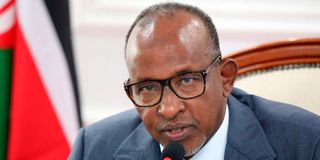
Health Cabinet Secretary Aden Duale.

Seven people who went to health facilities with symptoms consistent with Ebola have been cleared after testing negative.
Three of them had recently been to the Democratic Republic of Congo. The rest were contacts who had accompanied them to the hospital and were tested as a precaution. Health Cabinet Secretary Aden Duale, speaking at a press briefing on Friday, May 22, said Kenya's enhanced surveillance system had been activated.
Behind the seven negative results sits an infrastructure that, by the government's own admission, has only four designated laboratories in the entire country capable of testing for Ebola.
Three are in Nairobi, with only one outside the capital city, the Kenya Medical Research Institute, Kisumu. The only one built viral hemorrhagic fever isolation unit in the entire country is at Kenyatta National Hospital (KNH) in Nairobi, far from the borders where the risk of importation is highest.
As of May 21, 2026, the DRC and Uganda Ministries of Health had reported a combined 575 suspected cases, 51 confirmed cases and 148 suspected deaths. The outbreak has spread beyond Ituri Province, where it originated, into Nord-Kivu Province.
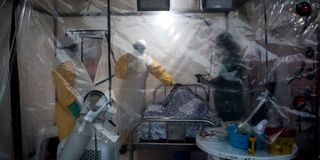
Three medical workers check on an Ebola patient in a Biosecure Emergency Care Unite on August 15, 2018 in Beni, DR Congo.
Already, eleven health zones in DRC are affected. Uganda has confirmed two laboratory-verified cases and one death; both linked to travel from DRC.
The World Health Organisation declared the situation a Public Health Emergency of International Concern on May 16. Two days later, the Africa Centre for Disease Control went further, declaring it a Public Health Emergency of Continental Security, its highest classification.
This, according to the International Health Organisation, is because the Bundibugyo strain driving this outbreak has no licensed vaccine and no approved therapeutic, and if a patient contracts it, the only response is supportive care and isolation.
The survival of the patients depends entirely on the immune system and on how quickly the patient is identified and treated. The case fatality rate for the Bundibugyo strain in previous outbreaks, according to WHO, has ranged between 30 and 50 per cent.
For Kenya, authorities say about 42,447 travellers have since been screened at points of entry as of May 21, including 2,965 in the preceding 24 hours alone. The Kenya-Uganda border at Busia handles thousands of crossings daily.
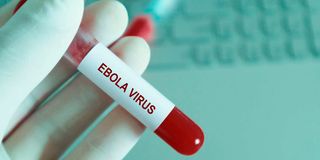
Ebola spreads through direct contact with bodily fluids such as blood, saliva and sweat from an infected individual.
Trade routes between western Kenya and Kampala are among the busiest in the region. Most retail goods arriving in Lodwar, Turkana's main town, originate from Uganda. The human and commercial ties between Kenya and the two affected countries are deep, constant and largely impossible to fully surveil.
Mr Duale said that the Ministry, through the Kenya National Public Health Institute, has activated a national Incident Management System. Rapid Response Teams are on standby.
Public Health Emergency Operations Centres are active at both national and county levels.
“Twenty-two counties have been identified as high-risk. One hundred and eighteen rapid response personnel are on standby. Over 880 national and county healthcare workers have been sensitised on Ebola preparedness and response,” he said.
He said that the Isolation and treatment facilities have been identified and equipped with personal protective equipment and essential response supplies released.
Principal Secretary Mary Muthoni has confirmed that Kenya can now process and return Ebola test results within six to eight hours of receiving a specimen, a significant improvement from the Covid-19 era when samples travelled to South Africa for analysis.
Dr Ahmed Kalebi, an independent consultant pathologist, says that for a laboratory to test for Ebola, it must be a Biosafety Level 4 infrastructure, which requires negative air pressure systems that prevent any particle from escaping the room.
Ther must be independent air supplies, chemical decontamination showers and waste treatment systems that process everything, including air and water, before it leaves the building.
“You cannot build this in an emergency. You cannot temporarily upgrade a BSL-2 facility. The standard is binary: the building either meets it or it does not. Most Kenyan laboratories operate at BSL-2. A small number at BSL-3. Neither is adequate for Ebola.” Dr Kalebi said.
“If an active cluster emerged, if ten or fifteen suspected cases presented simultaneously across Nairobi, western Kenya and the coast, the four qualifying laboratories would face a volume of samples they were not designed to process in parallel. Every hour of delay in confirmation is an hour during which a suspected case remains in an uncertain clinical status, potentially in contact with family members, healthcare workers and other patients.” He said.
The Covid-19 pandemic created a network of county-level isolation facilities that temporarily extended Kenya's containment capacity beyond Nairobi. When the pandemic ended, that network contracted.
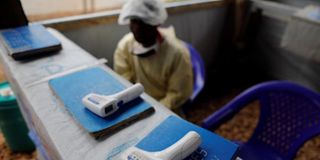
Thermometers are pictured at the entrance of an Ebola Treatment Centre in the Eastern Congolese town of Butembo in the Democratic Republic of Congo, October 4, 2019.
In Kisumu, the isolation space at Jaramogi Oginga Odinga Teaching and Referral Hospital has been converted into the hospital's private wing.
In Homa Bay, which borders Uganda and sits on Lake Victoria, where movement is difficult to fully monitor, officials confirmed that post-pandemic isolation facilities have been restored to normal health services. Senior health officials were, at the time of reporting, in meetings to discuss establishing new ones.
In Makueni, the repurposed campsite that served as a Covid-19 isolation facility has been decommissioned. Its bedding was distributed to local hospitals, and its grounds were transferred to the Kenya Medical Training College.
In Kericho, there is no dedicated isolation centre. The county's Chief Officer for Health said a ward would be designated if a case emerged. That is not an isolation facility. It is a plan to create one.
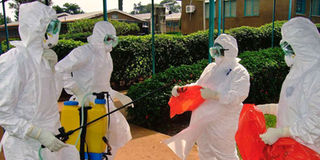
Health officials in the Democratic Republic of Congo.
The pattern across several counties is the same: the infrastructure that existed during the COVID-19 pandemic has either been dismantled, repurposed, or simply allowed to lapse, based on the reasonable assumption that the immediate crisis had passed. This assumption is now being tested.
In border counties like Turkana, which shares boundaries with both Uganda and South Sudan, there is more visible activity. Isolation points have been identified at Lokiriama near the Kenya-Uganda border and Nadapal near the Kenya-South Sudan border.
The Ministry confirmed in its May 2026 response that it is mapping ambulance capacity in high-risk counties with support from the Kenya Red Cross Society and strengthening engagement with private hospitals to improve early detection, referral, and reporting systems.
Cutting across all of Kenya's preparedness measures is a scientific reality of a lack of vaccines and treatment, a factor that no amount of screening, training, or laboratory investment can overcome.
WHO has approved two vaccines for Ebola virus disease caused by the Zaire strain, and has made strong recommendations for the use of two monoclonal antibody treatments for that strain. But the Bundibugyo strain is different, and none of those countermeasures applies to it. Africa CDC has cited the absence of licensed vaccines or approved therapeutics for the Bundibugyo strain as one of the primary reasons for classifying this outbreak at its highest risk level.
This means that if a case enters Kenya, the entire clinical response rests on supportive care, keeping the patient hydrated, managing fever and pain, treating secondary infections, and prompt isolation to prevent further spread. There is no pharmacological backstop. Survival depends entirely on the immune system, the quality of supportive care, and how quickly the patient is identified and treated.
Anthony Ombara, Senior Advisor, Kenya Resilience Action Network Africa, believes that Kenya is not sufficiently prepared for an Ebola eventuality.
" There is lax screening and weak visibility of protocols at high-risk border points like Busia and Malaba, as well as limited public information. Community awareness is also too low. Traders, truck drivers, bodaboda riders, border communities, schools, churches, mosques, and frontline health workers must know the symptoms, reporting channels and referral processes before a suspected case appears.
He adds: “If our first line of defence is uncertain, then the whole system is exposed," he explains.
"Kenya may have been spared so far, but luck is a fragile shield when surveillance is weak, communities are uninformed, and protocols are invisible. Ebola teaches us that epidemics do not arrive when systems are ready; they arrive to reveal whether systems were ever ready at all. As a nation, we must not wait for the first case to awaken; we need to strengthen our watch before the shadow reaches the door," he adds.
Follow our WhatsApp channel for breaking news updates and more stories like this.