Kenya records 314 Mpox cases as disease spreads across 22 counties
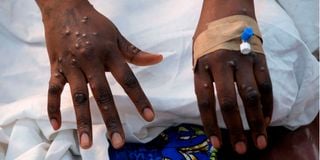
The hands of a patient with skin rashes caused by the Mpox virus.

Kenya has recorded 314 confirmed cases of Mpox as of July 31, 2025, marking a significant surge in infections exactly one year after the first case was detected at the Taita-Taveta border crossing, Health Cabinet Secretary Aden Duale has announced.
The outbreak, which began when an individual travelling from Uganda to Rwanda through Kenya tested positive for Mpox at the Taita-Taveta one-stop border point on July 31, 2024, has now spread across 22 counties, with new cases continuing to emerge despite intensified containment efforts by the Ministry of Health.
Mombasa County has the highest infections at 146, followed by Busia with 63 cases, Nakuru (21), Kilifi (19), Nairobi (17), and Makueni (13). Taita-Taveta and Uasin Gishu have recorded five cases each, while Bungoma has four cases. Kajiado, Kakamega, and Kiambu have each recorded three infections.
Kericho and Machakos counties have reported two cases each, whilst Migori, Kisii, Kirinyaga, Isiolo, Kitui, Narok, Baringo, and Trans-Nzoia have each recorded one case.
The Ministry of Health revealed on Friday that four new cases had been recorded in the previous 24 hours—two in Mombasa and one in Nairobi.
"A total of 33 cases are currently admitted to health facilities, whilst 54 are under home-based isolation and care. Furthermore, 222 cases have fully recovered. Unfortunately, five cases have succumbed to the disease since the onset of the outbreak, representing a case fatality rate of 1.6 per cent," CS Duale said in an official statement.
Contact tracing efforts have identified 422 people who interacted with confirmed Mpox patients. Of these, 392 have completed the required 21-day monitoring period, with the remainder still under observation. Fifteen contacts who were traced have subsequently tested positive for Mpox.
Read: Is spinal cord stimulation safe? Does it work? Here’s what you need to know if you have back pain
The government has screened over 4.7 million travellers at airports and other points of entry across the country, with suspected cases being identified for further investigation. Samples drawn from Mpox suspects are being tested at the National Public Health Laboratories and partner facilities.
"Subsequently, 905 samples from suspected cases have been laboratory-tested, of which 314 tested positive, representing a positivity rate of 34.6 per cent," the Health CS disclosed.
To contain the spread, the Ministry of Health, in partnership with county governments and other partners, has increased surveillance efforts nationwide. Rapid Response Teams have been deployed to strengthen the country's healthcare system through timely contact tracing, investigation of suspected cases, treatment, and provision of mental and psychosocial support to patients and their families.
However, concerns have emerged about the reliability of laboratory test results. In an official letter dated August 23, 2024, Africa CDC Director General Dr Jean Kaseya advised African Health Ministers that relying solely on laboratory test results for diagnosing Mpox is not advisable.
"The conclusion is that relying solely on laboratory test results for diagnosing Mpox is not advisable. Whilst important, lab tests should be interpreted in conjunction with clinical and epidemiological data. False negatives are possible, and a negative test does not entirely rule out Mpox, especially if there is strong clinical suspicion," Dr Kaseya explained.
The outbreak involves two main strains of Mpox. Until 2022, neither was frequently reported outside a handful of African countries. However, Clade IIb, which causes a milder version of Mpox, spread from Nigeria globally, prompting international concern and large-scale vaccine production efforts.
The more concerning development involves Clade I, the more virulent strain endemic in the Democratic Republic of the Congo. Africa CDC reports that Clade I has been detected in Kenya, Burundi, Central African Republic, Congo, DRC, Rwanda, and Uganda. Clade II has been reported in Côte d'Ivoire, Liberia, Nigeria, and South Africa, whilst both clades have been found in Cameroon.
The World Health Organisation declared an emergency involving the more lethal Clade I due to increased dissemination across Africa and the emergence of a novel subtype called Ib, which possesses characteristics favouring human-to-human transmission.
Duale urged the public to adhere to official public health advisories and seek accurate information from qualified healthcare professionals. Official updates can be accessed on the Ministry's website or via helplines 719, *719#, 0729 471 414, and 0732 353 535.
To protect against infection, the Health CS advised Kenyans to avoid close contact with suspected or confirmed Mpox cases, refrain from sharing personal items, use personal protective equipment such as gloves and face masks when caring for the sick, avoid sharing bedding and clothing with ill persons, practice frequent hand washing with soap and water or use alcohol-based hand sanitiser, practice safe sex, report suspected cases, and self-isolate if infected whilst seeking prompt medical evaluation.
"The public is advised to disregard any misleading or false information that may hinder public health efforts or cause unnecessary fear and confusion," CS Duale cautioned.