Kenya’s blood crisis and the push to end preventable maternal deaths

A section of participants during the second edition of the ‘Run for Her’ marathon at Ulinzi Sports Centre on Sunday
Photo| Lilys Njeru

What you need to know:
- PPH is excessive bleeding after childbirth. That is, bleeding more than 500 ml, which is equivalent to a pint of milk for normal delivery, or bleeding in excess of two pints or two packets of milk after cesarean section.
- The Nairobi run drew more than 6,000 participants and was mirrored across the country in counties such as Eldoret, Mombasa, and Makueni. Organisers say the movement has also sparked similar initiatives in Rwanda, Uganda, and Tanzania.
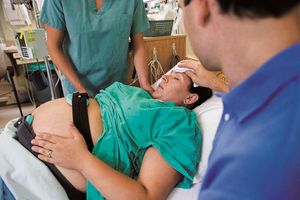
Stella Mwende’s second delivery was marked by trauma. When she became pregnant with her second child at 40, doctors classified it as high-risk, warning of complications such as gestational diabetes. Yet, in her telling, those concerns paled in comparison to what awaited her in the delivery room.
“I could feel warm blood trickling down my thighs and soaking beneath me. When my mother lifted the hospital sheet, we realised that I had blood smeared across my body, from my back up to my head. I was too weak even to sit up,” she offered.
This complication is medically referred to as postpartum haemorrhage (PPH).
Prof Obimbo, who chairs the department of human anatomy and medical physiology at the University of Nairobi, explains that this is excessive bleeding after childbirth. “ Bleeding more than 500 ml, which is equivalent to a pint of milk for normal delivery, or bleeding in excess of two pints or two packets of milk after cesarean section.”
And Stella is far from alone. Data from the World Health Organisation (WHO) shows that PPH is the leading cause of maternal mortality worldwide, with at least 14 million women experiencing it and 70,000 of them losing their lives as a result of the complication.
“To put it into perspective, a majority of those deaths are in the Sub- Saharan Africa. In Kenya, multiple studies reveal that we lose at least 6,000 women to pregnancy-related complications. Out of these 6,000 women, approximately 2,000 to 3,000 women die because of postpartum haemorrhage. It may sound like just a number, but these are women who come from families. They are wives, mothers, sisters, and daughters,” said the obstetrician and gynaecologist.
Prof Obimbo, and the end pph project lead, was speaking at the sidelines of a marathon held in Nairobi on Sunday, dubbed “Run for her, and save her life.”
“Knowing that these deaths are potentially preventable and treatable, we came up with this initiative in collaboration with the University of Nairobi, the Kenya Obstetrics and Gynaecological Society, the Middle East Association of Kenya, and the BPH Foundation, with a four-pillar strategy. Advocacy, research, capacity building and data ecosystem strengthening.
The Nairobi run drew more than 6,000 participants and was mirrored across the country in counties such as Eldoret, Mombasa, and Makueni. Organisers say the movement has also sparked similar initiatives in Rwanda, Uganda, and Tanzania.
Dr Patrick Amoth, Director-General for Health in the Ministry of Health, acknowledged that PPH is the leading cause of maternal mortality in the country.
“Our maternal mortality ratio is 355 per 100,000 live births. Our target for 2030 is to lower that to 70 per 100,000 live births. So you can see we are off track in that space and therefore coming together is about advocacy and partnerships to ensure that no mother should lose a life when giving birth,” he remarked.
“Mothers are not dying because we don’t know what kills them. Mothers are not dying because we don’t have expertise or because we don’t have the know-how, but because we have not come collectively as a society.”
Dr Amoth admitted that Kenya continues to grapple with a shortage of blood, attributing the shortage in part to a weak culture of blood donation.
“We are supposed to collect 500,000 units of blood, about one per cent of our population. We are working with implementing partners and a call to everyone to adopt a donation culture so that we have a sufficient amount of blood in our country. We are also working with the National Treasury to increase the financial allocation and are establishing regional centres and looking into having blood transfusion centres in each of the 47 counties.”
Michael Muthamia, project director at Jhpiego, says there are solutions to preventing and ending PPH.
"For example, we have collaborated with Makueni County to introduce Heat Stable Carbetocin for PPH prevention. It does not require refrigeration and can be stored on the shelves. It is giving very good results in terms of PPH management."