Kenya's cancer screening rate trails Rwanda, Cameroon as 2030 deadline looms
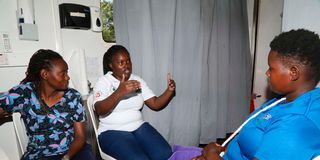
Cynthia Ougo (left) and Lucy Omollo take Mary Adhiambo (right) through guidance and counselling before conducting breast and cervical cancer screening during an outreach at Oriang Trading Centre in Rachuonyo West, Homa Bay County, on March 12, 2026.

What you need to know:
- The 2022 Kenya Demographic and Health Survey, covering nearly 17,000 women, placed cervical cancer screening prevalence at roughly 16.8 per cent.
- A separate academic analysis of the same data, which included younger women aged 15–24, put the figure even lower, at 7.4 per cent.
With only four years left to meet the World Health Organization's (WHO) 2030 deadline, Kenya is still lagging on all three pillars of the global strategy to eliminate cervical cancer. Screening rates are so low that officials are now restructuring the national programme in response.
The WHO’s 90–70–90 framework mandates that countries fully vaccinate 90 per cent of girls against HPV by age 15, screen 70 per cent of women with a high-performance test at ages 35 and 45, and ensure that 90 per cent of women diagnosed with cervical disease receive timely treatment by 2030.
Of these, Kenya is closest to the vaccination target, largely due to a recent policy shift. First-dose coverage has reached about 60 per cent. Under the previous two-dose schedule, completion rates hovered around only 30 per cent, meaning Kenya would have needed to triple uptake to meet the 90 per cent goal. However, following the adoption of a single-dose schedule in November 2025, that same 60 per cent first-dose coverage now qualifies as full vaccination, leaving just a 30-percentage-point gap to close.
Where Kenya faces its greatest challenge, however, is screening.
A study published in BMC Women's Health identified low awareness of HPV and cervical cancer screening as the primary barrier to screening in western Kenya, followed by fear and stigma surrounding pelvic examinations.
Similarly, an analysis of the 2022 Kenya Demographic and Health Survey found that financial constraints, limited access to screening centres, and cultural beliefs also discourage uptake. Meanwhile, a survey of healthcare providers at rural health facilities identified staffing shortages, inadequate training, limited space, and supply constraints as key barriers to service delivery.
In addition, a study at the Aga Khan University Hospital in Nairobi found that fear of the screening procedure itself was the main reason many women did not undergo routine screening.
"Screening saves lives. Kenya has made measurable progress, with rates among women aged 25–49 rising from 11 per cent in 2018 to 42 per cent in 2024. Nevertheless, this remains well below our national and global targets," said Health Cabinet Secretary Aden Duale.
The 2022 Kenya Demographic and Health Survey, covering nearly 17,000 women, placed cervical cancer screening prevalence at roughly 16.8 per cent. A separate academic analysis of the same data, which included younger women aged 15–24, put the figure even lower, at 7.4 per cent.
The country’s screening rate trails Cameroon (56 per cent), Malaysia (49 per cent), and Rwanda (28 per cent), and remains roughly four times lower than rates in developed nations.
Moreover, the aggregate numbers conceal stark internal disparities. Women aged 40–49 were seven times more likely to have been screened than those aged 15–24; women in the highest income bracket were nearly 60 per cent more likely to be screened than those in the lowest; and childless women were 60 per cent less likely to be screened than mothers.
A decade-long government review identified the structural causes of this shortfall. From 2011 to 2020, annual screening coverage for HIV-negative women fluctuated between under one per cent and 36 per cent, while for HIV-positive women it ranged between under one per cent and seven per cent. In no single year did coverage exceed 40 per cent.
Furthermore, even among women who screened positive for precancerous lesions, treatment compliance remained stubbornly low, ranging from 22 to 39 per cent over the same period.
To close these gaps, CS Duale's new plan leans heavily on technological innovation.
"We are transitioning to HPV DNA testing, the gold standard for early detection, while deploying innovative approaches such as self-sampling and digital health platforms to reach women who have historically been left behind," he wrote, adding that the broader effort underscores the government's commitment to ensuring that every woman is screened by age 35 and again by age 45, regardless of location or income.