Kenya’s hunger crisis deepens as country slips to 103rd in Global Index
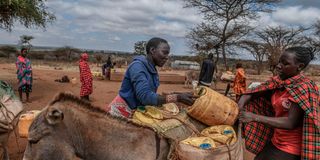
Locals with their animals in a drought affected area on August 29, 2025 in Bisil town, Kajiado County. Kenya is struggling with drought due to climate change and irregular rainfall. The drought poses a serious threat to agriculture, water supply, and livelihoods. The depletion of water resources is adversely affecting the local community, who rely on livestock for their livelihood.

What you need to know:
- Kenya ranks 103 out of 136 countries with a Global Hunger Index score of 25.9—tied with Mozambique and below Tanzania at 91 and Zimbabwe at 90.
- The GHI 2025 report places the country in a "serious" hunger situation, far worse than eight years ago when Kenya scored 23.1.
As global targets for Zero Hunger slip further out of reach, nearly two million Kenyans face acute food insecurity; and the situation is expected to worsen
Kenya ranks 103 out of 136 countries with a Global Hunger Index (GHI) score of 25.9—tied with Mozambique and below Tanzania at 91 and Zimbabwe at 90.
The GHI 2025 report places the country in a "serious" hunger situation, far worse than eight years ago when Kenya scored 23.1.
"A score of greater than 50.0 is extremely alarming, 35.0–49.9 is alarming, 20.0–34.9 is classified as serious, 10.0–19.9 is regarded as moderate, while a score of less than 9.9 is considered low," the report explains.
Higher-numbered ranks indicate worse conditions.
Published annually by Concern Worldwide, Welthungerhilfe and the International Food Policy Research Institute, the GHI score uses four indicators: undernourishment (insufficient caloric intake), child stunting (children under five too short for their age, indicating chronic undernutrition), child wasting (children under five too thin for their height, indicating acute undernutrition), and child mortality (the under-five mortality rate reflecting inadequate nutrition and unhealthy environments).
Global hunger has seen little reduction since 2016, pushing the 2030 Zero Hunger target out of reach.
"At the current pace, at least 56 countries will not reach low hunger, much less Zero Hunger, by 2030," the report notes. "If progress remains at the pace observed since 2016, low hunger at the global level may not be reached until 2137; more than a century away."
The reality on the ground
Last month, The Integrated Food Security Phase Classification system found nearly 1.8 million Kenyans experiencing high levels of acute food insecurity—IPC Phase 3 or above (Crisis or worse)—between July and September 2025 during the lean season.
Of these, around 179,000 people face IPC Phase 4 (Emergency), primarily in four arid counties—Baringo, Mandera, Marsabit, and Turkana. The rest are in IPC Phase 3 (Crisis).
The IPC system classifies food insecurity into five phases: Phase 1 (Minimal/None), Phase 2 (Stressed), Phase 3 (Crisis), Phase 4 (Emergency), and Phase 5 (Catastrophe/Famine).
This represents improvement from February to March 2025, when 2.2 million people faced acute food insecurity. According to IPC, above-average rainfall positively impacted crop and livestock production, water availability and access, improving household food security in the arid and semi-arid lands.
The reprieve may be temporary. Between October 2025 and January 2026, the food security situation is expected to deteriorate, particularly during the short rains season. An estimated 2.1 million people are likely to face high levels of acute food insecurity.
IPC experts attribute the deterioration to forecasted below-average rainfall expected to affect staple food prices, alongside conflicts over resource management and increased human-wildlife interactions.
The GHI 2025 report, released on Thursday, highlighted conflict as the most destructive force driving hunger and malnutrition globally.
"Armed violence fuelled 20 food crises affecting nearly 140 million people in the past year globally, with Africa being severely impacted," the report stated. "Humanitarian assistance budgets have dropped sharply, while military spending has surged—an inversion of priorities that undermines the global hunger response."
A regional crisis
Three weeks ago, the Intergovernmental Authority on Development warned that 42 million people across Kenya, Djibouti, Somalia, Uganda, South Sudan, and Sudan face high levels of food insecurity this year.
In its regional focus of the 2025 Global Report on Food Crises, IGAD observed the number of people in severe food crises nearly tripled—from 13.9 million in 2016 to 41.7 million this year in Kenya, Somalia, South Sudan, Sudan and Uganda.
The root causes
According to the US Department of Agriculture, Kenya's heavy reliance on rain-fed agriculture makes its population highly vulnerable to droughts and floods. Extreme weather events have become more frequent, damaging crops, killing livestock and reducing access to safe water.
While humanitarian assistance provides short-term relief, USDA notes, long-term resilience requires greater investment in sustainable farming practices, climate adaptation and diversified food systems.
Kenya also hosts a substantial refugee population, many at heightened risk of food insecurity.
Last year, the US government allocated $37 million to support refugees, enabling the World Food Programme to increase food rations and resume cash transfers in camps like
Dadaab and Kakuma.
Recent US aid cuts, however, have slashed food assistance for refugees, with some receiving only 28 per cent of recommended rations, according to the UN, putting vulnerable populations at further risk.
The response
In March, the Kenyan government and Kenya Red Cross Society, with the African Union and other partners, launched a $5 billion Kenya Food and Nutrition Resilience Program to address hunger through livelihoods, water access, environmental sustainability, health, and protection.
In September, President William Ruto's government set aside Sh5 billion to strengthen the livestock value chain—dairy, meat, leather—to boost profitability and create jobs.
Addressing delegates at the UN Food Systems Summit Stocktake in Addis Ababa in July, President Ruto noted that while meaningful progress has been made in providing
sufficient, safe, and nutritious food, more needs to be done.
"Starvation, malnutrition, and under-nutrition remain a harsh daily reality for far too many," Mr Ruto said, pitching for tailored financial products to support small-scale farmers, start-ups, and agri-preneurs in developing countries like Kenya. "At the same time, health challenges such as obesity and diet-related diseases are increasing at
alarming rates, causing illness and hampering socio-economic development."
During the summit co-hosted by Ethiopia and Italy, President Ruto called on countries to integrate food system strategies into national policies while embracing research, technology, and innovation.
"We must support academic and research institutions with the infrastructure they require while significantly scaling up investment in digital technologies, artificial
intelligence, and climate-smart agriculture," the Kenyan president urged.