The National Drought Management Authority (NDMA), the body responsible for drought management in the country, is struggling to feed the hungry due to chronic underfunding.
This means thousands of drought-affected households in arid counties risk going without critical support, with delayed payments under the State-run Hunger Safety Net Programme (HSNP), leaving arrears of Sh3.9 billion.
The HSNP is an unconditional government cash transfer programme implemented by NDMA in eight of Kenya's poorest and most arid counties — Turkana, Wajir, Mandera, Marsabit, Garissa, Tana River, Isiolo, and Samburu.
The revelations emerged on Thursday when NDMA Chief Executive Officer Hared Adan appeared before the National Assembly Departmental Committee on Regional Development.
National Drought Management Authority (NDMA) CEO Hared Adan during the National Steering Committee on Drought Response (NSCDR) drought response update media briefing at the Nairobi Serena on December 20, 2022.
Photo credit: File| Nation Media Group
Speaking before the parliamentary committee, Mr Adan revealed that NDMA had received only Sh1.5 billion of the Sh5.47 billion required for the 2024/2025 financial year, forcing the agency to make partial payments to beneficiaries.
“The chronic underfunding has severely limited the authority’s ability to make monthly payments to households. Because of the budget cuts, we could not make full payments for July, August, and September 2024. October payments were partial, and funds were depleted thereafter,” revealed Mr Adan.
“The chronic underfunding has severely hampered NDMA’s ability to deliver monthly payments on schedule. In the 2024/2025 financial year, HSNP secured only Sh1.5 billion, far below the Sh5.47 billion validated requirement, representing a shortfall of over 70 percent,” he added.
The meeting, chaired by Sigor Member of Parliament Peter Lochakapong, followed a motion by Turkana South MP Dr Ariko Namoit, demanding urgency around benefits owed to drought-affected households under the Hunger Safety Net Programme.
Each household under the HSNP programme receives a monthly cash stipend of Sh2,700, helping families buy food and meet other basic needs during periods of hardship.
The Nation learnt that the financial situation is so dire that the NDMA relies on donor contributions to pay statutory employee deductions.
Pastoralists with their herd of camels at the Dingiria water pan in Sokoke ward in Ganze, Kilifi County. A report by the National Drought Management Authority (NDMA) indicates that families in 23 arid and semi-arid counties are faced with food shortages and inadequate pasture and water
Photo credit: Maureen Ongala I Nation
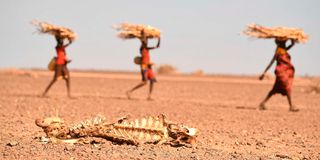
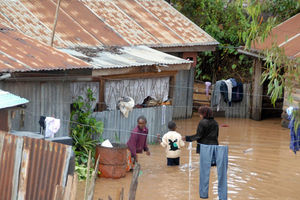
Mr Adan explained that, in the past, the agency played a crucial role in responding to disasters such as droughts and floods, but now, with limited funds, it has no capacity to intervene.
According to the NDMA boss, should disaster strike, Kenyans would be on their own.
The official further revealed that an appeal to the National Treasury for a supplementary budget request went unanswered.
“We deeply regret the suffering of families in various parts of the country. These delays stem solely from insufficient budget releases. NDMA remains constrained due to budget cuts over which it has little control,” he explained.
Launched as a flagship programme of Vision 2030 and central to the Bottom-Up Economic Transformation Agenda (BETA), the HSNP supports 133,800 needy households in eight arid and semi-arid counties.
The programme functions via a Management Information System linked to the Enhanced Single Registry (ESR), a joint effort with the Kenya National Bureau of Statistics (KNBS), to ensure transparency in beneficiary targeting.
Households targeted under the programme are those not covered by Inua Jamii , selected through a data-driven targeting system overseen jointly with KNBS.
Mr Adan emphasised that irregular exchequer disbursements forced NDMA to stagger payments between counties and that its communication with beneficiaries had been inadequate.
“We held consultations with the Treasury and Parliament before issuing updates to avoid triggering panic among households. Unfortunately, that silence fuelled anxiety,” he said.
He further explained that when HSNP’s budget classification was shifted from development expenditure to recurrent in the 2023/2024 financial year, it was intended to stabilise disbursements.
However, only Sh125 million became available monthly — far short of the required Sh456 million — causing backlogs and delays.
The NDMA boss also dismissed accusations of regional bias or ethnicity-based discrimination, saying that HSNP staff are recruited locally for cultural appropriateness and that beneficiary numbers by county reflect verified poverty prevalence, not politics.
The programme employs eight Programme Managers, 33 Programme Officers, eight Procurement Assistants, eight Accounts Assistants, and five Drivers, all from within the beneficiary counties.
Household allocations per county include: Turkana (39,917), Wajir (19,201), Mandera (22,229), Marsabit (20,453), Garissa (9,252), Tana River (7,377), Isiolo (7,027), and Samburu (8,344).
“The figures stem from verified data, not ethnicity. HSNP’s selection remains objective and auditable nationwide,” he said.
He appealed to the National Assembly for immediate action, requesting Sh3.9 billion to settle the current arrears and Sh5.47 billion for the 2025/2026 cycle to avoid future disruptions.
“Absent predictable funding, HSNP cannot meet its constitutional mandate or expand to all 23 ASAL counties as envisioned,” he warned.
“We appeal to Parliament to act decisively, compassionately, and without delay to secure Kenya's most vulnerable families,” he added.
Turkana South MP Dr Ariko Namoit condemned the delays, saying they are unacceptable as families depend on the HSNP for support.
“That families dependent on this lifeline have gone nearly a year unpaid is unacceptable. This programme is not optional — it is a constitutional right,” he said, asking the National Treasury to prioritise social protection with the same urgency as infrastructure investments.
“You can’t claim to uplift lives while drought-stricken Kenyans starve,” he added.
“We will push the Treasury and the State Department for ASALs to place HSNP at the top of the funding list,” he assured.
“We’ll also advocate for the clearance of Sh3.9 billion via a supplementary budget,” he stated.
Meanwhile, he directed NDMA to overhaul communication with beneficiaries to rebuild trust and clarity.
The committee is expected to table its recommendations soon, including urging the Treasury to raise HSNP funding and embedding the programme under the Medium-Term Expenditure Framework (MTEF) to buffer it from year-by-year volatility.
“Our actions now can halt thousands from slipping into deeper hunger,” noted Lochakapong.
The HSNP has long proven effective at cushioning households against drought shocks, but its sustainability hangs in the balance amid persistent funding gaps.