Kenya’s last mile to eradicate polio — and the man leading the charge
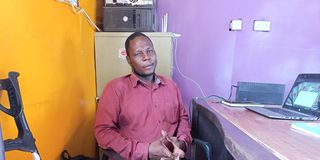
Nick Mc'ondwat during the interview at his office in Kisumu. He suffered a polio attack at the age of five and now uses his experience to create awareness about the disease.

What you need to know:
- Polio is a highly infectious disease caused by a virus that invades the nervous system and can cause total paralysis in a matter of hours.
- It is transmitted mainly through the faecal-oral route or contaminated water, or food; and multiplies in the intestine.
Imagine this: a virus invades your body's nervous system, causing total paralysis in a matter of hours. For most people, this remains an unthinkable nightmare. For Nick Mc'ondwak, it is a lived reality—one that has shaped every step of the 48 years he has been on earth.
Born healthy in 1977, Mc'ondwak arrived as a firstborn son to much celebration in his family's rural home in Homa Bay. He has no memory of those earliest years, only the knowledge that his birth was a moment of joy. But in 1983, at the age of five, his life changed forever.
His lower limbs became weaker with each passing day until they eventually denied him the ability to walk. His family rushed him to hospital, but none of the conventional medicine offered a solution. Desperate, they turned to traditional medicine.
"When the traditional medicine failed, I was once again taken to hospital and diagnosed with polio," he recalls.
The World Health Organisation (WHO) describes polio as a highly infectious disease caused by a virus that invades the nervous system and can cause total paralysis in a matter of hours. It is transmitted mainly through the faecal-oral route or contaminated water or food, and multiplies in the intestine.
According to WHO, one in 200 infections leads to irreversible paralysis, and amongst those, five to 10 per cent die when their breathing muscles are immobilised.
Although preventable through immunisation, Mc'ondwak missed the life-saving dose.
"When I was born, my parents lived in a rural part of Homa Bay, making access to the vaccine challenging," he shares, noting that all his younger siblings were vaccinated.
Prof Walter Jaoko, director of the Kenya Aids Vaccine Initiative (Kavi) Institute of Clinical Research at the University of Nairobi, emphasises that vaccination is the only shield against this incurable, highly contagious disease.
He notes that vaccine uptake in Kenya remains high, aided by a zero-dose catch-up mechanism designed to reach every child, especially in remote areas with difficult infrastructure.
"It is for this reason that the world is excited about the possibility of eliminating polio by 2029, just as the world managed to eradicate smallpox in 1980, thanks to uptake of the life-saving doses," he says.
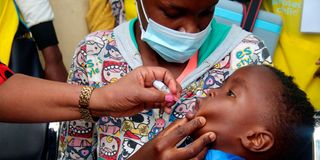
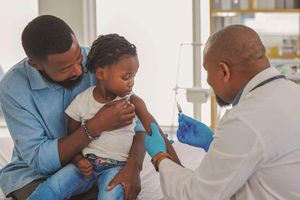
A child receives the polio vaccine.
Jaoko is confident in the existing tools. "We no longer need research on polio because the tools that we have are so efficient; it is just a matter of applying them and we will be able to eliminate the viral disease."
Immunisation has already eradicated wild polio types 2 and 3, a strain of polio virus associated with paralysis. The remaining wild polio type 1 is now found only in Pakistan, Afghanistan, and sporadically in Somalia, the Democratic Republic of Congo, and Mozambique. Kenya has not reported a case in years.
However, Jaoko warns that the fight is not over. "Eradication of polio needs a global effort. As long as the virus exists anywhere, the rest of the world is at risk of getting a resurgence."
Mc'ondwak recalls being admitted to a rehabilitation hospital after the diagnosis and later joining Joyland Special School in Kisumu.
At the learning facility, he came across a number of learners with disabilities, with a majority being those affected as a result of polio. The school provided him with polio shoes, crutches, and calipers, allowing him to lead a relatively normal life.
Despite the support system, he faced severe discrimination from his peers and the community around him.
"Many parents would stop their children from interacting with me over fear that they could also contract polio," he recounts. He believes he was enrolled in a special school partly to cushion him from such stigma.
Inspired by his personal experience, Mc'ondwak established an organisation in 1998 whilst in college to advocate for the rights of persons with disability and challenge negative community perceptions. He became a polio champion, committed to ensuring no other child would suffer from a preventable condition.
Stigma
Speaking to Healthy Nation, he highlights the devastating social impact of the disease.
"One painful realisation I came to was that once a child ends up disabled as a result of polio, both mother and child are often subjected to stigma, with some believing that the child is cursed. This stigma has led to children being hidden, abandoned, or the break-up of marriages. Some marriages break up as parents dispute whose lineage is to blame."
Despite the progress, challenges remain. Jaoko identifies misinformation—including false narratives linking polio vaccines to family planning—as a significant barrier leading to vaccine hesitancy.
The researcher emphasises the need for caregivers to present their children for vaccination, especially when the government issues directives for mass booster campaigns.
He also stresses the critical importance of booster shots during mass vaccination campaigns to maintain immunity.
"The booster shots are critical because the body requires to be reminded that as long as an infection is still spreading, if the immunity has not lived long enough, the body is at risk of becoming infected," he explains.
He acknowledges a vaccine stock-out in May that threatened to undermine disease control by lowering herd immunity, noting that thousands of new-borns were forced to wait for procurement of the vaccines whilst increasing their risk of contracting polio.
However, he praises the government for urgently procuring millions of doses to protect new-borns. "The move protected the children from the long-term effects of missing the vaccine," he says.
To achieve eradication, he recommends strengthening vaccination campaigns, enhancing surveillance, and leveraging Community Health Promoters and community engagement.
The professor of Medical Microbiology and Tropical Medicine further recognises efforts by Rotary International towards eradication of polio.
Also read: Experts warn of dire consequences as over 100,000 Kenyan children miss key routine vaccines
Jaoko, a member of Rotary Club Kenya, says the organisation came up with the global Polio Eradication Initiative in 1988 and has worked closely with WHO, United Nations Children's Fund, US Centres for Disease Control and Prevention, the Gates Foundation, and Gavi the Vaccine Alliance in an effort to achieve the agenda.
"Rotary has contributed more than $2.9 billion to the global effort to eradicate polio," says Prof Jaoko.
Rose Waringa, Rotary Club Western Regional coordinator, says the organisation has been engaging the public in talks on the need for vaccination whilst also supporting children suffering from polio.
She adds that their efforts have helped five of the six WHO regions be declared free of the wild poliovirus.
"We should not stop taking our children for vaccination when we are called to do so. Furthermore, the government should not slacken on disease surveillance and community engagement," she urges.
A latest report by WHO African Region in the second quarter of 2025 reveals significant strides in the fight against polio, highlighting regional collaboration, innovative vaccination efforts, and health system strengthening.
According to the report, 161 million children were vaccinated against polio in the period between April and June 2025. Kenya, Ethiopia, and Somalia vaccinated over 18 million children in a synchronised effort during the period, highlighting successful regional cooperation.
The report also reveals that the region has maintained high-quality surveillance, ensuring early detection of polioviruses.
"Africa achieved a 7.2 non-polio Acute Flaccid Paralysis rate and a 92 per cent stool adequacy rate in 2024, meeting targets for both key core surveillance indicators," says the September 2025 report.
Also read: Vaccine stock-outs at Kenya’s central store are disrupting preventive healthcare, an audit reveals
It adds: "The surveillance programme enabled 98 per cent (46/47) of countries in the African Region to have functional Environmental Surveillance Systems."
The health agency has also enhanced Africa's polio surveillance, anchored by a network of 16 labs that trace poliovirus from stool and wastewater.
Since January, WHO has trained regional lab teams, health workers, and data managers in genetic sequencing, with six of 11 labs piloting advanced techniques.
However, challenges remain. The report cites decreased immunisation activities due to resource constraints, conflict, misinformation, and community fatigue. It calls for a renewed focus on reaching zero-dose children, enhancing surveillance, and empowering women in the eradication effort.
WHO has now called for a renewed focus on improved population immunity, targeting "zero-dose" and under-immunised children in hard-to-reach areas, enhanced surveillance (both clinical and environmental) for rapid detection and response, and advancing gender equality and the empowerment of women to support eradication efforts.
"The region should also advance gender equality and the empowerment of women to eradicate polio, intensify vaccination campaigns, leveraging technology and innovative solutions."
Back in Kisumu County, Mc'ondwak continues to raise awareness on polio vaccination with the hope that the country will soon be declared free from the viral disease.
The polio champion says he often visits communities, schools, and uses local radio stations and social media to spread his message.
He remains hopeful: "I believe that as much as we are not yet there, we have achieved a lot. Cases of polio in the younger generation remain rare. We are getting closer to eradicating the disease."