Kenya’s nine Ebola cases trace to single DRC entry as Africa CDC warns outbreak is far from over
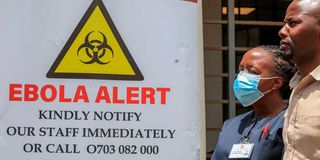
Posters displaying information about Ebola symptoms and hygiene precautions at Nairobi Hospital on October 7, 2026.

What you need to know:
- Africa CDC warns the Bundibugyo Ebola outbreak is far from over and is growing faster than any on the continent in a decade.
Genetic tests show all nine of Kenya’s Ebola cases came from a single introduction of the virus from the Democratic Republic of Congo (DRC). Scientists still cannot say how the virus reached Nairobi, an emergency meeting of African health ministers heard. The meeting, called by Africa CDC and the World Health Organization (WHO), was told the outbreak has grown faster than any other on the continent in the past 10 years.
A team from the DRC, Uganda, Kenya and Nigeria studied 1,126 virus genomes. Africa CDC Director General, Dr Jean Kaseya set up the team, led by Prof Jean-Jacques Muyembe of the DRC’s national biomedical research institute. It was asked whether Nigeria’s case was a new import from the DRC or a later case from the Kenyan chain.
The Kenyan and Nigerian viruses, along with one from Beni in the DRC collected on 12 October, fall into one group. Scientists are 88 per cent confident in this result. The Beni virus matches the Kenyan and Nigerian viruses at all 11 genetic points checked, including one change not seen in any other Congolese virus. All other Congolese viruses differ from the Kenyan virus by at least four changes and from the Nigerian virus by at least five.
The team concluded that all 2026 cases began from one jump of the virus from animals to humans, followed by continued spread between people. It also found the Kenyan and Nigerian cases are not linked to chains Uganda found in May and June. In Kenya, the results point to one entry followed by local spread, because the three Kenyan viruses differ from each other by only one to three changes.
However, the team stressed that genetic tests show which chain a virus belongs to, not where or from whom a person was infected. They cannot show where either patient caught the virus. They also cannot say whether the Nigerian patient got it from the Kenyan first case or whether both got it from the same unknown source. Nor can they rule out an untested chain of cases in Uganda while the patients were travelling through. They also cannot show whether people with mild symptoms are carrying the virus across borders.
The team’s main recommendation is that all four countries trace the two patients’ routes, dates and symptom onset to see whether their journeys overlapped.
The DRC was urged to test more virus samples, cover provinces and health zones not yet tested, and tighten screening at road borders and entry points. Kenya was advised to keep testing samples from the known chain to understand how far the virus has spread. Uganda was told to step up monitoring in border districts and among travellers to check for an unknown chain. Nigeria was asked to test any new Abuja-linked case, since a second virus sample would quickly show whether spread is continuing.
WHO Director-General, Dr Tedros Adhanom Ghebreyesus, warned against reading the search for a source as a search for someone to blame.
“While the epidemiological investigation has to trace the source of each infection, it is extremely important we avoid the temptation to apportion blame and focus our efforts on finding solutions. Ebola is compounding an already difficult humanitarian situation, aggravating hunger, interrupting essential health services, and placing an additional strain on a fragile health system,” said Dr Tedros.
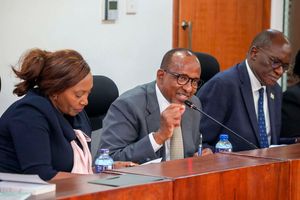
Kenya’s Ministry of Health Director General, Dr Patrick Amoth, told the meeting that all nine confirmed cases are linked to the index case, a Kenyan who had travelled from the DRC through Uganda and died on October 5. The eight secondary cases comprise four family members and four health workers who cared for him before the disease was suspected. A 65-year-old relative died on October 23, bringing Kenya’s toll to two, a case fatality rate of 22.2 per cent. Seven patients are in treatment and stable. Dr Amoth said two had tested negative and were awaiting a second test after 72 hours.
He noted that no chain of transmission had been found outside monitored contacts and there was no evidence of community transmission. All 135 listed contacts have been traced, nine of them outside Kenya, and those countries were notified under the International Health Regulations.
“All our 135 contacts were traced, and those in Kenya have been followed up daily. On Monday, October 26, the first 20 contacts who completed their 21 days of monitoring returned home to their families,” said Dr Amoth. Forty-six more patients were released on October 30.
Dr Amoth said Ebola has been declared a formidable epidemic under the Public Health Act, giving the response a legal footing, and that a national task force brings together both levels of government and development partners. Kenya has screened more than 700,000 travellers at points of entry and has five testing laboratories, including mobile units on the Uganda border, with results in six to 12 hours. It currently has 211 isolation and treatment beds, has trained close to 5,000 health workers, and has surge responders on standby. Eleven high-risk counties are setting up emergency operations centres, and a toll-free line and psychosocial support are available. Rwanda has donated 500 doses of an antiviral medication to support patients infected with Bundibugyo Ebola disease.
“Kenya’s experience has exposed gaps the whole continent must close. There is still no licensed vaccine or specific treatment for the strain, and Kenyan patients depend on investigational medicines whose supply is uncertain. Health worker infections also remain a continental priority. Four of our nine cases are healthcare workers infected in the line of duty before the disease was suspected. Protecting those who protect us through infection prevention and control, provision of personal protective equipment, and high index of suspicion and deployment of care must be a continental priority,” said Dr Amoth.
Dr Amoth noted that an outbreak that crosses borders must equally be met by surveillance and contact follow-up that crosses borders. Sustaining the response through the full 42-day countdown and keeping border counties prepared for as long as the outbreak continues in the region requires predictable financing.
Kenya asked Africa CDC and partners for early, equitable access, through the African Pooled Procurement Mechanism, to candidate vaccines for contacts and frontline workers and to treatments including mAb114 and remdesivir. Kenya also pledged to deepen cross-border coordination with the DRC and Uganda through joint surveillance and real-time exchange of information on contacts and travellers along the northern corridor, and harmonised screening and referral at borders through bilateral channels and the East African Community. Kenya will keep travel and trade open and will not impose restrictions beyond what the International Health Regulations and evidence require. Africa CDC’s six recommendations to ministers included keeping borders open and rejecting unnecessary travel and trade restrictions.
According to Africa CDC, the DRC has recorded 10,668 confirmed cases and 5,198 deaths in the ongoing Bundibugyo Ebola outbreak since it was declared on May 15, 2026. Uganda recorded 20 cases and two deaths, and its outbreak has ended. Kenya recorded nine cases. Nigeria and France each reported one imported case with no deaths.
At 166 days since the outbreak was declared, it is 2.6 times larger in cases and 2.3 times larger in deaths than West Africa’s 2014 epidemic was at the same point, according to slides. That epidemic had 3,967 cases and 2,105 deaths by then and went on to claim about 11,325 lives over two and a half years. The current outbreak has spread from one province and three health zones to ten provinces and 66 health zones. The DRC reported 96 new cases on 25 October alone.
“Behind every number is a family, a mother caring for a sick child at home, or a health worker who didn’t come back from a shift. We are not winning so far,” said Dr Kaseya.
There were some signs of progress. Sixteen of the 66 affected health zones have had no cases for 21 days, and 11 have been quiet for more than 42 days. Weekly case counts peaked at around 570 in epidemiological week 36 and have eased since, though Africa CDC said between 400 and 550 confirmed cases are still reported each week with no sustained decline. According to Dr Tedros, the DRC outbreak “is not a single outbreak in a single place. It is many outbreaks across a vast and affected region, requiring a sustained response everywhere at the same time.”
The weakest point is contact tracing. In the 2018 to 2020 DRC outbreak, responders listed 78.9 contacts per confirmed case. On that benchmark, the current outbreak should have about 793,734 listed contacts, but only 137,765 have been listed, or 17.3 per cent. As a result, more than 80 per cent of new cases are coming from communities and not from known contact lists, and about 65 per cent of deaths occur outside treatment centres, which Africa CDC says points to unsafe burials and undetected chains of transmission. WHO estimates true case numbers may be two to four times higher than reported.
There is still no licensed vaccine or treatment for Bundibugyo ebolavirus. A trial of remdesivir combined with the antibody treatment MBP134 had enrolled 762 participants by 21 October, about half its lower target of 1,500, and a trial of the antiviral obidesivir for people exposed to the virus had enrolled 577 of 1,000. Africa CDC stressed that enrolment is not evidence the drugs work. The Ervebo vaccine is licensed for the Zaire strain, and its protection against Bundibugyo is still being evaluated. So far, 16,585 frontline workers have been vaccinated under compassionate use and an observational study called BRAVO. A ring-vaccination trial called TUMAINI began in Bunia last week.
The agency’s six recommendations to ministers were stronger cross-border surveillance under formal agreements, more transparent funding that reaches frontline responders, higher national preparedness scores, support for accelerated research on treatments and vaccines, a single response framework with transparent financial tracking, and keeping borders open.