Concerns raised by Kikuyu elders over the use of disposable diapers on baby boys have renewed questions about whether prolonged use could affect the development of their reproductive organs.
The elders have urged parents to reduce the use of disposable diapers, particularly when children are indoors, claiming that prolonged exposure to heat and failure to change wet diapers could affect genital development.
The concerns followed observations during a traditional circumcision ceremony involving more than 100 boys in Kanunga village, Kiambu County, where the elders claimed some boys had unusually small reproductive organs.
However, what do doctors say? Can diapers restrict growth of a child’s penis?
“There’s no good evidence that disposable diapers make a baby boy’s penis shrink or slow its growth,” he says.
He adds that neither the warmth associated with wearing diapers nor a tight fit has been established as a cause of delayed genital development.
The debate partly centres on concerns about temperature around the testicles, with some arguing that the warmth retained by disposable diapers could interfere with male reproductive development.
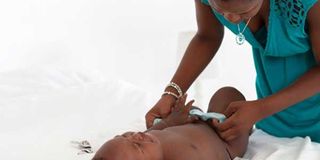
A baby wrapped in diapers sleeps comfortably. Photo| File
But Dr Winstar says research comparing cloth nappies and disposable diapers has produced mixed findings on how warm the skin around the testicles becomes.
“There’s no good evidence that either type affects genital growth,” he explains.
Although some studies have investigated differences in scrotal temperature among boys wearing different types of nappies, such findings do not establish that disposable diapers interfere with the growth of the penis.
Dr Winstar notes that research measuring genital size in newborn boys in countries such as India and Thailand was intended to establish normal measurements at birth, rather than investigate whether diaper use affects development.
“So far, published research hasn’t linked disposable diapers to problems with genital development,” he says.
According to Dr Winstar, male genital development begins before birth, with growth continuing during infancy, that is, one year and accelerating during puberty, which is about 18 years.
“The penis starts developing in the womb. It grows in the first few months after birth and more rapidly during puberty, usually reaching adult size by the end of puberty,” he says.
He explains that genes and hormones, particularly testosterone, play an important role in determining how the penis develops.
Nutrition also matters, as an improper diet can delay puberty and, consequently, the expected stages of development.
He cautions parents against judging their children's development by comparing them with other boys, noting that differences in appearance do not necessarily indicate an underlying medical problem.
In some cases, a penis may appear smaller than it actually is because part of it is concealed by surrounding skin or fat, a condition known as a buried penis.
“Sometimes a normal-sized penis looks small because it’s partly hidden by surrounding skin or fat,” Dr Winstar explains.
In a clinical assessment, a doctor gently stretches and measures the penis to establish whether its length falls within the expected range for the child's age.
Where measurements are significantly below what is expected, further assessment may be necessary to investigate possible hormonal or genetic causes.
Dr Winstar advises parents who notice that their son's penis appears unusually small or curved to have him examined by a doctor rather than assume that diapers are responsible.
Other warning signs include frequent difficulty passing urine, an opening through which urine comes out that is not located at the tip of the penis, and one or both testicles that have not descended into the scrotum.
He says these signs warrant medical assessment because they could point to conditions requiring further investigation.
Sudden pain or swelling in the scrotum, or an inability to pass urine altogether, requires immediate hospital attention.
Diaper and skin irritation
While disposable diapers have not been established as a cause of impaired genital growth, Dr Winstar says parents should pay attention to how long children remain in wet or soiled diapers.
Prolonged exposure to moisture can cause nappy rash and skin irritation, making regular diaper changes important for a child's comfort and skin health.
“Wet or soiled diapers can cause nappy rash. Change them promptly. A little diaper-free time helps the skin dry and heal,” he advises.
Parents are also encouraged to choose diapers that fit comfortably rather than tightly and to allow some diaper-free time when practical.
The distinction, therefore, is between maintaining proper diaper hygiene to prevent skin irritation and assuming that disposable diapers interfere with the development of a boy's reproductive organs. Current evidence does not establish such a link.