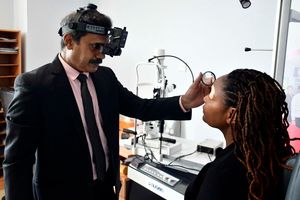
Kenya's optical industry hits Sh3.14 billion as more Kenyans seek eye care

Most eye clinic visits are routine, involving an eye exam or a new pair of glasses, with such ordinary visits making up 81 per cent of all optical visits and 82 per cent of spending.

What you need to know:
- Myopia, or short-sightedness, was the single leading diagnosis, responsible for 20.9 per cent of visits and 19.3 per cent of spend.
- It occurs when the eyeball is slightly too long or the cornea too curved, bending light to focus in front of the retina instead of directly on it, so that distant objects blur while close-up vision stays sharp.
Every day, hundreds of Kenyans walk into optical clinics complaining of blurred distance vision. By the end of 2025, that steady stream of patients had built a Sh3.14 billion industry, and new claims data shows the surge is being driven less by rising prices than by rising numbers of people needing glasses.
The data points squarely at refractive errors, conditions where the eye fails to bend light correctly onto the retina, as the engine behind the growth.
According to the Kenya Optical Industry Report compiled by health-tech platform Smart in partnership with the Kenya Association of Opticians , national optical spend among insured members grew from Sh2.99 billion in 2024 to Sh3.14 billion in 2025. Visits climbed from 203,023 to 213,465, while the number of unique patients seeking eye care rose from 175,380 to 186,357. The average cost per visit barely moved, up from Sh14,430 to Sh14,530, evidence, the report says, that Kenyans are not simply paying more for eye care, but that more of them are showing up needing it.
Myopia, or short-sightedness, was the single leading diagnosis, responsible for 20.9 per cent of visits and 19.3 per cent of spend. It occurs when the eyeball is slightly too long or the cornea too curved, bending light to focus in front of the retina instead of directly on it, so that distant objects blur while close-up vision stays sharp. Astigmatism, an irregular curvature of the cornea or lens that scatters light unevenly across the retina and distorts vision at every distance, followed closely at 17.3 per cent of visits and 15.8 per cent of spending.
Presbyopia, the age-related stiffening of the eye's lens that makes reading and phone screens difficult to focus on, made up 15.7 per cent of visits. It was, however, the costliest condition per case in the report, reflecting the price of the multifocal lenses often prescribed to treat it.
Further down the list, degenerative myopia, a severe, progressive form of short-sightedness in which the eyeball itself stretches and can damage the retina, risking permanent vision loss if untreated, accounted for 2.2 per cent of visits. Hypermetropia, or long-sightedness, caused by a shorter-than-average eyeball or an overly flat cornea that focuses light behind the retina, made up 1.5 per cent.
Most eye clinic visits are routine, involving an eye exam or a new pair of glasses, with such ordinary visits making up 81 per cent of all optical visits and 82 per cent of spending. But hospital-admission cases, though rare, are far more expensive. They account for just 1 per cent of visits, yet five per cent of total spending, costing an average of Sh91,460 per case, more than seven times the Sh12,974 cost of a routine visit.
The data show that eye problems are also a working-age problem. Adults aged 21 to 50 accounted for 68.4 per cent of all optical visits, with those aged between 31 and 40 being responsible for 28.7 per cent. Women sought care more often than men, making up 56 per cent of visits against 44 per cent for men.
Children were markedly under-represented in the numbers. Patients aged 0 to 10 made up just 5.3 per cent of visits, a gap the report does not explain, but which raises questions about whether paediatric vision problems are going undiagnosed rather than simply not occurring.
Cost, too, went up with age. The average spend per visit rose from Sh9,360 among children aged between zero and five, to Sh21,600 among patients aged between 61 and 70, and to Sh35,060 for those aged between 71 and 80.
Access to insured optical care remains starkly uneven across the country. Nairobi alone accounted for 57.8 per cent of all optical visits and 62.0 per cent of total revenue in 2025. Mombasa was a distant second at 5.4 per cent of visits, followed by Kisumu and Kiambu at 4.3 per cent each. Other counties represented included Kajiado, Nakuru, Uasin Gishu, Machakos, Nyeri and Embu.
The report notes that the 10 counties generating the most optical visits, 86.3 per cent of the national total, are served by only 40.7 per cent of the country's active optical providers. This mismatch suggests either under-served demand outside major towns, or patients travelling into urban centres to access care that is not available closer to home.
The report also found that most patients who use their optical benefit do so only once a year: 88.2 per cent of optical patients recorded a single visit in 2025, while just 11.8 per cent returned for a repeat claim, at an average annual spend of Sh16,890 per patient.
Dr Victor Opiyo, President of the Optometrists Association of Kenya, is warning of a significant pshift in ophthalmic health, driven largely by modern lifestyle changes and increased screen exposure among children. He explained that patients today present with a wide range of ocular complaints, though a few key symptoms dominate clinical visits.
Also read: She went for an eye check-up and left with a TB diagnosis: The health secrets your eyes can reveal
"The most common complaints we hear most of the time are reduced distance vision, photosensitivity, in other words, photophobia and itchiness, which directs us towards allergies, among others, plus eye pain. Those are the most common complaints that we are getting nowadays, plus foreign body sensation in the eyes," Dr Opiyo explained.
While eye conditions affect people of all ages, Dr Opiyo noted a concerning trend specifically targeting younger demographics. The culprit appears to be a drastic reduction in outdoor play coupled with prolonged indoor device usage.
"We have noticed a change in pattern. Most of the time nowadays, we are finding that most of the patients are kids, and they are coming in with reduced distance vision. And that could be because of too many e-devices; they don't play outside most of the time, and this puts them at risk," Dr Opiyo noted.
He added that globally, as societies become increasingly digital and indoor-centric, cases of myopia (short-sightedness) are climbing rapidly.
"Globally, the world is struggling with the levels of short-sightedness because most of the time we don't get out; we are just indoors, and we are on our devices, and that is the nature of society today. Short-sightedness has increased in terms of numbers, and even if you look at the global indices, by 2050, we are projecting that half of the world will be short-sighted. So it is something that we are really, really struggling with, and we have new modalities of how to manage the levels of short-sightedness currently, unlike before," Dr Opiyo stated.
He also raised concerns over a troubling pattern in patient behaviour: delaying essential medical attention until conditions reach advanced or irreparable stages. According to Dr Opiyo, this tendency to ignore early warning signs is particularly prevalent in eye care, leading to preventable vision loss.
"The behaviour of seeking medical attention for Kenyan patients is worrying. The reason is that, most of the time, most of the patients come with eye diseases or eye problems at the end stage. We sit with sickness for a very long time; maybe sometimes we use over-the-counter eye drops, and maybe something is worsening at the back of the eye," Dr Opiyo stated.
A primary cause for delay is that many serious conditions progress without obvious pain or discomfort. Open-angle glaucoma, often referred to as the "silent thief of sight," is a prime example of a condition that steals vision without clear early warning signs.
"Remember, we also have some eye diseases like glaucoma, which is a silent thief of the eye. You won't feel any pain; you won't get any signs unless you are very, very keen. There is a type of glaucoma, which is open-angle glaucoma; most of the time it's painless. You are losing vision from the periphery, so patients normally are not aware of what is happening.”
"That is why we are saying that regular eye tests are very, very important. And I keep telling most of my patients that most of the time, listen to your body. Anytime your body is trying to communicate to you that something is happening, the best, best thing to do as Africans, as Kenyans, is always to seek medical attention," Dr Opiyo emphasised.
"We need to change our behaviours when it comes to seeking medical attention, and always try to report at the nearest facility as early or as soon as possible. Because most of the time, in medical terms, some diseases that are diagnosed or caught at an early stage are easier to manage than coming with a disease at an end stage," Dr Opiyo added.