Kenya to start Mpox vaccination next month, says ministry
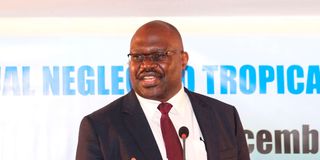
Deputy Director-General for Health at the Health ministry, Dr Sultani Matendechero. He says Kenya does not have to wait until infections have risen tremendously.

What you need to know:
- The ministry’s objective is to achieve herd immunity among populations, which will prevent the potential threat of the deadly disease spreading further.
The Ministry of Health will from next month start vaccinating thousands of Kenyans it has classified as ‘high-risk’ and susceptible to Mpox disease, the deputy director-general for Health Sultani Matendechero has said.
The ‘high-risk’ populations the government plans to start with include truck drivers operating beyond Kenya’s borders, hoteliers who time and again come into contact with these drivers, those involved in operating entertainment joints frequented by the drivers as well as commercial sex workers who ‘trade’ along the routes the drivers frequent.
Speaking to Healthy Nation in an exclusive interview, Dr Sultani said despite Kenya so far only recording 14 Mpox cases and one death, “it doesn’t mean that there is no danger as the situation can explode”.
The ministry’s objective, he noted, is to achieve herd immunity among populations, which will prevent the potential threat of the deadly disease spreading further.
According to the World Health Organization (WHO) herd immunity, also known as population immunity, is the indirect protection from an infectious disease that happens when a population is immune either through vaccination or immunity developed through previous infection.
“We don’t have to wait until infections have tremendously risen, that is not the only rationale for vaccination. There is a potential of these 14 Mpox cases to grow into thousands of more cases and hundreds of deaths based on what we have seen in the Democratic Republic of Congo(DRC) because over there, we are looking at an upwards of 1,500 cases and 500 deaths,” he said.
Imported cases
“If you look at the 14 cases that we have recorded in the country,11 of them were imported while three were ‘homegrown’ as a result of community transmission (when a person comes with the disease from outside the country and then they infect someone else) and even though we have managed to contain that transmission in Kenya, it is not automatic,” Dr Matendechero explained.
“We have screened more than 1.6 million people across all points of entry into the country. Whenever a suspected case is detected, we quickly take samples to the laboratory and once we have confirmed, we move the person away and embark on contact tracing,” Public Health and Professional Standards PS Mary Muthoni told Healthy Nation, noting that this has helped them trace more than 60 people who were later discharged after it was confirmed that they did not contract the deadly disease.
“One of the most impactful things our community health promoters (CHPs) are doing is what we call event-based surveillance, a powerful tool that we did not leverage on very well during Covid-19 pandemic. We are now sensitising our CHPs to be able to observe those rare events and report, and so whenever there is anything that almost looks like Mpox , they will immediately report so that we are quickly able to send in our rapid response teams to assess and take samples,” the PS explained, adding that CHPs also have electronic smartphones fitted with a software known as electronic community health information system (eCHIS) as well as M-dharura.
“One of the things we have done is to see how we can interface those two platforms so that we can digitise our event-based surveillance process.This will revolutionise the speed at which we are able to respond to any suspected public health issue,” PS Muthoni assured.
Dr Matendechero added: “We do not want to take chances because in Kenya, we lost about 5,000 people to Covid-19. We are not happy that one person has died from Mpox because in public health, one life lost is one too many and this is why we don’t want to get to a situation whereby we are overrun by this disease".
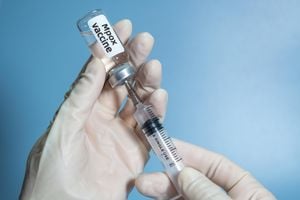
Dr Matencdechero, however, disclosed that so far no Mpox vaccine has landed in the country and all they have is a pledge that doses will be delivered from the Africa Centres for Disease Control (CDC) by donors such as Gavi, the Vaccine Alliance.
“We have not been reached in terms of priority, but we are really trying to make sure that at the slightest opportunity we get an allocation for Kenya, even if it is enough doses to cover health workers in high-risk areas because vaccination is the gold standard for prevention,” Dr Matendechero, who is also a member of the Emergency Consultative Group of Africa CDC, said.
In September this year, Bavarian Nordic A/S (OMX: BAVA) and Gavi announced an advance purchase agreement (APA) to secure 500,000 doses of the MVA-BN® mpox vaccine (marketed as JYNNEOS® or IMVANEX®) to be supplied to countries in Africa impacted by the Mpox outbreak.
The vaccines are funded by Gavi’s First Response Fund, a new financial mechanism created in June this year to make cash rapidly available to purchase vaccines in health emergencies.
This means that Kenya will not spend any money to procure the doses, according to Dr Matendechero.
The MVA-BN vaccine received prequalification from the WHO on September 13, and Bavarian Nordic will be ready to supply the vaccines pending the signing of a supply agreement with Unicef, Gavi’s alliance partner, which will be delivering these doses.
“The First Response Fund was designed in collaboration with Gavi donors and partners specifically to provide rapid early funding for emergencies such as Mpox. Using it today to fund the first direct transaction for vaccines in support of equitable access and the global response, just over a month since Mpox was declared a public health emergency, takes us a long way towards our goal of protecting those most at risk,” said Dr Sania Nishtar, CEO of Gavi.
“We are committed to working with affected governments and our partners to turn these vaccines into vaccinations as quickly and effectively as possible and, over time, to build a global vaccine stockpile if sufficient funding is secured for Gavi’s work through 2030.”
Dr Matendechero further noted that Kenya will also receive vaccine donations from Japan.