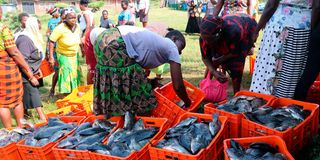
Cage fishing is slowly transforming the lives of some women who initially depended on the wild catch from Lake Victoria at Uyawi Beach in Bondo Sub-County.
Depending on wild catch exposed them to many challenges, including competing for the limited supply of fish and engaging in the infamous practice of ‘sex for fish’, which has been blamed for the high HIV prevalence along the beaches.
The women have formed 20 groups, each comprising 30 members. They partnered with the local non-governmental organisation, Bolena Fish Farm, and have started cage fishing, where fish are raised in a confined cage suspended in the lake.
Rose Akoth, a member of one of the groups, says that this new method of fishing has had a positive economic impact on her life.
“Initially, we walked to different beaches looking for fish to sell. In the end, we would either miss out or find only small quantities that we could not sell at a profit,” she notes.
“To get good fish that you could sell and make a profit,” she continues, “you had to have a friend who would occasionally require sexual favours in order to get fish”.
People harvest fish from the cages in Lake Victoria.
Photo credit: Kassim Adinasi | Nation
But cage fishing has proved fruitful, offering the women several opportunities.
“Our partnership with Bolena Farms has provided us with adequate aquaculture training, and we now have a better understanding of fish farming,” she adds.
Currently, 600 women are actively involved in fish production, from harvesting eggs from broods and raising them in nurseries to transferring them to cages and harvesting them.
“We have ponds where we keep brood stock, male and female tilapia. We harvest the eggs and hatch them in our hatcheries. This is significant because we produce millions of fingerlings, which we sell to other farmers — this is another source of income,” says Emmaculate Penina, a member of the group.
The women do all the work themselves, from harvesting the eggs and hatching them to selecting the best fingerlings for the cages and hardening them before transferring them to the cages.
“We have undergone extensive training and have a thorough understanding of the entire production process. Currently, we are raising the best fingerlings for the cages, and the farmers who buy from us are giving glowing reviews about the quality of our products,” she notes.
“One of the main ingredients in fish feed is soya beans. The soya beans are grown by the members themselves. We need huge quantities of feed, so we have women from the group cultivating soya beans. They squeeze oil from the beans and sell us the residue, which we use to make feed,” she notes.
According to Mary Atieno, one of the women members, cage fishing has elevated them from abject poverty.
Initially, they depended on wild catches, which were mainly done by men. Culturally, Luo women are forbidden from fishing; the furthest they can go is to the shores to collect the men’s catch.
Some of the fish harvested from the cages in Lake Victoria. Cage fishing is transforming lives of women in Uyawi beach in Bondo, Siaya County.
Photo credit: Kassim Adinasi | Nation
Within two years, the women’s groups have harvested twice: the first time they managed 20 tonnes from the cages in August 2024; this year, they got 52 tonnes. One kilogramme goes for Sh300.
“Women are never allowed to go out and fish. However, with this new cage fishing technology, we ride engine boats to check on our fish, feed them, and harvest them. This technology has broken the jinx,” says Atieno.
“The number of fish in Lake Victoria has drastically reduced. Thousands of fishermen have since abandoned traditional fishing methods and ventured into cage fishing.”
The technology has also reduced conflict between Kenyan fishermen and Ugandan security officers, who used to arrest them whenever they crossed into neighbouring territories.
“Kenya has the smallest portion of the lake, while Tanzania and Uganda have taken the lion’s share. Kenyan fishermen have suffered at the hands of Ugandan security officials for years, but today, with the new technology, the number of arbitrary arrests has decreased,” adds Atieno.
Bella Akinyi, the founder of Bonela Fish Farms, says that the reduced fish stock in the lake has caused many people to live in abject poverty along its shores.
“We have a high HIV prevalence rate along the shores of the lake, and abject poverty is one of the main causes. Our partnership with local women’s groups has made a significant impact. These women have been empowered, and there are many more who still need support,” she says.
She adds that the fish population in the lake has reduced and the number of fishermen depending on fishing is growing. This has led to many people living in poverty.
“We partner with individual companies to help us reach rural women engaged in aquaculture. We train them in aquaculture and finance management. We finance three cycles of production and then allow them to continue independently,” says Diana Muthika, communications officer at the AECF.
Africa Enterprise Challenge Fund CEO Victoria Sabula said that to close financing gaps, there is need to think about creating more investment vehicles and facilities.
“We need to think about creating more investment vehicles and facilities that are targeted at women entrepreneurs. Progress has been made, but there is so much that needs to be done,” Ms Sabula said.
She said that accelerating this will require investing in women in business so they can better access and unlock the already available capital.
She said building the right structures and systems will create more funding channels tailored to women-led enterprises. She said that governments, investors, and development partners must be willing to do so to unlock the full economic potential of women entrepreneurs across Africa.
She said that AECF’s work with rural women entrepreneurs across Africa has yielded deep insights, especially into community-driven solutions led by women far removed from mainstream market opportunities.