Makueni pilots Kenya’s first 15-nutrient pregnancy pill for pregnant women
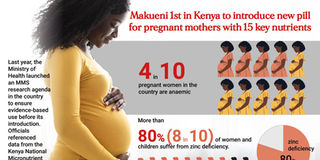
About four in 10 pregnant women in the country are anaemic, and more than 80 per cent (eight in 10) of women and children suffer from zinc deficiency.

What you need to know:
- The Multiple Micronutrient Supplement pill has no taste and will offer better adherence while providing more nutrients and minerals.
When Marcella Atieno gave birth to her first son in 2010, she attended most of her antenatal care visits at Jaramogi Oginga Odinga Teaching and Referral Hospital. Fresh out of campus, she knew nothing about motherhood or what to do as a pregnant woman. It took some time before she opened up to her mother, who later advised her to start attending clinics. Her mother kept a close watch on her and urged her to take Iron and Folic Acid Supplementation (IFAS) pills without fail.
“I did not know what supplements were. I was given the tablets during one of my clinic visits. The first time I tasted them, I did not like it. I vomited,” she said.
Marcella told Nation that the pills tasted like metal, and although she hated them, she found ways to ensure she took them.
“I was told that it was important for me and my baby. I would hide the pill in a lump of ugali and make sure I didn’t chew too much to bite it. Sometimes it would go down, other times I could taste it and vomit,” she recounted.
During a side event at the ongoing International Maternal Newborn Health Conference, which has brought together over 1,800 delegates from 60 countries, Makueni Governor Mutula Kilonzo Junior shared that many women in his county experience what Marcella went through. They struggle with the taste of a pill that is crucial for both themselves and their unborn babies during pregnancy.
His county is now piloting the first-ever Multiple Micronutrient Supplement (MMS) pill, set to be rolled out later this week and given free to all pregnant mothers in Makueni.
Unlike IFAS, which contains only iron and folic acid, MMS provides 15 essential vitamins and minerals. It has been proven as a safe and effective way to improve the diets and nutritional status of pregnant women.
This marks the first time an MMS pill will be introduced in Kenya through a pilot programme by the Makueni County Government in partnership with Vitamin Angels under the Transforming Lives Through Nutrition project. The initiative is expected to run for about four years.
While MMS is already in use in other countries, this is its first introduction in Kenya.
Last year, the Ministry of Health launched an MMS research agenda in the country to ensure evidence-based use before its introduction. Officials referenced data from the Kenya National Micronutrient Survey, which showed that about four in 10 pregnant women in the country are anaemic, and more than 80 per cent (eight in 10) of women and children suffer from zinc deficiency. A National MMS working group was formed with the aim of transitioning the country from using IFAS to MMS.
Joyce Mutua, Makueni’s Health executive, told Nation that the county decided to pilot the initiative because its data, mirroring the national outlook, shows that 40 per cent of pregnant women have anaemia. She noted that although Makueni has been a leader in preventing maternal deaths, particularly from post-partum haemorrhage -PPH- (excessive bleeding of about 300 millilitres), many women still present with anaemia, which is one of the risk factors for PPH.
“Our data shows that all mothers attending antenatal clinics took the iron and folic acid supplementation without fail. Yet, we still struggled with mothers coming in to deliver while anaemic,” she said.
Joyce and her county team conducted a survey and found that most mothers took the supplements home but never ingested them because of the taste.
“Already, when a woman is pregnant, she will certainly feel like throwing up. They complained that the supplement made it worse,” she told Nation.
She added that MMS has no taste and will offer better adherence while providing more nutrients and minerals.
“This is like farming. If you ensure the farm has fertiliser, the crop will be healthy and give better yields. A mother’s overall health is important,” she said.
Joyce noted that beyond supplementation, the county is also encouraging mothers to eat nutrient-rich foods but since they are in an arid and semi-arid region, they are practising innovative farming methods that require little water.
“We are encouraging mothers to grow and eat sweet potatoes. We also know that baobab has rich nutrients that are important for mothers.”
Christine Muindi, the county reproductive Health coordinator for Makueni County, said before the county decided to roll out MMS, they conducted a feasibility study to find out why mothers were presenting with anaemia despite taking home the iron and folic supplements.
“One of our problems was that we were not able to measure whether they actually take what they are given. This time, we decided to understand why before doing any implementation,” she said.
Christine told Nation that when pregnant women attend their antenatal care visits early and are given the supplements, they will have better outcomes.
“The mother will be given a total of 180 tablets, which will last about six months. They will continue taking them during pregnancy and even immediately after delivery. The earlier they come to the clinic, the better, because they will benefit throughout the pregnancy,” she explained.
Prof Moses Obimbo, an obstetrician and gynaecologist, explained that the requirement for iron during pregnancy is about 60 milligrammes per day. He noted that most supplements on the market provide about 30 milligrammes. Sometimes, absorption of this iron is impaired because there are no co-transporters or facilitators to help move the iron into the system.
“That is why it is important to have multiple micronutrients. Most of them work together to facilitate the transportation of each other into the system. We think that is the right way to go.”
Prof Obimbo cautioned that iron levels during pregnancy must be constantly monitored as some multiple micronutrient supplements may not contain sufficient amounts.
He explained that nutrients and minerals are crucial because as the baby develops, they draw most nutrients from the mother.
“If a mother is pregnant and starts with a normal blood level of 12, should she not take any supplement, by the end of the pregnancy, it will have gone down to eight. She will basically be having moderate anaemia.”
If a mother does not take in enough calcium, the baby will also be affected, impacting bone and teeth development. Prof Obimbo added that other micronutrients such as zinc, selenium, and manganese are essential for cell division and development.
He explained that when a baby is growing, cells divide very rapidly.
“We need this nutrition for proper growth of the baby. And most importantly, apart from forming the other organs of the body, the most critical is the formation of the brain.”
He warned that if a mother misses out on these nutrients, deficiencies such as anaemia can affect the child. If a mother goes into labour while anaemic, it means she already has low blood volume. Two things are likely to happen: when she loses even a minimal amount of blood, she can easily tip into shock because she already has too little blood to sustain her.
Once a pregnant woman goes into shock, it worsens the effects of post-partum haemorrhage. The bleeding can then progress into what doctors call disseminated intravascular clotting: the blood forms small clots and can no longer clot properly, leading the mother to bleed to death.
Even if a mother with anaemia survives post-partum haemorrhage, Prof Obimbo said there is a likelihood she will not have enough milk for her baby.
“It would mean that she can easily go into postpartum blues or postpartum depression. Anaemia has wide-ranging effects, not just during labour, but also beyond the labour process.”