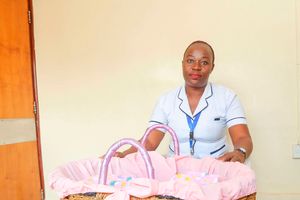
Behind the joy of triplets and quintuplets lies a dangerous silence about maternal and newborn risk

A pregnancy. High-order pregnancies involving triplets or more are widely celebrated in Kenya, yet they pose extreme risks to mothers and babies.
What you need to know:
- High-order pregnancies involving triplets or more are widely celebrated in Kenya, yet they pose extreme risks to mothers and babies. Behind the joyful headlines are high rates of prematurity, haemorrhage, and newborn death, often worsened by limited specialist care.
- Most hospitals lack the capacity to safely manage high-risk multiple pregnancies, leading to preventable complications and quiet losses after delivery. Without early referral to specialised centres, many outcomes are determined long before birth.
When news breaks that a Kenyan woman has delivered triplets, quadruplets, or even quintuplets, the country erupts in celebration. Cameras flash, politicians rush to congratulate, and well-wishers flood maternity wards with diapers and milk. For a moment, the nation unites around the latest "miracle mother".
Yet behind those joyful headlines lies a sobering truth. High-order pregnancies—those involving three or more babies—are among the most dangerous conditions in obstetrics. What appears as a heart-warming miracle often masks a quiet, harrowing fight for survival, a struggle that too often ends in tragedy once the cameras turn away.
This should matter to every Kenyan, because what we applaud as triumph frequently exposes deeper cracks in our healthcare system. High-order pregnancies, whether conceived naturally or through assisted reproduction, carry immense risk. Mothers face higher rates of pre-eclampsia, postpartum haemorrhage, preterm labour, and deep venous thrombosis—a blood clot that can kill within hours. Their babies are often born prematurely, underweight, and urgently needing intensive care.
Evidence from the Centre for Effective Global Action shows that women identified early as "high risk" are significantly more likely to develop serious complications before and during delivery. At Moi Teaching and Referral Hospital, studies show that multiparous mothers—those who have had several pregnancies or are carrying multiple babies—face especially high risks of haemorrhage and clotting disorders.
These cases may be a major driver of Kenya's stubbornly high new-born death rate. According to the 2022 Kenya Demographic and Health Survey, our neonatal mortality rate remains at 21 deaths per 1,000 live births. Nearly one-third of these deaths are caused by prematurity—the leading cause of new-born deaths in Kenya. Many of these infants come from high-order pregnancies.
What the public rarely hears are the specific dangers unfolding inside the womb. Some twins develop Twin-to-Twin Transfusion Syndrome, where one baby receives too much blood and the other too little. Others suffer Twin Anaemia–Polycythaemia Sequence, in which one twin becomes dangerously anaemic while the other's blood becomes abnormally thick. In rare cases, babies may be conjoined, sharing organs and requiring highly specialised surgery. Extreme prematurity may also lead to encephalomalacia, a severe form of brain injury caused by poor blood or oxygen supply. These are not abstract medical terms—they are the silent tragedies behind many celebrated multiple births and require specialist care available in only a handful of hospitals.
Yet across the country, we continue to see small hospitals proudly announcing the delivery of triplets, quadruplets, or even quintuplets as if this were a medical victory. In reality, these facilities lack the capacity to monitor or manage such pregnancies safely. Without neonatal ICUs, maternal-foetal medicine (MFM) specialists, blood banks, or advanced imaging, these deliveries are extremely risky. What often follows is a quiet, unreported tragedy: the loss of new-borns within days or weeks of birth.
Good doctors do not celebrate such outcomes—they brace for them. The hard truth is that only three hospitals in Kenya—Moi Teaching and Referral Hospital, Kenyatta National Hospital, and Aga Khan University Hospital—have certified MFM specialists trained to manage high-risk and high-order pregnancies. These specialists work alongside neonatologists to detect foetal anomalies, monitor growth disparities, plan for preterm delivery, and coordinate neonatal intensive care. Without early referral, many outcomes are effectively sealed long before birth.
The rise in high-order pregnancies is also being driven by the growth of assisted reproduction. Some fertility clinics, eager to increase success rates, implant multiple embryos during IVF. While well-intentioned, this practice dramatically increases the likelihood of high-order pregnancies and their associated risks. Globally, responsible IVF programmes have shifted towards single-embryo transfer to protect mothers and babies. Kenya must urgently adopt similar regulations. Fertility should never come at the expense of safety.
This is more than a medical issue—it is a policy failure. Prenatal counselling should be mandatory for all women undergoing IVF and for anyone found to be carrying multiple foetuses. They deserve clear, evidence-based discussions about risks, costs, and all available medical options, including embryo reduction when clinically appropriate.
Early referral should be policy, not luck. Any pregnancy involving more than two foetuses, and any multiple pregnancy in a woman over 35 or with a history of multiple births, should trigger automatic referral to a tertiary centre with specialist capacity.
Our government must act decisively. Kenya needs national IVF regulations limiting the number of embryos transferred and requiring transparent reporting of multiple-birth rates. We must expand neonatal ICU capacity, train more MFM specialists, and strengthen our emergency referral systems. The media also has a duty to tell the full story. Celebrating the birth of five babies without asking how many survived is not journalism—it is negligence.
Justice and equity
The question Kenya must ask is not how many babies are born, but how many live. Behind every viral photo of a mother cradling quintuplets lies a deeper question of justice and equity: Did she receive the care she deserved? Was she informed of the risks? High-order pregnancies are not spectacles. They are a stress test of our healthcare system—revealing whether our policies, our resources, and our compassion are enough to keep both mother and child alive.
Kenya must stop glorifying survival by luck and start guaranteeing it by design. The right to become a mother must be matched by the right to survive it. No woman should lose her life while giving life, least of all while the nation cheers.
The writer is Deputy Director of Reproductive Health and Head of Department, Maternal Foetal Medicine Department, Moi Teaching and Referral Hospital, and Chairman, Kenya Obstetrical and Gynaecological Society-North Rift.