More than a ride: The women on pink motorcycles fighting cervical cancer
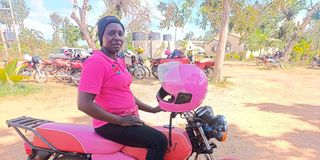
Josephine Awuor, who lost her mother to cervical cancer last year. She uses her experience to encourage women to go for screening.

What you need to know:
- The World Health Organization estimates that cervical cancer is the fourth most common cancer in women globally, with 660,000 new cases reported in 2022.
- Of the 350,000 deaths recorded that year, 94 per cent occurred in low- and middle-income countries.
- The highest rates of incidence and mortality are found in sub-Saharan Africa, Central America, and South-East Asia.
The motorcycle cuts through the morning haze, its bright pink frame a striking contrast against the ochre dust of rural Siaya. Behind the rider sits a woman clutching a small bag, her eyes fixed on the road ahead. She is on her way to find out if she has cervical cancer.
In Ugenya Sub-county, where agriculture remains the mainstay and the sight of women tending farms is as common as the sunrise, access to healthcare has long been a luxury measured in kilometres. The nearest health facility can feel like a world away when the only options are walking or paying for transport that most cannot afford.
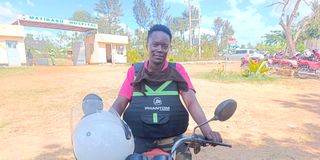
Patricia Atieno during the interview. She is among more than 40 young women trained by Matibabu Foundation to ride bikes while creating awareness on cervical cancer.
But something is changing. Dotting the dusty village roads, amid the ordinary motorcycles that revolutionised rural transport in the late 2000s, are these unmistakable pink machines—chauffeured by young women on a mission that is part transport, part healthcare, part community mobilisation.
They call them Boda Girls.
Josephine Awuor, 30, pulls up at Matibabu Foundation health centre with her passenger. The woman has come for cervical cancer screening. Josephine helps her dismount, walks her to the entrance, exchanges a few words of encouragement, and watches her disappear into the clinic. Then she checks her phone. Another client is waiting in a village three kilometres away.
"I make trips to the villages and hospitals every day, ensuring women have easy access to maternal-child health services and cervical cancer screening," says Josephine, adjusting her helmet. A smile crosses her face, but there is weight behind it—the kind that comes from carrying a story too heavy to forget.
This is not just a job for Josephine. It is a promise made at a graveside.
The death that changed everything
Towards the end of 2024, Josephine's mother, a farmer from Gem in Siaya County, began complaining of persistent back pain. She was a woman accustomed to labour—long hours bent over crops, hands deep in the soil. Pain was familiar. She dismissed it as the price of hard work and reached for over-the-counter medication whenever it flared.
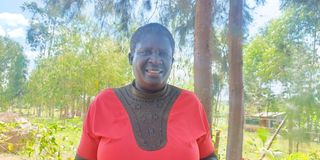
Rosemary Agolla during the interview. After recently undergoing cervical cancer screening at Matibabu Foundation Hospital, Ms Agolla emphasised that free transport was the deciding factor in her seeking care.
What the family did not know was that their mother, who lived alone, was hiding something else: constant vaginal discharge that she mentioned to no one.
"One evening in October 2024, I got a call from my mother," Josephine recalls, her voice quieter now. "She told me the discharge had increased and had a foul smell. She was in so much pain and needed to see a doctor."
The following morning, her mother made her way to Yala Sub-county Hospital. The doctors there examined her and immediately referred her to Aga Khan Hospital in Kisumu for further tests. A few days later, the results arrived.
Stage three cervical cancer.
"We made calls to close family members," says Josephine. "Everyone was in tears."
Her mother was placed on treatment immediately. Chemotherapy sessions came every two weeks. The family hired private vehicles to transport her from Gem to Kisumu—a journey that drained their finances as quickly as the disease drained her body. A special diet was prescribed. Medical bills piled up.
But it was not the money that haunted Josephine most. It was watching her mother lose her dignity.
"Cervical cancer robs a woman of her dignity due to the foul smell from the vaginal discharge," she says. "My mother was in constant pain. She would spend the whole night crying."
In May 2025, six months after diagnosis, Josephine's mother died.
The grief was suffocating. But somewhere in that darkness, a resolve began to form.
"I would not want any other woman to go through what my mother went through," says Josephine. "That is why I use her experience to encourage women to go for screening."
A programme born of necessity
For decades, rural Kenya remained largely inaccessible. Bad roads and long distances meant trekking was often the only option. The late 2000s brought change when the government opened up dirt roads and zero-rated imports on motorcycles, triggering a boom in uptake that transformed mobility for millions.
But while motorcycles made markets and trading centres reachable, healthcare remained a different story. For women in remote villages, accessing maternal health services or cancer screening meant navigating not just distance, but cost, time, and the demands of families that depended on them.
Dr Edwin Ouma, chief medical officer at Matibabu Foundation, saw this gap widening.
In 2022, the facility launched a programme to train young women to ride motorcycles—not just to ferry passengers, but to actively bring women to the health centre for reproductive health services. The riders would be ambassadors, educators, and lifelines rolled into one.
"One observation we have made after launching the programme is that our female clients express confidence in having fellow women carry them on motorbikes," says Dr Ouma.
"They say women riders are gentler."
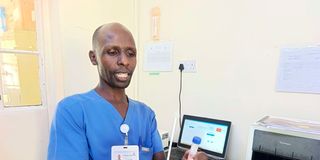
Geoffrey Langat, a laboratory technician, showcases a brush and tube used to collect cervical cancer screening samples. An eligible woman uses the equipment to self-collect samples during screening.
The programme, dubbed ‘Boda Girls’, has since trained over 40 riders. Each is assigned a monthly target and earns Sh100 per trip. The rides are free for women seeking antenatal and postnatal care, family planning services, or cervical cancer screening.
But transport is only half the job. The riders are also trained to create awareness—going door to door, attending chamas, speaking at church gatherings—to generate demand for screening services that many women do not know exist.
"Whenever I meet eligible clients, I ask if they know anything about cervical cancer screening, then strike up a conversation," says Josephine. "Most women are kind enough to invite me to speak to their groups. The fact that I also promise to get them to the hospital and back free of charge is a blessing to villagers from humble backgrounds."
As of December 2025, Josephine had personally facilitated the screening of over 40 women. The thank-you messages she receives from clients, she says, are what keep her going.
"It feels so good whenever a woman walks up to me on a random day to thank me for ensuring she got to the facility safely," she says. "But my best experience is having a woman screened for cervical cancer."
A silent epidemic
The numbers are staggering.
The World Health Organization estimates that cervical cancer is the fourth most common cancer in women globally, with 660,000 new cases reported in 2022. Of the 350,000 deaths recorded that year, 94 per cent occurred in low- and middle-income countries. The highest rates of incidence and mortality are found in sub-Saharan Africa, Central America, and South-East Asia.
Kenya is no exception. According to the Global Cancer Observatory 2022 report, the country records 5,845 new cases and 3,591 deaths from cervical cancer each year. It is the second leading cause of cancer deaths among Kenyan women, after breast cancer.
That translates to 10 women dying every day from a disease that is preventable through vaccination and treatable when detected early.
Yet screening rates remain alarmingly low. The Kenya Demographic Health Survey reveals that only 16.8 per cent of women in the country have ever undergone cervical cancer screening.
A 2023 study published in the National Library of Medicine found that most patients in western Kenya were diagnosed only at advanced stages, after symptoms had already emerged. By then, survival rates had plummeted.
"In Kenya, we do not have routine screening as it happens in other countries," says Dr Diana Wangeci Njuguna, a lecturer at Dedan Kimathi University of Technology's School of Nursing. "What we have is opportunistic—screening of those who already have symptoms."
The result is a healthcare system that catches cancer too late, when treatment is expensive, painful, and often futile.
Fear, stigma, and the power of self-collection
Rosemary Agolla, 57, understands why women avoid screening. A resident of Ukwala in Siaya County and a church leader, she underwent her first cervical cancer screening at the age of 52 after attending a health talk at a hospital in Siaya. Her results came back negative. Doctors advised her to return for routine screening every year.
She never went back.
"I was not comfortable with the whole idea of screening, which involved the medic collecting the sample herself," says the elderly woman.
For five years, Ms Agolla stayed away. Then she met Patricia Atieno, one of the Boda Girls from her village, who explained something new: women could now collect their own
samples.
Intrigued, she invited Patricia to speak to her church's women-only group. What Patricia discovered during that session revealed the depth of fear and misinformation surrounding cervical cancer.
"I realised some of the women were scared of screening due to fear of what would happen if they tested positive," says Patricia. "I took my time explaining that when detected early, the virus can be treated before progressing to cancer."
Many women in the group revealed they did not know where to access screening services or how much they cost. Others were deeply uncomfortable with the idea of a health worker collecting samples from their bodies.
When Patricia explained that they could collect their own samples in private—and that the service was free, with transport provided—the mood shifted.
"The following morning, I was among the first clients taken to Matibabu Foundation health centre," says Ms Agolla.
At the facility, she received a health talk and was trained on self-collection. She then went into a private room where she collected her own sample, placed it in a sealed tube, and handed it to the laboratory. Within an hour, her results were ready.
"I am now more confident knowing my health status," she says.
But Ms Agolla also carries a heavier memory. A fellow church member had noticed foul vaginal discharge and, ashamed, began avoiding church functions. She eventually confided in a friend but remained reluctant to visit a health facility. When her condition deteriorated, she was rushed to Siaya County Referral Hospital. Months later, she died.
Inside the laboratory
Geoffrey Lang'at, laboratory technician at the facility, walks through the screening process with practised precision.
After a health talk, each patient receives a sample brush and tube with clear instructions. The collection is simple but requires care.
"While squatting, the client inserts the brush up to the cervix, turns it five times clockwise and anticlockwise, then places the brush in a tube, seals it, and presents it to the lab," he explains.
At the laboratory, Lang'at adds a reagent to the sample and loads it into an Ampfire machine—a device donated by the Rotary Club of Siaya that has transformed the facility's capacity.
"With the machine in place, the turnaround time for cervical cancer screening is one hour and 30 minutes," he says. "The machine offers specific and sensitive results while allowing women to collect their samples in private."
Before the machine arrived in March 2025, the facility received up to 20 samples per month. Now, on a good day, it processes 20 samples daily. Walk-in clients arrive from beyond Ugenya Sub-county, drawn by word of mouth and the promise of dignity in the screening process.
The only limitation is that the machine requires six samples per run to avoid wasting reagents.
Since March 2025, the health centre has screened 1,172 women. Of these, 236 tested positive for HPV. Seventy-eight were found to have high-risk strains that, if left untreated, could progress to cervical cancer.
"While screening is free, those found with the virus are advised to start treatment using the Social Health Authority," says Dr Ouma.
The bigger picture
Dr Diana believes initiatives like the Boda Girls programme offer a blueprint for bridging healthcare gaps in underserved communities. But she warns that isolated efforts are not enough.
"Distance to health facilities and unavailability of screening services play a role in late cervical cancer diagnosis," she says. "Initiatives targeting underserved women should be adapted to increase early detection and treatment."
She is also concerned about women who screen once but never return for follow-ups.
"Once the test is negative, some women fail to come back in three years or one year as advised, thinking they are safe," the medic says.
Beyond screening, Dr Diana points to the urgent need for HPV vaccination among children aged nine to 14 years. A 2025 Unicef survey revealed that only three out of 10 eligible girls in Kenya received the vaccine in 2023. Uptake remains low due to misconceptions—claims that the vaccine causes infertility or that it encourages underage sex.
"The vaccine is key to prevention. Rwanda has already included it in its vaccine schedule. We should follow suit," she says.
While lauding Kenya's policies on cervical cancer management, Dr Njuguna notes that implementation lags far behind.
"My recent research on HPV vaccine rollout in 11 African countries, including Kenya, revealed that most countries had outdated policies while implementation was close to zero," she says.
This month, she and the Rotary Club of Nairobi, Thika Road, will offer HPV DNA testing for women in Nairobi and its environs at a subsidised rate to improve uptake.
"Cervical cancer awareness should be prioritised just like other diseases, not only in the awareness month of January," she says. "We also need to introduce routine screening in our health centres so that any eligible woman walking into a facility can access the service."
Full circle
Back in Ugenya, the afternoon sun beats down on the dusty road. Josephine secures her helmet and kicks her pink motorcycle to life. There is a woman in the next village who has agreed to come for the screening. Another life, perhaps, that will not end the way her mother's did.
"We can save more women through early screening," says Josephine, her voice steady now. "It is time women took charge of their health by knowing their cervical cancer status."
She accelerates into the dust, a blur of pink against the brown earth—carrying grief, carrying hope, carrying the weight of a promise she intends to keep.