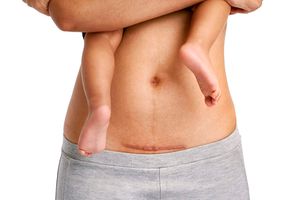
My body, my birth: Why more Kenyan women are choosing elective C-Section births
Beyond medical emergencies, a new generation is choosing elective C-sections to reclaim control over pain, timing, and their bodies.

What you need to know:
- In Kenya, C-section rates have risen dramatically.
- According to the Kenya National Bureau of Statistics, the national rate climbed from nine per cent in 2014 to 18.3 per cent in 2024, far exceeding the World Health Organization’s recommended threshold of 10 to 15 per cent.
- This represents a doubling of surgical deliveries in one decade.
There was no emergency. No complication. No medical reason at all. Yet Sarah Wanjiru, weeks pregnant with her first child, had made up her mind: she would have a Caesarean section (C-section). When she shared her decision with close friends and family, the questions came swiftly. What was wrong? Was the baby in danger? When she explained that nothing was wrong, that she had simply chosen it, the conversation would stop.
"People kept asking what was wrong. When I told them nothing was wrong, that I simply chose it, the conversation would just stop," she recalls.
Sarah, 38, is part of a quiet revolution reshaping childbirth in Kenya. Across hospitals and birthing centres, a growing number of women are requesting surgical delivery without any medical indication. No breech babies. No placenta complications. No previous surgical births. They are choosing major abdominal surgery over vaginal delivery, and their reasons are as varied as the women themselves.
Grace Mwangi, 34, is a project manager at a tech company. Her life runs on schedules and timelines. When she became pregnant with her daughter, now six months old, she knew her body and mind could not withstand the unpredictable nature of labour.

Dr Richard Mogeni, obstetrician and gynaecologist at Moi Teaching and Referall Hospital in Eldoret.
"I know it sounds clinical, but I wanted to know exactly when my baby would arrive," Grace explains. "I wanted my husband to arrange his paternity leave. I wanted my mother to travel from Nyeri at the right time. I wanted to schedule my work handover properly."
She had spent months researching birth outcomes, pelvic floor dysfunction, and long-term complications. She had read studies about urinary incontinence rates following vaginal delivery and learned about pelvic organ prolapse. The more she read, the more the surgical option appealed to her.
"My obstetrician kept emphasising that labour is 'natural,' but so is dying from infections we now prevent with antibiotics," Grace says. "Natural does not automatically mean better. I looked at the evidence and made an informed choice about my body."
Her mother disagreed. "She kept saying women in our family had been giving birth naturally for generations. But I am not living my grandmother's life in the village. I am living mine, in a time when I have options."
For Aisha Odhiambo, 29, the decision emerged from a darker place. At 16, she witnessed her older sister endure a traumatic vaginal delivery that resulted in a severe tear, haemorrhaging, and months of painful recovery. The experience left an indelible mark.
"I know it is not rational," Aisha admits. "I know most births do not go that way. But I could not shake the images from my head. Every time I thought about going through labour, I would have panic attacks."
When Aisha became pregnant with her son, she was upfront with her healthcare provider about her anxiety. After several therapy sessions and multiple conversations with her obstetrician, she requested an elective C-section.
"Some people told me I was being dramatic or that I should just get over it," she says. "But my mental health matters too. I needed to feel safe bringing my child into the world, and I did not feel safe imagining a vaginal birth."
Emotionally destroyed
The surgery gave her a sense of control that eased her anxiety throughout her pregnancy. "I am not saying it was easy. Recovery was hard, and I have a scar. But I do not have the trauma I feared. I got to meet my son in a way that did not leave me emotionally destroyed."

Pauline Oketch, a nurse at St Paul's Mission Hospital in Homa Bay.
Rebecca Kamau, 41, made a different calculation. Her first child was born vaginally after 26 hours of labour that she describes as the most gruelling experience of her life.
While both she and her daughter emerged healthy, Rebecca suffered significant tearing and spent months in physical therapy for pelvic floor dysfunction.
"I could not laugh without leaking urine," Rebecca says. "Sex was painful for almost a year. And everyone kept telling me that it's normal after childbirth, like I should just accept it."
When Rebecca became pregnant at 40 with her second child, she knew immediately she wanted a different experience. "I am older now. My recovery time is longer. I have a four-year-old who needs me. I could not afford to spend months rebuilding my pelvic floor again while chasing a toddler."
Her request for an elective C-section met resistance. "My new obstetrician kept suggesting I try a vaginal birth again, saying the second one is usually easier. But 'usually' is not good enough when you are the one taking the risk."
Rebecca eventually found a provider who respected her choice. Her surgery was scheduled, her recovery planned with help in place, and her son was born without complications.
"I knew what I was signing up for this time."
These four women represent a fraction of the thousands considering planned C-sections in Kenya.
The procedure can be either elective or emergency. An elective C-section is a planned surgical delivery scheduled in advance, often without an immediate medical emergency. An emergency operation is performed urgently when unforeseen complications threaten the life or health of the mother or baby.
In Kenya, C-section rates have risen dramatically. According to the Kenya National Bureau of Statistics, the national rate climbed from nine per cent in 2014 to 18.3 per cent in 2024, far exceeding the World Health Organization’s recommended threshold of 10 to 15 per cent. This represents a doubling of surgical deliveries in one decade.
Out of 1.2 million hospital deliveries in Kenya in 2024, over 220,500 were through C-section, compared with about 219,100 a year earlier.
The disparities are stark. Among the wealthy, the rate has soared to 33 per cent, compared to just five per cent among the poorest. In Nairobi, it stands at 28 per cent, while Kirinyaga reports rates as high as 40 per cent. Rural counties like Wajir and Mandera report rates as low as two to four per cent.
New WHO research shows surgical delivery continues to rise globally, now accounting for more than one in five (21 per cent) of all childbirths. This is set to increase, with nearly a third (29 per cent) of all births likely to occur by C-section by 2030.
Dr Richard Mogeni, a consultant obstetrician-gynaecologist at Moi Teaching and Referral Hospital (MTRH) in Eldoret, has been at the frontline of this evolving landscape.
"You may have watched the news some time back about a woman delivering on the floor," Dr Mogeni begins. "Everyone was mad, but personally, I was not mad because I know we have let down the women in this country."
In developed countries, he explains, there is painless labour. "Women deliver in a bathtub. They can be on WhatsApp, talking while labouring and walking around. In our setup, labour is the most painful experience a woman can go through. It becomes traumatic."
The absence of widely available pain relief during labour — specifically epidurals, which require trained anaesthetists Kenya lacks in sufficient numbers — means women face hours of unmanaged pain.
"Some women tell me, 'I cannot go through what I went through before,'" Dr Mogeni says. "Fear of pain is primary."
MTRH delivers approximately 10,000 women annually and performs around 250 surgical deliveries monthly, both emergency and planned. Planned procedures contribute about one-third of these, representing roughly eight to 10 per cent of all deliveries.
Over five years, Dr Mogeni has watched C-section rates at the facility climb from around 15 per cent to approximately 25 per cent.
He encounters varied requests. "We have heard: 'My father died on this date and this baby is predicted to be a boy — I want him born on this particular date.' Or 'I want my children's birthdays aligned.'"
Socio-economic factors play a significant role. "If you are a CEO somewhere, you have this fear about being vulnerable in a public ward," Dr Mogeni explains. The privacy and predictability of a scheduled surgical birth appeal to women accustomed to control.
Previous trauma is also a serious factor. "Women come and say, 'I cannot go through that again.'"
Some see it as practical family planning. "Women who have achieved their desired family size say, 'I want a C-section and then tubal ligation.'"
Concurrent conditions
Others have concurrent conditions. "They have another condition that can be operated on, like a huge cyst, and the doctor chooses to do both procedures simultaneously."
When a woman without a medical indication requests a C-section, Dr Mogeni faces a complex ethical dilemma.
"Ethically, doctors should not perform a procedure that is not medically necessary. But we must balance patient autonomy against the risks."
The bureaucratic reality complicates matters. "You cannot write 'C-section on maternal request' in medical records. Even insurance cannot accept that."
This forces doctors to document alternative justifications for a procedure driven by patient choice. "Medical practice requires documenting the reason for intervention, the risks, the alternatives, and the benefits."
The result is extensive counselling. "A responsible doctor cannot easily agree without allowing the woman to undergo counselling, sometimes one or two sessions, before the final decision."
Some women remain adamant. "Eventually, we might yield because the delivery has to happen," Dr Mogeni admits. "You know you do not have an alternative for painless labour. And she has insisted."
He emphasises another crucial factor. "Four things are required for normal delivery: the baby must be aligned correctly, there must be adequate contractions, the passage must be adequate, and there must be a psyche."
That last element — psyche, or mental readiness — cannot be manufactured. "If a woman does not have the psyche to deliver normally, the moment she experiences the first pains, she will say, 'No, I cannot.' Once she has said that, what else can you do? Normal delivery requires cooperation."
When doctors proceed with a maternal request, documentation becomes crucial. "You clearly indicate that this is a C-section on maternal request. You enumerate the woman's reasons. You declare your ethical conflict in advance. And you have her sign."
Contrary to popular assumption, Dr Mogeni argues that surgical delivery may carry more legal risk than vaginal birth. "Truly, there is litigation pressure. But through experience, I think the procedure puts you at more risk regarding litigation."
A woman who delivers vaginally typically goes home the next day with minimal follow-up. "Our interaction is minimal. I will see her maybe two weeks later."
Surgical delivery requires extensive monitoring. "I have to monitor her in the ward. She will call about anything strange she feels. Two weeks later, she still has pain. Six weeks is when pain subsides."
The surgical risks are numerous. "There is a risk of infection and significant bleeding. Normal delivery averages 300ml blood loss, but a C-section ranges from 500 to 1,000ml."
Complications extend beyond the immediate post-operative period. "Healing is not straightforward. They can develop adhesions where the intestines, bladder, and uterus attach.
Those with keloid scarring develop large swellings on the incision. Others develop hernias."
"Sometimes due to pressure, the doctor might forget or lose something inside the abdomen, or injure organs like the bladder or intestines. There are actually more legal risks with the operation."
However, for maternal requests, the calculation shifts. "The major risk is failure. If a mother wants a C-section and you insist on a normal delivery and fail, she will be dissatisfied. If you insist on vaginal delivery and the baby becomes tired or ends up in the nursery, blame shifts from patient factors to provider factors."
Despite rising rates, MTRH is not surrendering to the trend. Dr Mogeni describes the hospital's Trial of Labour After Caesarean Section (Tolac) protocol.
"We have developed a protocol for delivering those who have had one C-section before with no contraindication - a specific situation in which a medicine, procedure, or surgery should not be used because it may be harmful to the person. Worldwide success is 70 per cent. In our setup, we are hitting over 60 per cent."
Looking ahead, Dr Mogeni outlines critical areas that need attention.
"We need to discourage unethical practices fuelled by misinformation — now with social media, where people share lived experiences and become influencers. Education is very important so people get correct information."
On birth preparedness, doctors should discuss "which way you want to deliver, where you want to deliver, what options you have, and what your fears and concerns are."
"The only groups where we can prevent these surgeries are those requesting without medical indication and first-time mothers," Dr Mogeni explains. "As a consultant obstetrician, whenever I encounter a first-time mother, I must try to induce labour. If she fails, then we proceed surgically."
At St Paul's Mission Hospital in Homa Bay, Pauline Oketch has spent years in maternity care. As a frontline nurse, she offers a perspective from beyond urban centres.
"Vaginal deliveries are still more common. What has changed is awareness — people outside the medical field are now learning about procedures that have always existed. The perception that elective C-sections have overtaken vaginal births is not accurate," says Ms Oketch.
Her hospital's numbers differ from those of urban centres. Out of approximately 40 women who deliver monthly at the facility, around seven to 10 undergo the procedure.
Requests do come. "Most women cite fear of pain. Many are influenced by stories from other mothers and frightening experiences they hear about," she explains. "There may also be gaps in education during antenatal clinics. However, fear of labour alone is not an indication for elective surgical delivery."
Legitimate medical reasons she encounters include malpresentation such as breech; previous C-section where mothers with uterine scars face rupture risk; and underlying conditions like high blood pressure or heart disease.
"Most come prepared for labour," Ms Oketch notes. "Only a few are scheduled for surgery, mostly mothers with previous scars."
Even women with a previous surgical birth often hope to labour. "Some still come hoping to labour because they feel recovery takes longer after surgery. However, once assessed, we may determine that labour is unsafe and recommend an elective C-section."
In her years of practice, Ms Oketch has encountered only one case performed without clear medical justification. "The mother had complications after her previous delivery and was very fearful. She requested an earlier delivery and convinced the doctor to proceed."
"Women need more information about labour — its process and benefits. Labour pain can help create a strong bond between mother and baby. With better education and reassurance, women may feel more confident about vaginal delivery instead of fearing it."