My Ebola experience in Liberia, and why Kenyans should not be afraid
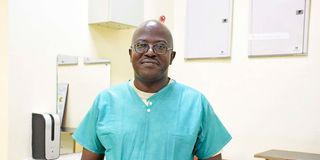
Andrew Wasike, a senior critical care nurse who also handles infection control and prevention training at Kenyatta National Hospita, during the interview on June 24,2026.

What you need to know:
- Andrew, now a senior critical care nurse who also handles infection control and prevention training at Kenyatta National Hospital, was not fazed by the prospect of travelling to Liberia.
- His only worries were that he did not have a valid passport at the time, and his wife was expecting their daughter.
It all started with a call from an official at the International Organisation for Migration, a call that remained speculative for Andrew Wasike, who had just been told that his services were needed to help a West African country tackle an Ebola outbreak.
Andrew, now a senior critical care nurse who also handles infection control and prevention training at Kenyatta National Hospital, was not fazed by the prospect of travelling to Liberia. His only worries were that he did not have a valid passport at the time, and his wife was expecting their daughter.
The caller did not give him assurance that he would be part of the delegation. It was more like a suggestion. But it became clear that he was needed when he received a call from Kenya's Ministry of Health.
Between that call and their departure, they had only four days to prepare.
The year was 2015.
At that time, Liberia was deep into an Ebola outbreak first reported in Lofa County in March 2014 after a Liberian woman who had travelled from Guinea tested positive. There was also an active outbreak in Guinea and Sierra Leone.
Liberia was still recovering from a civil war that had ended in 2003, which had decimated its infrastructure, including the health system. At that time, the country had only about 50 doctors serving a population of 4.3 million people. It was a crisis that demanded a unifying Pan-African approach.
On September 8, 2014, an Emergency Meeting of the African Union Executive Council authorised the deployment of the African Union Support to the Ebola Outbreak in West Africa. The World Health Organization had already declared the outbreak a public health emergency of international concern.
A UN official, Sarah Crowe, who worked for the United Nations Children's Agency, equated the spread of Ebola in Liberia at that time to wildfire.
Andrew was among the 170 healthcare workers deployed to Liberia and Sierra Leone.
The four days of preparation involved a series of medical tests, obtaining travel documents, eligibility checks through license authentication, and signing contracts.
On the day they were to travel to Liberia via chartered plane, his daughter was born. He had only a few hours to see her before leaving.
"I had already signed up for the mission. In as much as my fatherly instincts wanted me to stay, I had to go and help the Liberians," he tells the Nation.
They arrived in Liberia on a Friday night.
This was not Andrew's first encounter with Ebola. The first time he came across Ebola patients was in 2001, when he was a young nurse working in the remote part of Mt Elgon in Bungoma County. Ugandan officials had notified the Ministry of Health that there were contact tracing cases from Kenyans who had travelled to Uganda's Ebola epicentre for a burial. He helped trace them to their homes and quarantine them. Thankfully, none tested positive.
Liberia was different.
Even though landing there was a relief for him, Andrew says it felt like entering another world.
"The heat there was too much. It was like Mombasa, but on steroids. The food we were used to was not there. We mostly had seafood," he says.
"We found a country on lockdown. It was my first time seeing any country on lockdown. Their health infrastructure at that time was not that good. They did not adhere to prevention and control measures. We had a lot of work to do," he recalls.
On their first Sunday in Liberia, all the healthcare workers, regardless of their religion, were taken to a Catholic church in Monrovia.
At the altar, there were photos of more than 40 healthcare workers who had died as a result of Ebola.
Seeing those photos was a subtle but powerful training: adhere to all safety protocols, or you might not come out of this mission alive.
"That sunk in," he says.
"We were told that should anyone lose their lives, their bodies would not be flown to Kenya. They would be buried in Liberia," he shares.
The medics operated in a bubble, mostly moving together with protection from the police and military.
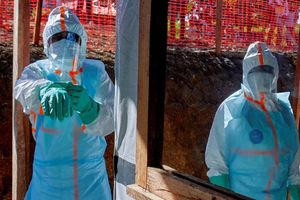
In their first two weeks in Liberia, they underwent rigorous training on infection prevention and control measures conducted by the World Health Organization and officials from Liberia's Health ministry. They started with cold cases (training with simulations rather than actual patients) before progressing to the real work, where they trained with confirmed Ebola patients.
Andrew notes that most functional health facilities were mission hospitals. Most private hospitals in the country had completely shut down because they lacked the capacity to handle Ebola cases due to insufficient equipment and personal protective gear.
He was in charge of treating both Ebola patients and the non-infected. He also trained communities on prevention measures, helping to stop the spread of the disease.
Most clinics treating patients were in a deplorable state.
"You would find a medic with just a desk, sometimes with no drugs," he says.
At that time, most Liberians relied on traditional or alternative medicine, which put patients at greater risk because there was no use of protective equipment like gloves.
Caretakers for Ebola patients often ended up dying or spreading the disease.
"That's why most hospitals ran out of space because there were too many patients," he recalls.
In the six months they were there, they learnt a great deal about handling highly contagious diseases.
It was a Kenyan clinical officer who identified the last known Ebola case in Liberia. The patient was treated and after recovering, the country was declared Ebola-free.
Andrew draws parallels between the situation in Liberia then and what is happening in the Democratic Republic of Congo now. He says the same apprehension that Kenyans are feeling today was also present in 2014.
The only difference is that the current outbreak involves a different strain of the Ebola virus. He believes Kenya is well prepared to handle Ebola, thanks to the training they received in West Africa.
Since their deployment to Liberia, the health workers formed a caucus that responds to such emergencies. That is why Andrew is not worried about Kenya recording Ebola cases.
"We are well trained. We have been training other healthcare workers from around the country should we get an outbreak," he says.
He admits feeling disappointed when people protest over an Ebola centre being set up in Laikipia.
"Ebola is not just a health issue, it is also a security issue. If you want to protest about Ebola, take time and read about it," says Andrew.
"We just need to play by the book and ensure safety. I have never been scared of Ebola. Care should not be equated to fear," he adds.
He explains that as long as safety protocols are followed, no one should be worried because trained professionals will take care of everything to contain the disease.
Safety, Andrew says, includes timely health communication, a skilled workforce, proper equipment, and a high level of professionalism.
"I think Covid-19 was worse than Ebola," he says.
So far, at Kenyatta National Hospital where he works, they have received suspected cases, quarantined them, but none have tested positive for Ebola. The isolation unit there has about eight bed spaces, which Andrew says will likely hold the most severe cases.