Nick Wambugu, known for documentary 'The People Shall', battles rare blood disorder
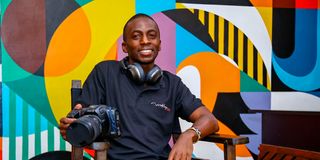
Nick Wambugu, an award-winning filmmaker, creative visionary and storyteller, during an interview.

What you need to know:
- 2025 brought acclaim for Nick Wambugu's documentary, recognition as one of the ‘Business Daily’s’ Top 40 under 40, and an arrest over claims linking him to the BBC expose ‘Blood Parliament’, which both he and the broadcaster deny.
As the year draws to a close, few would look back on 2025 and call it an ordinary year for filmmaker and storyteller Nicholas Nick Wambugu. A lot has happened. The year brought acclaim for his ‘People Shall’ documentary, recognition as one of the ‘Business Daily’s’ Top 40 under 40, and an arrest over claims linking him to the BBC expose ‘Blood Parliament’, which both he and the broadcaster deny.
It also ends with a diagnosis that has reshaped everything- hypocellular MDS.
According to Dr Rohini Radia, a haematologist, MDS stands for Myelodysplasia. “Myelo is blood cells, and dysplasia is where they are disorganised. The common type of Myelodysplasia is hypocellular, where there are a lot of cells, but essentially, the bone marrow has become non-functional. It is disorganised and produces too few blood-forming cells.”
“Myelodysplasia is commonly a disease of much older patients,” she says. “There are no obvious known causes. Hypocellular myelodysplasia is rare, and it accounts for about 10 per cent of patients with myelodysplasia. For hypocellular myelodysplasia, the important thing is to distinguish it from aplastic anaemia, which is also present in younger patients. Aplastic anaemia is where the bone marrow is also empty and non-functional, but it's not associated with a pre-leukemic phase, and the treatment is different. So, the treatment for aplastic anaemia is immune suppression or a bone marrow transplant. But with hypocellular myelodysplasia, you tend to treat it with a bone marrow transplant or chemotherapy if the patient is not fit enough,” she offers.
It began quietly. The 34-year-old storyteller started feeling unusually tired. He did not immediately read the fatigue as sickness.
“That was around October. The ‘People Shall’ documentary was premiering at the NBO film festival. At the time, I was high on adrenaline and working long hours. I told myself, we work hard right now and rest after the festival,” he offers.
There was also a persistent whooshing sound. One that he remembers too well, but his film, one that depicts the 2024 anti-finance bill protest, was his priority. So, this too he ignored.
“When the festival ended, I decided to rest at my sister’s place,” he says.
We meet there weeks later. Nick sits across from this reporter, the conversation repeatedly punctuated by coughs. We slow the interview, waiting each time for him to recover.
“I was resting but feeling even more fatigued, and the whooshing sounds. It was then that my sister suggested that I see a doctor. The specialist said my condition was serious and required urgent admission to the high dependency unit for close monitoring. I was admitted for five days. On the fourth day, they did a bone marrow biopsy. Three weeks later, I learned that I had hypocellular MDS. I had never heard of it before,” he says.
In his telling, the doctors did not point to a specific cause but suggested it could be genetic, possibly triggered by other factors.
“The condition impacts all three main blood cells,” Dr Rohini says. “Low red cells cause fatigue, low white cells increase infection risk—including neutropenic sepsis—and low platelets make you prone to bleeding easily.
For the filmmaker, it all came down to this: staying away from others. His work, his stories, and his career—all of it is temporarily on pause.
Blood Parliament arrests
Nick was among four filmmakers roughed up by police at their Karen studio on May 2, linking them to the BBC documentary. The documentary alleged that the Kenya Defence Forces and the National Police Service were involved in some of the killings during the Gen-Z-led protests of June 25, 2024. The case is still a matter in court.
“I tell stories of the mavericks, the misfits, the people who never get the spotlight but form the backbone of who we are. I cannot do that now, and it feels weird being on this other side, where I am being interviewed and talking about a condition I knew nothing about a few months ago. Besides the shock and the stress that came with the arrest, I have enjoyed great health in the recent past,” he remarks.
Now, the condition demands at least Sh100,000 every week from his pocket to manage it. “It is an expensive affair. I miss the camera, I miss the long nights edits, but the one thing that’s on my mind right now is, ‘how do I raise the Sh9 million for the transplant?’
According to Dr Rohini, the treatment depends on how severe the low blood counts are and the risk of developing or progressing to acute leukaemia from myelodysplasia.
Ultimately, the only curative option is a bone marrow transplant. As there are no known certain triggers, it's not considered preventable.
“For patients with hypocellular myelodysplasia who have very low blood counts, there is an urgent need for bone marrow transplant because of the risk of having a number of blood transfusions, and the risk of life-threatening bleeding as they have low platelets.”
Friends, colleagues, and well-wishers have raised Sh3 million to support his treatment. “The worry is that whatever resources we raise go into the management of the condition, and that’s why I urgently need a bone marrow transplant. The longer I stay here, besides the cost, I risk contracting other diseases as I am now vulnerable to opportunistic infections,” Nick offers.
People can channel support through: https://www.istandwithnick.com/