Covering protests in Kenya in 2025 was not just another professional assignment for me as a journalist; it was a defining experience that tested my convictions, safety, and my understanding of the country I report on every day.
It was a year in which the streets became newsrooms, tear gas replaced notepads, and the line between observer and participant often felt dangerously thin.
Kenya is no stranger to public demonstrations, but 2025 felt different. The protests were angrier, more sustained, and deeply personal for many Kenyans. They were no longer just about policy disagreements; they were about life, death, dignity, and the perceived collapse of accountability. Moving from one protest to another, it became clear that this was not a passing moment but a defining chapter in the country’s civic history.
The year began in the shadow of the Finance Bill 2024 protests, which had spilled into early 2025. Those demonstrations were huge by any measure. They paralysed Nairobi, drew thousands of young people to the streets, and forced Parliament into tense debates under public pressure.
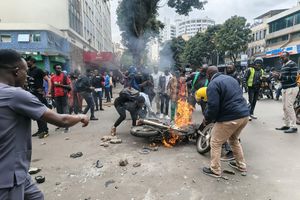
One of the stones that attackers pelted at an NTV vehicle at Northlands City, Eastern Bypass on March 27, 2023.
Photo credit: Dennis Onsongo | Nation Media Group
As a reporter, long days were spent navigating police barricades in the Central Business District, filing updates amid clouds of tear gas, and chasing reactions from lawmakers as the nation watched.
At the time, it felt like the peak of public outrage. The crowds were vast, the slogans sharp, and the anger unmistakable. But as the year unfolded, it became clear that those protests, as significant as they were, would be eclipsed.
The outrage was immediate and visceral. This was no longer about taxes or legislation; it was about a life lost in the custody of the State and the State’s indifference to such cases before.
The protests that followed Ojwang’s death dwarfed the spilled protests from 2024. They were larger, more spontaneous, and far more emotionally charged. Thousands poured into the streets not just in Nairobi, but in towns and cities across the country. What struck me most was the unity—students, workers, parents, and even elderly citizens marched together, chanting against police brutality and demanding justice.
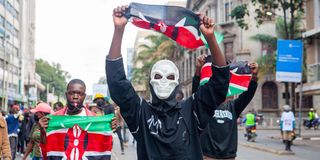
Protesters picketing along Kimathi Street in Nairobi during the commemoration of the Gen-Z protests on June 2, 2025.
Photo credit: Billy Ogada | Nation Media Group
For the first time in Kenya, police stations, previously feared, were targets of angry protesters. It is in these stations where, as my covering has established, 26 people have so far died from December 2024 to December 2025.
Covering those protests was unlike anything I had experienced. The mood was raw. People were not merely protesting; they were mourning and raging simultaneously. At one demonstration near a police station, I watched protesters kneel on the tarmac, hands raised, chanting the name Ojwang'. Moments later, police advanced, firing tear gas. The contrast was brutal.
For journalists, the risks multiplied. During Ojwang’s protests, hostility toward the media intensified, particularly from security officers. Several colleagues were assaulted or had their equipment damaged. I was once cornered by officers who accused me of filming “sensitive operations,” despite clearly identifying myself as press. It took intervention from senior officers for me to leave without being detained.
At some point, the entry of goons for hire into protests was evident. Young men, in their early 20s, paid to infiltrate rather peaceful protests not only disrupted the protests, but wreaked havoc- often robbing, stealing, injuring, and maiming protestors. All in the full glare of police officers.
The robbing, clobbering, and stealing happened to me in March 2023 when covering the looting of former President Uhuru Kenyatta’s family's farm at Northlands , Ruiru, Kiambu County. My phone was taken by force, my clothes torn, and my head hit by the butt of a machete as I was kicked and punched by tens of drug-filled youth, all in the presence of police officers barely 20 metres away, on the other side of the road.
In 2025, Kenya’s civic space during protests was marked by escalating clashes between demonstrators and state security forces, with independent investigations revealing a troubling pattern of excessive force by police. A report by the Independent Medico-Legal Unit’s (IMLU) findings, most of the 97 documented extrajudicial killings involved victims shot in the back while fleeing, underscoring a failure by law enforcement to adhere to legal and human rights norms even as citizens exercised their constitutional rights to assembly and expression.
University of Nairobi students hold protests in Nairobi’s central business district on September 2,2024 against the university funding model.
Photo credit: Evans Habil | Nation
These protest waves — including mass demonstrations on Saba Saba Day and anniversaries of earlier uprisings — saw police deploying live ammunition, tear gas and water cannons, resulting in dozens of deaths, hundreds of injuries and widespread arbitrary arrests. Civil society groups and rights bodies have repeatedly raised alarms about a shrinking civic space, citing not only lethal crowd control but also obstacles to monitoring, intimidation of activists and journalists, and the use of anti-terror laws against peaceful dissent.
Drawing from medico-legal documentation, forensic investigations, survivor testimonies, and nationwide monitoring, IMLU verified 97 extrajudicial executions, 18 deaths in custody, 72 cases of torture or ill-treatment, 49 protest-related injuries, more than 1,500 arbitrary arrests, and five enforced disappearances.
In its annual report titled “The State of Human Rights in Kenya”, the Kenya National Commission on Human Rights showed that Kenyans continue to endure a disturbing wave of abuses; many perpetrated by those meant to protect them.
In its latest review covering December 2024 to December 2025, the Commission reports receiving and processing 2,848 allegations of human rights violations, with adults aged 35–59 lodging a majority of the complaints at 1,297. This was followed closely by 1,210 cases filed by youth aged 18–34, an unsurprising reflection of a generation pushed to the edge, while 257 complaints came from older Kenyans.
“We (KNCHR) documented 57 killings between December 2024 and December 2025, many occurring during the peak of youth-led protests in June and July. All these cases were extrajudicial killings executed by state security personnel,” Ms Ogangah said.
“These are not mere statistics, but human lives cut short, often by those sworn to protect them. We have also noted that security officers have themselves died in the line of duty," the KNCHR boss said.
Participants during the Shujaaz Memorial concert held on July 7, 2024 at Uhuru Park in Nairobi.
Photo credit: Billy Ogada | Nation Media Group
Every protest assignment required constant calculation. Where do you stand to get the story without becoming the story? How do you document violence without escalating it? In 2025, those questions were not abstract. They were matters of personal safety.
The Gen Z presence remained strong throughout the year, but after Ojwang’s death, the protests broadened beyond youth activism. Many of the people I interviewed were not seasoned demonstrators. Some had never protested before. “I stayed quiet for too long,” one middle-aged woman told me during a march in Nairobi. “But this could have been my son.”
That sentiment echoed everywhere. The protests became deeply personal, fuelled by fear that anyone could be next.
Reporting on them meant listening more than speaking, observing more than questioning. Often, the most powerful moments were unscripted—mothers crying, strangers embracing, protesters shielding journalists from advancing police.
There were also darker moments. I covered scenes where protesters were beaten, arrested, or shot at close range. I spoke to families waiting outside police stations, unsure whether their loved ones were alive or injured. Filing those stories late at night, I often struggled to sleep, replaying scenes I could not unsee.
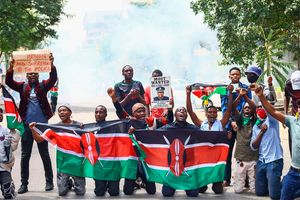
Protesters picket along Kenyatta Avenue in Nairobi on June 25, 2025.
Photo credit: Billy Ogada | Nation Media Group
The pressure did not only come from the streets. Politicians demanded narratives that suited them. Security agencies accused the media of exaggeration. Online, journalists were attacked relentlessly, accused of bias or betrayal. Yet the work had to continue. The public needed an accurate record of what was unfolding.
What became clear to me is that the Ojwang’s protests marked a psychological shift. Kenyans were no longer reacting to policy; they were confronting the power of the State itself. The fear that once kept many indoors had cracked. Even as arrests and deaths mounted, people returned to the streets, day after day.
By the end of 2025, the protests had reshaped public discourse. Courts were petitioned, oversight bodies were pressured, and police conduct was scrutinised more closely than at any time I can remember. Whether justice will ultimately be served remains uncertain, but something fundamental had changed.
For me, covering the protests reaffirmed why journalism matters most in moments of crisis. It is not about choosing sides; it is about bearing witness. It is about standing where power collides with the people and recording the truth, even when it is uncomfortable or dangerous.
Looking back, the Finance Bill 2024 protests were a warning shot. The killing of Ojwang’ in June 2025 was the explosion that followed. Together, they defined a year when Kenyans took to the streets not just to be heard, but to be seen, counted, and remembered.
As a journalist, I leave 2025 with pride, fatigue, and a deep sense of responsibility. Pride in the stories told, fatigue from the cost of telling them, and responsibility to continue documenting a country still struggling to reconcile power with accountability.
The streets taught me many things, but above all, they reminded me that truth is often born in chaos—and someone must be there to record it.