Nine years, three tumours, two transplants: One family's fight against a cancer that keeps returning
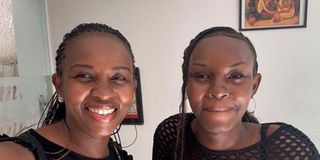
Lakita Frida Abongo (right), who is battling osteosarcoma, with her mother Joyce Mwangi.

What you need to know:
- Lakita Abongo is Kenya's only confirmed case of Li-Fraumeni syndrome – a rare, inherited condition that makes carriers prone to multiple cancers.
When Lakita Frida Abongo wheeled herself towards the graduation podium at Crawford International School this June, the atmosphere shifted from formal celebration to pure awe. The entire room rose to its feet in a thunderous standing ovation.
Bound to a wheelchair, having flown straight from a hospital bed in India, the 19-year-old was receiving her Year 13 diploma alongside her peers. It was a milestone hard-won through nearly a decade of fighting a form of bone cancer. Her battle began in September 2017.
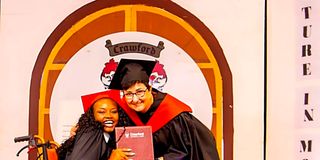
Lakita Frida Abongo, a student at Crawford International School, with Executive Principal Amanda Birkenstock, during the June 2026 Year 13 graduation, at the school's Tatu City Campus.
Then aged 10, Lakita started complaining of pain around her knee after playing sports, the kind of pain a parent might dismiss as the result of too much running, an awkward landing, or growing pains. Her family assumed it was nothing more than that.
But the pain did not ease; it grew worse and more persistent. Her mother, Joyce Mwangi, eventually took her for a scan, which revealed what looked like a tumour. Seeking answers, the family travelled to India, where doctors diagnosed her with osteosarcoma, a cancer that forms in the bone. She immediately began chemotherapy, followed by surgery to remove and replace the affected knee and bone. For a while, it seemed the worst might be behind them.
Also read: Toothache that became a tumour: Woman's 15-year medical nightmare that ended in landmark surgery
It was not. Doctors later found a second, separate tumour on Lakita's thigh, unconnected to the original cancer in her knee. Faced with its spread, they decided to amputate the leg. More chemotherapy followed, but this round came at a cost: she developed myelodysplastic syndrome, a bone marrow disorder her mother describes as a kind of pre-leukaemia. The condition attacked her ability to produce blood cells, particularly platelets, leaving her body dangerously depleted and unable to clot or fight infection effectively.
"The only way forward was a stem cell transplant," says Joyce. The first attempt used an autologous transplant, where doctors used Lakita's own cells, conditioned and reintroduced into her body. It failed. They tried again, and this time Joyce donated her own bone marrow cells for the second transplant. This one worked. "From 2022 through the start of this year, my daughter was well."
During those four years, the family exhaled. Lakita returned to her normal life and attended classes without the shadow of hospital visits hanging over her. That reprieve ended this year when she began complaining of shoulder pain. Once again, the family attributed it to prolonged use of crutches. But a PET scan revealed a new tumour on her shoulder.
"Because she had already undergone a transplant, her body could not withstand another round of the aggressive chemotherapy that had treated her earlier cancers," Joyce explains. Doctors chose immunotherapy instead, but during her second cycle, Lakita suffered a severe reaction that forced them to halt the treatment altogether. She has since been switched to a different chemotherapy regimen, which she continues today.
The repeated recurrences were not, it turns out, simply bad luck. Lakita's father lost his life to colon cancer, and cancer has claimed most of his side of the family. When Joyce raised this family history with doctors in India, they ran additional tests. The results revealed that her daughter has Li-Fraumeni syndrome, a rare, inherited genetic condition passed down through her father's family that predisposes carriers to a wide range of cancers over their lifetime.
In Kenya, testing for Li-Fraumeni syndrome is unavailable, so samples must be sent abroad for confirmation. As far as Joyce is aware, her daughter is the only confirmed case in Kenya, though she believes there are likely many suspected cases that have never been formally tested or diagnosed.
Since her diagnosis, the family has connected with the Li-Fraumeni Syndrome Association through its Africa branch. Though the organisation is based in the United States, the Africa chapter functions primarily as a support network for families in the region, offering the kind of community Joyce and her daughter lacked when they first began navigating the diagnosis.
Asked how the family has coped, Joyce is candid: it has been tough, particularly financially. The burden has shifted over the years. During Lakita's stem cell transplants, the defunct National Hospital Insurance Fund, through its self-employed contribution category, covered a portion of the costs. But the family's most recent trip to India for follow-up checks was not covered. Abongo has since aged out of her previous registration and had to be re-enrolled as an adult, a bureaucratic gap that left the family to cover the trip themselves.
"Losing my husband to cancer, and now watching my daughter go through a version of the same fight, has taken its own toll that is incredibly difficult," Joyce says. "What has filled that gap is community: friends, family, strangers, and people at my daughter's school have all contributed to fundraising efforts that go towards chemotherapy costs and Lakita's broader care."
The family's relationship with Lakita's medical team in India is not one they can easily hand off to local doctors. Even though Lakita is monitored in Kenya with tests every three months, the family returns to India to see the doctors who carry her full history from the moment her treatment began in 2017. That trip is coming sooner than scheduled. Originally due in three months, the family now expects to travel back to India within the next month for Lakita's continued follow-up care.
Dr Nicholas Okumu, an orthopaedic oncologist at Kenyatta National Hospital (KNH), explains that osteosarcoma is the most common form of bone cancer, though it remains rare overall. Sarcomas account for less than one per cent of all cancer cases, compared to breast cancer, which represents nearly 20 per cent. However, in children, sarcomas make up to five per cent of cancer diagnoses.
"Osteosarcoma typically occurs during the teenage years and early twenties, between ages 11 and 20-plus," Dr Okumu explains. "This onset is tied to rapid growth phases: as cells divide quickly to build bone during adolescence, errors in cell division are more likely to occur, leading to cancer. In rare cases, genetic conditions like Li-Fraumeni syndrome, a gene mutation present from birth, predispose individuals to various cancers, including bone cancer, brain tumours, leukaemia, and breast cancer."
"Bone cancers commonly present around major joints such as the knee, hip, or shoulder," he adds. "Key symptoms include pain and localised swelling in the knees, hip joints, and shoulders; reduced mobility or difficulty walking; and pathologic fractures caused by weakened bones."
Detection heavily relies on provider awareness. Dr Okumu states that patients often present to primary healthcare facilities where clinicians mistake early symptoms for minor injuries, prescribing painkillers and rest instead of ordering X-rays. Even when X-rays are taken, non-specialists frequently fail to recognise the classic features of bone cancer.
"The problem is that many patients go to a health facility and mention these symptoms, but because the clinician lacks suspicion, they either just give painkillers and tell them to go home and rest," says Dr Okumu. "Sometimes they get an X-ray, but a lot of times the clinician does not recognise what they are seeing. What we would really love is for someone to do an X-ray, and for the person reading it to understand the features common in these cancers, so they can pick them up at an early stage. But again, for patients who actually get X-rays and are referred through the system from level two to three upwards, by the time they present to us in a specialised centre like KNH, there is a significant delay."
Consequently, research shows a typical delay of up to six months between a patient's initial visit to a health facility and their arrival at a specialised centre like KNH. These delays are compounded by inefficient referral pathways, progressing slowly through Level 3, 4, and 5 facilities, and unnecessary localised testing, such as delayed MRIs or improperly managed biopsies.
"In high-income countries, sarcomas are treated exclusively in specialised centres by multidisciplinary teams including orthopaedic oncologists, radiologists, and pathologists," says Dr Okumu. "This centralised model yields limb salvage rates above 90 per cent."
By contrast, delayed presentation in Kenya historically led to amputation in over 95 per cent of cases, with limb salvage rates below five per cent. However, since the establishment of a dedicated orthopaedic oncology unit at KNH, limb salvage rates have improved to roughly 30 per cent. Still, if the cancer spreads to other parts of the body, it becomes difficult to treat. Early detection and direct referral are therefore essential for both survival and limb preservation.
To address these challenges, specialised teams are implementing several key initiatives. These include rolling out a standardised training manual to help frontline workers recognise sarcoma symptoms early, and developing AI-integrated ultrasound technology to assist primary clinicians in detecting bone tumours at an earlier stage.
"We have a project where we want to use ultrasound machines fitted with an AI model that can help primary healthcare workers detect these tumours early," says Dr Okumu. "Hopefully, that will also support earlier referral. The last thing I've initiated is a discussion around working with community health promoters so that they can help not just sarcoma patients but all cancer patients navigate the referral pipeline, assist with travel and logistics, and follow up in local communities to prevent loss to follow-up."
"If we use community health workers effectively, they could be a valuable source of information for patients, especially those coming from far away to big hospitals like KNH," he adds. "They can also help us follow up with patients in the community, check on how they're doing, and make sure we don't lose them to follow-up."
Patients also receive specialised, integrated mental health care, including psychological counselling and end-of-life care, within the specialist team. Those who have undergone amputation can also benefit from advanced technologies to design comfortable, functional prosthetics for mobility.
[email protected]