No fresh Ebola cases recorded yet but Kenya faces 21-day test
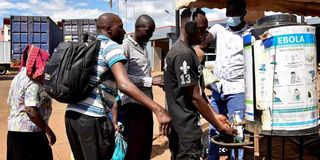
Travellers sanitize their hands before entering at the Kenya immigration services to access port health services at the Busia One Stop Border Post October 8, 2026.


Kenya has detected no secondary Ebola infections more than a week after an imported case died, but health experts say the country must complete a 21-day monitoring period before transmission can be ruled out.
The Ministry of Health says all 122 people identified as contacts of the patient have been listed and verified, with 108, or 88.5 per cent, in quarantine and undergoing daily monitoring. None has developed symptoms, according to Health Cabinet Secretary Aden Duale’s statement of October 11. The patient, a Kenyan who travelled from the Democratic Republic of Congo through Uganda, died on October 5 and was given a safe and dignified burial the following day.
Dr Ahmed Kalebi, an independent consultant pathologist and infectious disease researcher, says the absence of new cases is encouraging, although it is too early to declare the outbreak contained. “Each further symptom-free day gives us more reason to hope that secondary infection and local transmission have been avoided,” he said.
Contact tracing rose from 28 people on October 6 to 66 in quarantine by October 8. The ministry has tested 293 samples, with only the imported case positive, and screened 667,675 travellers at 26 entry points. Five laboratories, including two mobile facilities at Lwakhakha and Busia, can return results within six to 12 hours. The immediate concern is whether any of the exposed contacts will develop symptoms during the virus’s incubation period. Experts caution that remaining symptom-free today does not necessarily mean a person will not become ill later.
A model published in Emerging Infectious Diseases in 2026, drawing on the 2007 Bundibugyo virus outbreak in Uganda, estimates an average incubation period of about 7.8 days. Its calculations suggest that approximately 74 per cent of people who eventually develop the disease would show symptoms by day 10, rising to about 98 per cent by day 21.
Dr Kalebi said the first contacts were nine to 10 days past exposure, while health workers last exposed on October 5 were on day eight, against a historical average incubation period of 6.3 days for Bundibugyo virus, which does not predict when or whether contacts will develop symptoms.
“I’m cautiously optimistic that we may have ‘dodged the bullet’, although we cannot yet say that with certainty until all those in quarantine are cleared,” he said.
Prof Omu Anzala, a virologist and member of the National Task Force for Ebola, says every contact must complete 21 days of monitoring from their last relevant exposure and undergo a final assessment before clearance.
He estimates that monitoring would end around October 24 for passengers on the flight, counting from October 3, and October 26 for health workers whose last exposure was on October 5.
Prof Shem Otoi, an infectious disease modelling expert at Daystar University, says the greatest concern would be a new case that cannot be linked to the known patient, potentially signalling local transmission.
“I am not worried about one or two imported cases. My fear is local transmission,” he said. Kenya has also expanded its treatment and emergency response capacity. The ministry says 241 isolation beds are available across five hospitals in Nairobi, Eldoret and Mombasa, including up to 50 intensive care beds at Moi Teaching and Referral Hospital.
A total of 4,917 health workers have been trained, while 343 emergency responders are on standby, including 102 who served during the 2014–2016 West Africa outbreak.
On October 12, Kenya declared Ebola a formidable epidemic disease and gazetted the Public Health Ebola Rules 2026. The Public Health Act empowers the Health Cabinet Secretary to make rules governing contact tracing, observation camps, movement in infected areas and access to premises, with prosecution possible for deliberate violations.
The ministry says travel, trade, transport and public gatherings remain unrestricted, with airports, seaports and border crossings operating normally under enhanced screening.
Ebola is not airborne; transmission occurs through direct contact with the blood or body fluids of an infected person who is sick or has died. The ministry has urged the public to avoid rumours, seek medical attention promptly if symptoms develop and call the toll-free number 719 for guidance.
Prof Anzala warns that preparedness must continue beyond the immediate threat. “Once you start managing by crisis it becomes very expensive,” he said.
Follow our WhatsApp channel for breaking news updates and more stories like this.