No global treaty as plastic pollution talks collapse yet again
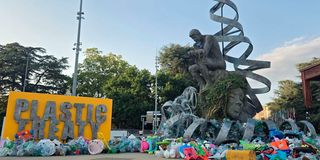
An art piece outside Palais des Nations in Geneva where the plastics treaty negotiations are taking place.


What you need to know:
- Geneva was poised to deliver the breakthrough that last year’s Intergovernmental Negotiating Committee, INC5.1, had failed to achieve
Amid tense corridors, last-minute wrangling, and even sessions that stretched late into the night, countries have walked away from the UN Palais des Nations in Geneva without a treaty to curb plastic pollution.
For 10 days, more than 2,600 participants gathered at the UN headquarters, including more than 1,400 representatives from 183 countries and hundreds of observers from various organisations.
Geneva was poised to deliver the breakthrough that last year’s Intergovernmental Negotiating Committee, INC5.1, had failed to achieve.
Plastics, in the many forms that they come in, have become ubiquitous in our lives. Think of the toys in your home, the beverages that come packed in plastic bottles or the straws, the list is endless. Over the years, the world has been choking in plastic pollution, with a UNEP “Drowning in Plastics – Marine Litter and Plastic Waste Vital Graphics” revealing that global plastic production amounts to about 400 tonnes each year. Most of it, the report shows, ends up in the marine environment, natural environment or landfills. Multiple studies reveal that there could be more plastic in the oceans than fish by 2050.
This context is important because it formed the basis for developing a global plastic treaty that would legally bind countries in the same way that countries are legally bound to fight against climate change. The United Nations initiated the process anchored on three objectives: reduce plastic production, enhance recycling efforts, and promote sustainable alternatives.
In 2022, the United Nations Environment Assembly (UNEA) agreed to adopt a legally binding global plastics treaty by the end of last year.
At INC5.1, there was a dreadlock. In Geneva, the committee chair’s text served as a starting point for the delegates. By Friday morning, there were clear signs of yet another collapse.
The biggest issue of the talks has been whether the treaty should impose caps on producing new plastic or focus instead on things such as better design, recycling and reuse.
Speaking during the plenary, Environment Cabinet Secretary Deborah Barasa called for a coherent global treaty, adding that Kenya was determined to end plastic pollution.
However, the 10-day talks were unable to reconcile divergent positions on whether to focus primarily on limiting plastic production or turning the focus to addressing waste management and recycling.
“Failing to reach the goal we set for ourselves may bring sadness, even frustration. Yet it should not lead to discouragement. On the contrary, it should spur us to regain our energy, renew our commitments, and unite our aspirations,” INC Chair Ambassador Luis Vayas Valdivieso told delegates. “It has not happened yet in Geneva, but I do not doubt that the day will come when the international community will unite its will and join hands to protect our environment and safeguard the health of our people.”
UNEP Executive Director Inger Andersen described the last 10 days as hard-fought “against the backdrop of geopolitical complexities, economic challenges, and multilateral strains.”
Karen Landmark, Managing Director of GRID-Arendal, a non-profit organisation that supports UNEP, said: “What is most disheartening is that we urgently need to solve this nature crisis, and when negotiations must be extended several times, it sends an unfortunate signal.”
Civil societies have also voiced their concerns regarding the failed agreements, after three years of negotiations.
“The vast majority of governments want a strong agreement, yet a handful of bad actors were allowed to use the process to drive such ambition into the ground. We cannot continue to do the same thing and expect a different result. The time for hesitation is over, ”said Graham Forbes, Greenpeace head of negotiations at the conference.
The African Group of Negotiators urged that commitments to ending plastic pollution be actionable, with clear obligations to provide stable finance that is accessible and predictable.
The meeting was adjourned on Friday morning with the committee saying that negotiations will be resumed at a future date, to be announced.