No new Ebola case among 108 quarantined contacts in Kenya
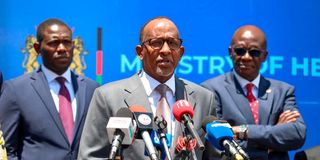
Cabinet Secretary for Health Aden Duale, accompanied by other government officials, addresses journalists during a press briefing at Afya House in Nairobi on October 6, 2026, after Kenya confirmed its first case of the Ebola virus.

The government has announced that 108 contacts of the Ebola case reported five days ago are in quarantine and being monitored closely, with none developing symptoms of the Bundibugyo virus disease.
In a statement on Sunday, Health Cabinet Secretary Aden Duale said no new case had been recorded beyond the single imported case involving a Kenyan who had travelled from the Democratic Republic of the Congo through Uganda. The patient tested positive, was isolated on October 5 and died the following day.
“All 122 contacts of the case have been listed and verified. 108 (88.5 per cent) are in quarantine and being monitored daily, and none have developed any symptoms thus far. Tracing of the remaining contacts is ongoing, in collaboration with international partners where necessary, while surveillance remains active around the clock,” Mr Duale said.
According to the CS, 293 samples were tested from 289 alerts, with only the confirmed case testing positive. He said Kenya had screened 667,675 travellers at 26 points of entry, including 2,345 in the past 24 hours.
“The Ministry notified the World Health Organisation within 24 hours, in line with the International Health Regulations (2005). The National Taskforce, the National Public Health Emergency Operations Centre and the National Incident Management System are active, and rapid response teams are on 24-hour standby,” he said.

Health CS Aden Duale at a past event. He has disclosed that the US Ebola preparedness funds were allocated directly to partners for surveillance, clinical preparedness, emergency operations and logistics, not through the Ministry of Health.
Mr Duale said five designated laboratories, including two mobile laboratories at the Lwakhaha and Busia border points, were testing samples. Samples can be referred from any county, with confirmed results available within six to 12 hours.
On county preparedness, the CS said 241 isolation beds were available in five hospitals in Nairobi, Eldoret and Mombasa. These include up to 50 intensive care beds at Moi Teaching and Referral Hospital.
He added that 4,917 health workers had been trained in Ebola management, while a surge team of 343 trained responders was on standby. The team includes 102 responders who served during the 2014–2016 West Africa Ebola outbreak.
The CS said there were no restrictions on travel, trade, transport or public gatherings, and no lockdown was in place.
“Airports, seaports and border points are operating normally, with enhanced health screening. Kenya continues to welcome visitors, investors and partners, and will keep the international community informed through regular, transparent updates,” he said.
Meanwhile, several urban centres in the Rift Valley region have been identified as potential hotspots in the event of a spike in Ebola infections in the country.
The centres, which serve as stopovers for truck drivers operating across East African countries, including the Democratic Republic of the Congo (DRC), Uganda, South Sudan and Rwanda, are bustling with activity, with authorities facing questions over their preparedness.
Experts warn that if screening at the Kenya-Uganda border falters, urban centres along the Northern Corridor risk becoming Ebola outbreak hotspots.
The centres, which serve as stopovers for long-distance truck drivers, include Mai Mahiu, Longonot, Naivasha, Gilgil, Kikopey, Pipeline, Salgaa, Molo, Londiani, Kedowa, Chepseon, Kericho, Narok, Bomet, Mulot, Suswa, Sotik, Kipsitet and Kapsoit. They are spread across Nakuru, Kericho, Bomet and Narok counties.

Public Health and Professional Standards Principal Secretary Mary Muthoni.
Timboroa, Eldoret and Kitale are among the urban centres in the North Rift region also being monitored.
Most of these centres lie along the busy Nairobi-Nakuru-Eldoret-Busia highway and the Nairo “Screening and surveillance must be heightened at the Kenya-Uganda border to contain the spread of the deadly disease. Urban centres along the Northern Corridor should also be closely monitored because they serve as stopovers for travellers, mainly truck drivers from Uganda and the Democratic Republic of the Congo,” said Dr Reuben Osiemo, a public health officer.
The Nairobi-Nakuru-Eldoret highway forms part of the Northern Corridor, a major transport route linking Kenya to western Kenya and landlocked countries, including Uganda, South Sudan, Rwanda and Burundi.
It also connects Kenya to the Democratic Republic of the Congo, which has been at the centre of the regional Ebola outbreak.
The road carries much of the westbound cargo originating from the Port of Mombasa and Nairobi.
“Nakuru has heightened surveillance and preparedness measures following the confirmation of the imported Ebola case in Kenya. Our surveillance systems are on high alert to detect and contain any suspected case,” said Mr Moses Obiero, the Nakuru County Public Health Emergency Operations Centre manager.
Dr Joseph Sitonik, the Bomet County executive committee member for health, and Dr Betty Langat, the Kericho County director of health services, separately said their respective county governments had put measures in place to respond to any emergencies.
Dr Sitonik and Dr Langat said isolation centres had been set aside and health workers trained to handle suspected cases and prevent further transmission.
Follow our WhatsApp channel for breaking news updates and more stories like this.
Reporting by Kevin Cheruiyot, Eric Matara and Vitalis Kimutai