Private hospitals threaten to demand cash from patients if SHA fails to clear bills
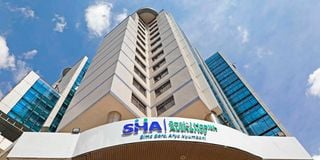
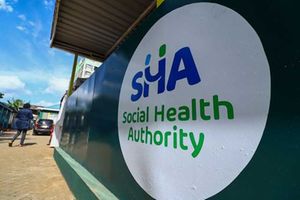
The Social Health Authority building in Nairobi.

Private hospitals across the country may soon require patients to sign mandatory liability forms committing to pay defaulted bills should the Social Health Authority (SHA) fail to honour payments, in what they say is a desperate bid to stay afloat amid a crippling debt crisis.
The Kenya Health Federation (KHF), representing 60 per cent of the country's healthcare providers, has advised its network members to implement the cautionary measures as facilities face an imminent collapse due to swelling unpaid bills.
In a memo seen by the Nation, the federation outlined the proposed measures as healthcare providers struggle with debt crises, investor hesitancy, and reduced trust from the financial sector.
Dr Tim Theuri, KHF's chief executive, defended the decision, saying it was not made in bad faith but as a response to the current crisis facing federation members.
"We are asking Kenyans now to come and assist us. One of the ways they can assist us is by signing those forms," he told Nation.
The process will see private facilities notify patients directly—or through their agents or guardians—when payments remain pending within contractual periods.
"They can then reach out to SHA to follow up on payment," Dr Theuri explained. "If a payment has been made, they can also give us the payment advisory. But we will be requesting them to sign an ultimate liability form so that we are also covered in law."
However, SHA chairperson Abdi Mohammed told Nation that the network members listed have no contract with SHA, making it impossible for him to comment on the issue—despite most facilities in the KHF currently being empanelled by SHA.
"If you find a facility that has written that [patients should sign a liability form) then we can comment on it," he said. "This is a memo, it has no head or tail. It has no impact."
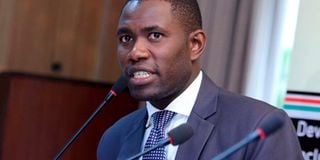
Dr Ouma Oluga, the Health Ministry's Principal Secretary in charge of Medical Services, did not immediately respond to the Nation’s enquiries on the issue.
The private healthcare sector is still waiting for claims worth approximately Sh33 billion owed by the defunct National Health Insurance Fund (NHIF).
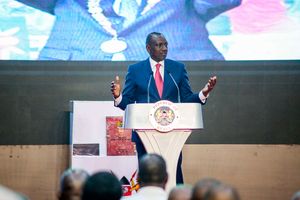
On March 6 this year, President William Ruto ordered that all hospitals owed Sh10 billion and below by the government be paid with immediate effect. He then directed the ministry to undertake a 90-day audit through a verification committee to ensure remaining private hospitals with NHIF debts above Sh10 billion also received payment.
Dr Theuri confirmed to Nation yesterday that none of these payments have been made to date.
"We are ready for verification, we are ready to be audited, but they can't keep calling us thieves if they have not put mechanisms in place which can separate people who are good from those who are not good," he said.
The debt crisis has triggered a domino effect across the healthcare sector, with facility owners now being listed in the Credit Reference Bureau (CRB).
"The moment you get listed in CRB, you cannot access further money and it becomes very difficult," Dr Theuri said. "We have seen private equity funds come into the health sector before, and banks advance us short-term credit facilities. Right now, even overdrafts are not coming easily and not in large amounts."
Investors are increasingly wary of the sector's prospects, with the biggest concern being the lack of return on investment.
"Investors are saying that if the biggest purchaser for health—the government—is late on payments, then we do not have credibility on how our investments are going to behave," Dr Theuri said.
Dr Theuri warned that since facilities were not involved during the negotiation of contracts given to them by SHA, they have no recourse when payments are not made. This is why the only option is to approach patients seeking services.
"We may be forced to move to cash only so that we are able to sustain our cash flows," he said.
He cautioned that facilities may also be forced to refer patients to government facilities—a move that would create a bigger burden with no guarantee of quality care due to huge crowds in public hospitals.
"Have these people understood how the sector operates? They are just policymakers. They are doing it on paper," he said.
The hospitals are demanding greater transparency from SHA, asking the authority to inform Kenyans about monthly collections, payments made, and outstanding balances owed to facilities.
"Unless it is a deliberate effort to kill the private sector, they should just have told us to move to other businesses," Dr Theuri said.
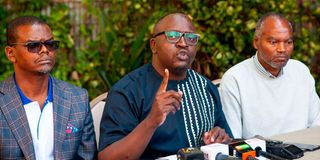
Members of the Rural and Urban Private Hospitals Association of Kenya, from left, Vice Chairman Joseph Kariuki, Chairman Dr Brian Lishenga and Simon Mbugua address journalists at the Boulevard Hotel in Nairobi on February 20, 2025.
The situation has been worsened by recent actions from the Health ministry and the Kenya Medical Practitioners and Dentists Council, which have been delisting facilities, downgrading others, and putting some on hold over fraud claims.
Dr Theuri said this has created a ripple effect on investors, particularly international brands.
"If you are investing in a market where people are being called fraudulent, you see that there is hesitancy around that. People do not come and put money into the sector," he said.
Dr Brian Lishenga of the Rural and Urban Private Hospitals Association (Rupha) of Kenya, one of the network members, confirmed that a way forward for members will emerge on Tuesday.
"We as Rupha concur and are taking steps in our Special General Meeting," he said.