Scientists come up with new weapon to fight malaria
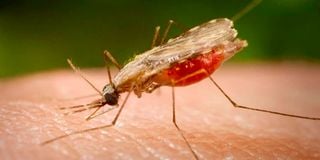
Anopheles mosquito. It is the main main vector for malaria. Africa bears nearly the entire global burden of malaria.

What you need to know:
- In the recent economic survey, malaria was the second leading cause of death in Kenya.
- This is despite the many interventions that are in place to reduce malaria transmission; including children vaccines.
If malaria-causing mosquitoes were sportsmen who play boxing, their key rivals –insecticides, could probably win only the first few bouts. In subsequent matches, mosquitoes will have learnt all the tricks that their rivals use to hit a blow that either kills them or causes an injury. They internalise all the tricks such that no matter how hard they are hit, they become immune to pain and are eventually crowned the winners.
In the fight against malaria, this seems to be happening, but not in a literal boxing match. Mosquitoes have become so clever that they keep singing and perching on humans regardless of the interventions put in place to keep them at bay. Some have become resistant to insecticides.
In a new study published in the scientific journal Nature, scientists from Harvard University have come up with a new way to fight malaria. Using two drug compounds, they found a way that mosquitoes can absorb the drugs through their legs when they settle on a mosquito net and eventually stop them from transmitting malaria.
The study explains that the scientists tested a number of drugs that are in the pipeline for possible development as human therapeutics, since they wanted to have many options when testing for the specific drug.
“At some stage during testing, these compounds may prove unsuitable for human use for reasons such as unfavourable pharmacokinetics (the study of how the body interacts with administered substances for the entire duration of exposure), inadequate safety profiles or high likelihood of resistance, and therefore could be repurposed for use in mosquito-targeted interventions. This strategy could be particularly useful for clinically developed antimalarials that ultimately cannot be used as treatments in humans,” the scientists explain. The study will be conducted in Ethiopia and Burkina Faso.
Children's vaccines
In the recent economic survey, malaria was the second leading cause of death in Kenya. This is despite the many interventions that are in place to reduce malaria transmission; including children's vaccines.
Nation reached out to Harvard scientist, Flaminia Catteruccia, an Italian professor of Immunology and Infectious disease, who explained the details of their study.
In the simplest terms, what is the core innovation described in this study? How does it fundamentally differ from existing malaria prevention methods?
Ours is a completely innovative strategy: we use antimalarials to kill parasites in the mosquito rather than kill the mosquito itself. This way, we avoid generating resistance in the mosquito against this strategy.
What are the names of the compounds (or drugs) used and do you think they will be available in Africa where many people die of malaria?
These compounds are called ELQ-453 and EL!-613 and were generated by our collaborators at Oregon Health and Science University. If the initial field trials that we will hopefully perform over the next few years will go well, these compounds will be incorporated into bed nets, which will be distributed to people in malaria-endemic regions. We are doing some preliminary tests in Ethiopia and Burkina Faso, using small netting material.
Why is it so crucial to find new ways to combat malaria transmission, especially given the progress made earlier in the century?
Malaria cases have plateaued in recent years, also due to insecticide resistance in mosquitoes. A lot of work still remains to be done to reduce the burden of malaria
How exactly do the drugs work?
They block the parasite mitochondrial electron transport chain, which is essential during development in the Anopheles female.
The study mentions widespread insecticide resistance. How significant is this problem globally, and specifically, what impact has it had on the effectiveness of traditional methods of malaria prevention.
Insecticide resistance is incredibly widespread in mosquito populations and is severely impacting the efficacy of bed nets.
Can you explain what "circumventing insecticide resistance" means in this context? How do these new compounds achieve that?
While the compounds per se do not prevent a mosquito from developing resistance to insecticides, their incorporation in insecticide-treated nets would increase the lifespan of bed nets. This is because even if a mosquito survives the action of the insecticide, these drugs kill the malaria parasites they would otherwise carry, thereby preventing transmission between humans. In a way, bed nets that incorporate these compounds would represent a sort of portable clinic for ‘curing’ mosquitoes of malaria parasites
How do these compounds block parasite transmission without killing the mosquito? Why is it advantageous not to kill the mosquito in this approach?
We don’t want to kill the mosquito as otherwise they would at some point develop resistance. We reduce the chance of parasite resistance to the drugs by using compound combinations.
What does it mean to dramatically expand understanding of druggable targets in mosquito-stage parasite development?
The chemical screen we performed identified several parasite targets that are essential for development in mosquitoes and could therefore be targeted by drugs
Why is this important for future research?
This is a new tool for malaria control, with potential to be deployed in malaria-endemic regions to help reduce the burden of this devastating disease