Scientists get down to suppress stubborn weed
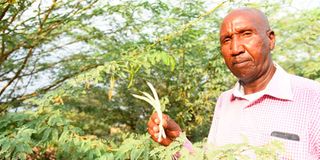
Ilchamus Member of County Assembly Joseph Leparsalach says his entire ward is covered by the thorny poisonous plant.

What you need to know:
- Among local communities in Kenya’s semi-arid counties, the ill-natured plant has caused suffering to both humans and livestock
- The study will centre on whether the ‘mathenge’ plant could have allopathic properties where it releases chemical properties in the soils which suppress the growth of indigenous trees
A plant that was initially meant to address desertification and help reclaim Kenya’s barren lands has become a menace in recent decades.
Prosopis juliflora, native to Mexico and the Caribbean, was introduced in Kenya in the 1980s by the Kenyan government and the Food and Agriculture Organisation.
But after two decades, the plant commonly known as ‘mathenge’ became invasive and dangerous to other plants and animals.
Among local communities in Kenya’s semi-arid counties, the ill-natured plant has caused suffering to both humans and livestock.
But researchers from local universities are now working to develop new plant species that are eco-friendly as an alternative to the weed.
Dr Kaleb Mwendwa, a lecturer at Masinde Muliro University of Science and Technology and the lead researcher of the building research capacity for sustainable food and water security in sub-saharan African project, told Healthy Nation that scientists want to establish the link between its biological factors such soil and water nutrient factors and the genetic factors in the environment in Turkana and West Pokot counties in order to eliminate or reduce its impact in the ecosystem.
"We want to understand why it becomes very aggressive even after cutting it and this is one of the issues we are looking at. We want to look for other species that can out-compete the ‘mathenge’ plant so that the indigenous trees can flourish," said the expert.
The researchers are drawn from various research institutions such as Technical University of Kenya, Kenyatta University and University of Nairobi. The project is being conducted in other two African countries, Malawi and Ghana.
The researchers are working with the support of University of Southampton and UK-based Global Challenge Research Fund.
He said that the study will centre on whether the ‘mathenge’ plant could have allopathic properties whereby once it has shed its leaves; they release chemical properties in the soils which suppress the growth of indigenous trees such as acacia in dry areas.
"If it is true then, we want to find possibilities to suppress these compounds. If we manage then we could be moving closer to getting the solution because we want the indigenous trees to go back the original state," added the Dr Mwendwa.
The research, he said, will investigate the plant’s seed bank in the soils to establish the most dominant one in the soils in order to end the phenomenon.
A seed bank stores seeds to preserve genetic diversity, hence it is a type of gene bank.
He said that already, researchers have conducted satellite mapping and are in process of undertaking drone mapping to enable the researchers to isolate the species from the acacia species.
"At the end of this study, we want to come up with scalable and workable framework for the management of Prosopis juliflora. We want this to be cascaded to the national level because this is a problem in many parts of Kenya such as Bura in the coast region," he added.
Dr Namenya Daniel, another researcher at MMUST said that the plant is threat to food security since it spreads in the water catchment areas and farmers are not able to cultivate their crops. It also curbs growth of pasture for livestock.
Are there benefits of this unwanted plant? Dr Mwendwa says: ‘Absolutely, we have just found out this plant is an important player in absorbing greenhouse emissions. You have heard that the country’s forest cover has gone up and this plant is one of the trees that contributed to the increase."
He added: "One, we are saying we want to eliminate it and on another, we are saying it is contributing to forest cover. It is a complex issue and it is time for managers, policy makers and scientists need to find a middle ground to tackle this particular issue."
Mr Clement Nadio, Turkana County Director of Environment said that the Mathenge plant was threat to the livelihoods and livestock in the region and was dominant in rivers suggesting that it can thrive in areas with high moisture content levels.
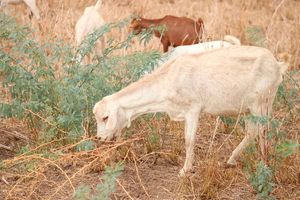
"It is not forage, the green vegetation is not eaten by livestock apart from pods. It is not beneficial to pastoral communities, acacia is of great benefit to the herders since they can get the leaves during the dry season," he said, noting that it spreads through droppings from the livestock after feeding on its pods.
The county official noted that although the county had banned commercial production of charcoal from indigenous trees as a national directive, it has now allowed production of charcoal and building materials from the Mathenge plant to reduce its woeful impact to the environment.
"It is a concern to researchers and counties. We need studies to help us to find ways to manage and control its spread in this region," said Mr Nadio.