Scientists on a mission to make finger millet great again
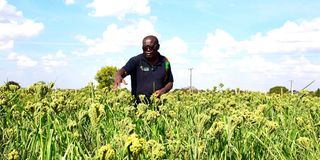
Dr Henry Ojulong, a scientist with the International Crops Research Institute for the Semi-Arid Tropics, inspects a finger millet field at the Karlo Arid and Rangelands Research Station in Makueni. He is part of a scientific cohort developing high-yielding, drought-resistant varieties designed to bolster food security in a changing climate.

What you need to know:
- Nutritionally, finger millet ranks among the most potent cereals. It is rich in calcium, iron, and fibre, making it ideal for children as well as pregnant and lactating mothers.
- Nutritionists also recommend it for people battling anaemia. It is commonly eaten as porridge and brown ugali.
Inside a section of the Kenya Agricultural and Livestock Research Organization’s (Karlo) arid lands research station at Kiboko in Makueni County, a group of smallholder farmers moves slowly through rows of finger millet, their eyes scanning for something specific.
For hours, the farmers scout and select desirable varieties, filling out questionnaires in a crucial step of a mission led by researchers determined to reverse a worrying decline in production of the hardy cereal.
"A big panicle means high yield," said Esther Mutuku, a farmer from the neighbouring Maangiuvungu Village, after voting for her preferred varieties.
What the farmers did not know was that the traits they preferred were derived scientifically from wild grasses believed to be distant relatives of cultivated finger millet.
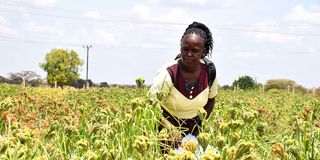
Esther Mutuku, a farmer, scouts a finger millet crop at the Karlo Arid and Rangelands Research Station in Makueni.
Shivali Sharma, a plant breeder with Crop Trust, an organisation involved in the millet improvement project, made the revelation. “You have voted for finger millet lines with bristly panicles. These are traits coming from grass that grows naturally in the wild,” she said, simplifying the complex cross-breeding process that produced the new varieties.
"We are trying to develop new finger millet varieties that are not only high yielding and nutrient dense but also more resilient across various ecological zones in the country."
As a dryland crop, finger millet withstands harsh climatic conditions and requires minimal fertiliser. Agronomists note that it has few pests, both in the field and in storage.
"It is the only cereal whose value appreciates as it stays in the store. The longer it remains, the more money consumers are willing to pay for it. This makes it both a food security and a nutrition security crop," said Henry Ojulong, a finger millet breeder at the International Crops Research Institute for the Semi-Arid Tropics (ICRISAT).
Nutritionally, finger millet ranks among the most potent cereals. It is rich in calcium, iron, and fibre, making it ideal for children as well as pregnant and lactating mothers. Nutritionists also recommend it for people battling anaemia. It is commonly eaten as porridge and brown ugali.
In Western Kenya, where finger millet is a vital crop, scientists are alarmed by the steady decline in acreage under cultivation in recent years. Among them is Chrispus Oduori, a senior scientist and manager at Karlo, who calls himself the "father of finger millet" across the continent due to his relentless work promoting the orphaned crop. He credits finger millet for funding his own education.
The trend has also troubled cultural enthusiasts and nutritionists.
According to scientists, government policy has contributed significantly to the decline. "The government has made finger millet an orphaned crop over the years. It has sidelined millet production and instead focused on maize," said Dr Ojulong.
To reverse this trend, scientists from Karlo, ICRISAT, and Egerton University have joined forces to develop new, high-yielding, and nutritious finger millet varieties that are resilient to climate shocks. The millet improvement project, which also operates in Alupe (Busia County), Koibatek (Baringo County), and Soin (Kericho County), places the smallholder farmer at the center of its efforts.
Major challenge
The team of scientists understands that there is no one-size-fits-all approach to adaptation. "We know we need to develop finger millet varieties suited to specific agro-ecologies. There is no room for a single variety with wide adaptation that can be grown across the entire country. That is why we must understand the needs and preferences of farmers in different regions and give them what they need," said Dr Sharma.
According to Bernard Towett, a plant breeder and lecturer at Egerton University involved in the finger millet improvement project, harvesting remains a major challenge hindering production. "One of the biggest challenges facing finger millet production is the labour required for harvesting. To address this, we collected germplasm from wild grass varieties with a natural snapping characteristic.”
"We have since introduced the snapping trait into finger millet through multiple crossings. The snappi millet is a game changer. A farmer no longer needs a knife to cut the panicles. Apart from being easy to snap, this variety also serves as good animal feed. We have also developed a brown variety that snaps, in line with farmers' preferences," he told Healthy Nation on the sidelines of the farmers' field day.
A key part of the campaign to restore the glory of finger millet is creating demand through value addition. "We are bringing finger millet back into the spotlight by using its flour to bake cakes and cookies that have proven irresistible. Finger millet may soon overtake wheat in baking because it is gluten-free," said Phoebe Mwangangi, a climate-smart farming champion from the Makindu region in Makueni County.
Scientists add that industrial use of finger millet in the baking and malting industries presents significant opportunities for the crop.
"The government's 2018 national flour blending policy, which mandates millers to blend maize and wheat flour with at least 10 per cent of high-nutrient, drought-tolerant crops such as finger millet, sorghum, and cassava, has the potential to rejuvenate finger millet production," said Towett. "The policy was designed to boost food security, increase the nutritional value of wheat and maize flour, create demand for underutilised crops, and reduce poverty."
Dr Oduori has called on farmers in arid and semi-arid regions to take advantage of the growing demand for finger millet to improve their economic fortunes. "Ukambani and the North Eastern regions hold huge untapped potential for finger millet production. They boast large tracts of land that farmers can use to meet the growing demand," he said.