Seedlings of hope: University joins youth in drive to spur Makueni’s green revolution
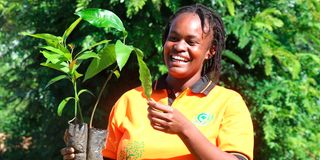
Emma Mutule displays mango seedlings in Nthongoni township, Makueni County, on March 28, 2026. She operates a vibrant tree nursery to support an aggressive environmental conservation campaign initiated by Lukenya University.

What you need to know:
- Youth-led tree nurseries are transforming livelihoods while restoring degraded lands across Makueni’s arid and semi-arid regions.
- Conservation efforts are creating income streams as communities embrace tree planting to combat climate change and land degradation.
A sprawling nursery teeming with thousands of assorted seedlings greets visitors entering Nthongoni township in Makueni County. The vibrant nursery, operated by Emma Mutule, reflects a growing conservation culture taking root in the semi-arid region, once known for springs flowing from the neighbouring Chyulu Hills National Park.
“We are big in Acacia tortilis and Melia volkensii. These indigenous trees are popular with local conservationists mainly because they tend to thrive in arid and semi-arid regions. Besides shade and other conventional ecological uses, Acacia tortilis is a major source of feed for livestock while Melia volkensii is a source of high-quality timber,” Emma says.
Her conservation journey began during the Covid-19 crisis. She had just graduated from university when the global economy slowed down. Today, she does not regret her decision to shelve job hunting and relocate to the countryside. The high cost of acquiring seedlings to restore her family’s degraded rangeland sparked the idea of starting a tree nursery—an idea that has since unlocked a steady income for the young conservationist.
Emma’s story mirrors that of Elida Mutie, another young environmental conservation champion making a living by selling assorted seedlings. She runs a thriving nursery in neighbouring Muusini village. She began with Melia volkensii, an indigenous hardwood that requires specialised skills and patience to propagate, before expanding to include assorted fruit trees.
“Although we bank on individuals who buy seedlings to either expand their farming portfolio or rehabilitate their degraded farmlands, the bulk of the sales comes from institutions, government and nongovernmental organisations supporting conservation initiatives. Lukenya University has provided a huge steady market for our seedlings,” Elida says.
She refers to the private university, which has launched an aggressive conservation campaign in the region. The institution works closely with local communities to rehabilitate degraded landscapes by planting trees in schools, market centres, and open spaces. Emma and Elida are among dozens of nursery operators enlisted in the campaign to grow 10 million trees across Kambu Sub-County by 2032, aimed at restoring land degraded by charcoal production, overgrazing, and climate change.
“The Lukenya University 10 Million Trees campaign is one of the ways we use to create awareness about mitigating climate change. We have crossed the 1.5 million trees mark as we move to convert arid and semi-arid regions to arable land through environmental conservation and conservation of biodiversity,” says Vice Chancellor Judith Wafula.
The university distributes seedlings free of charge during public forums and outreach programmes, encouraging communities to plant trees and conserve existing ones. It has also partnered with Athletics Kenya to promote the 10 million trees campaign through an annual marathon, where budding athletes run alongside elite competitors from across the country.
The conservation drive began in 2023 after the university hosted a workshop on sustainable pastoralism that brought together young delegates from across the continent.
A study conducted by the university shows that the initiative is unlocking economic opportunities beyond tree nurseries. “Our study has shown increased production of honey in the target region due to the conservation of foliage trees. At the same time, the study has revealed an increase in the production of mangoes and other fruits within the target region,” says Mutheu Kasanga, the university’s deputy vice chancellor in charge of infrastructure.
The conservation campaign, alongside the 15 billion tree-growing initiative championed by William Ruto, comes at a time when Kambu Sub-County is recovering from frequent elephant invasions from Tsavo East National Park and Tsavo West National Park, where the animals have been destroying crops and water infrastructure.
The government, in partnership with Tsavo Trust, has fenced off parts of Tsavo West National Park to mitigate human-wildlife conflict.
“With the accelerated greening campaign, we are ready for the next phase of economic recovery—restoring the orchards and livelihoods destroyed by elephants,” says Augustine Nyalita, chairman of the Aa ma Mbuini Residents Association, which represents the region targeted by the conservation drive.