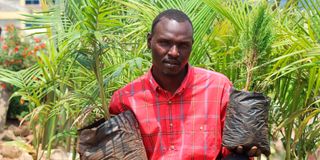
A lush, landscaped plot rises on elevated ground at the junction of the Tenwek–Silibwet highway in Bomet town, a burst of green and colour against the hum of passing traffic.
Rows of flowers in neatly arranged pots catch the eye, transforming what could have been an ordinary roadside space into a miniature botanical haven.
A low metallic fence surrounds the rows of flowers and trees of different varieties – exotic, indigenous and ornamental – arranged in rows in different sizes in what makes heads turn. A lockable entrance guards against destruction of the trees and flowers by animals, human beings and curbs theft round the clock.
Flowers and trees at a garden run by Erick Cheruiyot in Bomet town.
Photo credit: Vitalis Kimtai | Nation Media Group
Metallic and plastic flower pots of different colours – green, black, maroon, yellow, beige and grey – sit side by side with cemented ones in neat rows, in what reveals the organisational skills of the owner of the nursery. It is here that Erick Cheruiyot operates an enterprise, selling indoor and outdoor flowers and tree seedlings, a business he started almost eight years ago.
Going by the well-tended garden, one would expect to see a house, a private or commercial building in the area, but lining the back of the nursery are semi-permanent kiosks and an adjacent car wash, while the tarmac road, Bomet-Kaplong highway, acts as the front of the picturesque garden.
Artists from the region occasionally pay a fee to use the space to record videos for their music, while some locals stop by to take photos, especially on weekends. It has a small well-manicured lawn with two chairs and a table replicating how a hotel or home garden ideally looks like.
Some of the flowers and trees in the nursery are Golden, Christian, Thika palm, Mardavilla, Araucaria and Italian Cypress. To set up shop, Cheruiyot used Sh300,000, which would have been higher had he leased the land. He was given the parcel to use for free by a government agency as a result of the impact it has on environmental conservation.
He bought a tank, cemented part of the facility, erected a metallic fence, bought a table and chairs, and connected electricity, which also acts as a security light in the area at night, thus curbing crime. The plants retail at Sh100–Sh1,500, though some more expensive ones are sourced from other towns across Bomet, Kericho, Narok, Kisii and Nyamira on order.
“There is a lot of demand for potted flowers and ornamental trees by hotels, business enterprises and homeowners as real estate expands in the region,” Cheruiyot said.
Flowers and trees in a garden in Bomet town on February 18, 2026.
Photo credit: Vitalis Kimtai | Nation Media Group
On a number of occasions, he sources particular varieties of tree seedlings from Nairobi, Mombasa and Nakuru – depending on a customer’s needs. Cheruiyot has the main tree and flower nursery at his home in Koma village, Chepngaina, Bomet Central, about four kilometres away, but uses the facility in town as a marketing front.
He has supplied most of the major hotels in Bomet town with the trees and flowers planted in their compounds, offering sheds and beautifying the places.
“It excites me to watch flowers and trees we have planted and taken care of as they grow, beautify the places they are planted in, and contribute to environmental conservation,” he says.
During the Lake Region Economic Bloc conference in Bomet in 2018, he was among those contracted by the county government to engage in beautification of the town, a process that included planting of ornamental, exotic and indigenous tree seedlings.
“This small unit has enabled me to educate my children who are in college, secondary and primary schools. I have improved the business inch by inch over the years and I use referrals as a marketing tool,” Cheruiyot says.
“Former Bomet governor Joyce Laboso had a vision to beautify Bomet town when she took office, but her death on July 29, 2019, brought the dream to an end. The trees we planted, as if taking cue from her demise, also withered and died altogether.”
A number of the trees that survived were destroyed by the cattle roaming the town, with mostly donkeys, goats, sheep and cows feeding or stepping on them.
An attempt by the department of water and environment to ban the cattle from the town centre did not bear fruit, as the rules were later relaxed and appeared to have been withdrawn.
“I also provide landscaping services to clients in the region, a craft I have been engaged in for the last four years. A number of hotels, private homes, public offices and churches are some of my clients,” he said.