Selling everything for a cure: The financial ruin of rural cancer care
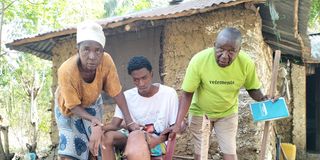
18-year-old James Furaha, a cancer patient, is supported by his father, Emmanuel Konde, and his mother, Margaret Nyevu, at their home in Mjanaheri village, Magarini, Kilifi County. The family has exhausted their resources seeking treatment for James.

What you need to know:
- The affected families and cancer patients interviewed appealed to the government to establish cancer diagnosis and treatment centers in every county.
- They argued this is essential to prevent situations where low-income individuals die due to unaffordable care and a failing healthcare system.
In the remote village of Mjanaheri, Kilifi County, Emmanuel Konde gently lifts his frail son, James Furaha. His worn hands cushion the 18-year-old’s weak frame. Furaha, pale and listless, leans into his father’s arms, eyes half-closed, as Konde painstakingly helps him stand.
Beside them, Furaha’s mother, Margaret Nyevu, touches her son’s shoulders, her face etched with worry. The parents whisper reassurances as the boy struggles for breath; a testament to enduring love against the harsh reality of sickness.
“Don’t let suffering take your spirit. We’re with you,” says Nyevu. “We trust in God. It shall be well,” said Konde.
This is the third year Furaha has endured pain from a condition that began as a persistent rash below his left knee in November 2022, while he was sitting for his primary school exams. He scored 315 marks out of 500, earning a place at Moi Boys High School in Taita Taveta County in January 2023.
Shortly after he started secondary school, the rash developed into a tumour, causing acute pain. Teachers summoned Konde, a local pastor, and advised him to seek serious medical help. By the second term of 2023, Furaha was out of school.
After months of consultations and a biopsy, the diagnosis was confirmed: cancer.
Lacking capacity at local dispensaries for advanced tests and imaging, the family began a costly pilgrimage to major hospitals across the Coast region; both public and private, including Malindi General, Kilifi County
Referral, Mombasa Coast General, The Mombasa Hospital, and Cerba Lancet Kenya.
“Between 2023 and 2024, we did X-rays, CT scans, MRIs, and all kinds of blood tests. We paid cash for everything, as we were not enrolled in the Social Health Authority (SHA) then,” Konde explained.
A pathology report from Cerba Lancet Kenya dated August 28, 2024 confirmed a low-grade, locally aggressive tumour.
Doctors advised amputating part of Furaha’s leg to prevent the cancer from spreading.
“I was deeply shaken to learn that my son has been diagnosed with an early, stage 1 cancer, localised within and below the knee,” said Konde.
The family enrolled in SHA in September 2024 after the diagnosis, but it has provided little relief. Most tests and even prescribed pain relievers are not covered, forcing them to buy medication from private pharmacies.
“My son’s condition has drained my family financially and psychologically. I’ve sold our land, livestock, and properties. I’ve spent nearly Sh900,000. Currently, I am left with nothing,” said Konde.
The Konde family’s ordeal mirrors that of many in rural and underserved communities across the Coast region and Kenya at large when faced with chronic diseases like cancer.
In Lamu West, Benjamin Kimani, 39, a mechanic and father of one, was diagnosed with liver cancer in June 2025 after experiencing fatigue, abdominal pain, and swelling. Painkillers from Mpeketoni Sub-County hospital provided no lasting relief.
His brother, a clearing agent, transferred him to Mombasa, where tests confirmed liver cancer at an initial stage.
After his first chemotherapy session, Kimani’s SHA allocation of Sh500,000 was exhausted. He requires a top-up for a second session but has nothing left. His wife and child now rely on extended family and well-wishers.
A similar situation is faced by 39-year-old Peter Munga from Hidiwa Village in Witu Ward, Lamu County. Munga, a mechanic and father of two, first developed a rash on his right bicep in early 2025, which appeared to be a common skin condition. After initial treatment at Witu Health Centre proved ineffective and the rash continued to spread, he grew concerned. A medic there referred him to a dermatologist at King Fahd Hospital on Lamu Island, who subsequently referred him to a specialist in Mombasa. He was advised to undergo a series of tests, including X-rays, blood work, an MRI, and a biopsy of the affected area.
“After some weeks, the results were out,” said Munga. “I was told that I had stage 1 muscle cancer, also known as sarcoma. Through the support of family, friends, and well-wishers, I have spent over Sh450,000, mostly out-of-pocket, to undertake these tests.” He added that SHA had provided only dismal support.
He has paid for most of the tests and medical supplies in cash as they were obtained from private hospitals not covered by the SHA. To receive treatment, he is planning to travel to India this month, a journey that will require at least Sh1.2 million.
“Currently, I have about Sh700,000, which was fundraised by my family and friends. I am hopeful I will raise the full Sh1.2 million needed to travel to India for treatment,” he said.
The affected families and cancer patients interviewed appealed to the government to establish cancer diagnosis and treatment centers in every county. They argued this is essential to prevent situations where low-income individuals die due to unaffordable care and a failing healthcare system. “If the state isn’t ready to establish cancer centres in every county, then treatment for such diseases should be made free,” said Stephen Hinzano, a
community elder in Kilifi.
For Furaha, the youngest in a family of nine, he prays for swift treatment to relieve his constant pain. He longs to regain his health so he can return to the classroom and resume his studies. His dream is to one day become a doctor.
A passionate basketball enthusiast, he also looks forward to the day he can be back on the court, shooting hoops again.
“I can’t walk normally anymore,” Furaha said. “Because of my condition, I’m forced to wear baggy clothes instead of my usual shorts and trousers. Cancer has kept me out of school for three years now, but I am still strong and confident. I will defeat it. I won’t allow it to shatter my dreams.”
During an interview with the Nation, Lamu Deputy Governor Mbarak Bahjaj, who also serves as the county Health executive, stated that the county has made significant strides in fighting chronic diseases, including cancer.
"Early last year, Lamu established a Sh35 million cancer diagnostic unit to strengthen surveillance and enable early treatment," said Dr Bahjaj. The unit is situated at the King Fahd County Referral Hospital. The same year, the unit received a major boost when Olympus-Denmark donated a state-of-the-art laparoscopic tower.
Erick Otieno, the Lamu Branch Secretary-General of the Kenya National Union of Nurses, challenged county governments to prioritise specialised training for nurses and other medics in public hospitals, particularly in cancer care.
"We would appreciate it if our nurses and other medics were given opportunities to pursue advanced studies in oncology nursing," said Otieno. "In Lamu, we have fewer than seven such specialists despite a clear and growing demand."
Dr Bahjaj acknowledged that the new cancer diagnostic unit was established in direct response to a notable increase in cancer-related ailments in Lamu in recent times. According to county Health Department data, cervical cancer is the most prevalent, followed by prostate cancer, with colorectal cancer emerging in third place.
“This is a new dawn for Lamu residents as these services were previously hard to access. People would travel all the way to Mombasa for them at a high cost,” said Dr Bahjaj.
He expressed confidence that the newly launched unit would also enable the county to establish accurate cancer prevalence statistics, correcting a longstanding data gap.
“We have discovered many cancer cases in Lamu recently, yet official figures—based on 2020 data—suggest a prevalence of only 0.3 per cent. That figure is misleading because we lacked diagnostic capacity then. Many people went to Mombasa for diagnosis, and their data was recorded there. With our own unit now established, I believe we
will have accurate local data in the near future,” Dr Bahjaj explained.
In recent years, Kenya and the world have faced a growing burden of chronic diseases, commonly referred to as Non-Communicable Diseases (NCDs). These illnesses now pose a significant global health challenge and rank among the top 10 causes of death across all income levels.
Common NCDs in Kenya include stroke, coronary heart disease, dementia, and certain cancers. According to the 2022 Kenya Demographic and Health Survey, the rise of NCDs is attributed to multiple factors, with behavioral changes being a primary driver.
Risk factors
Key risk factors such as unhealthy diets, tobacco use, harmful alcohol consumption, and physical inactivity have been exacerbated by rapid urbanisation and shifting lifestyles. Socio-demographic factors like region, wealth, and education also influence these risks, with overweight and obesity representing a particularly widespread concern.
According to the World Health Organization, cardiovascular diseases are the leading cause of NCD-related deaths globally, followed by cancers, chronic respiratory diseases, and diabetes. Low- and Middle-Income Countries bear the greatest burden, accounting for 77 per cent of these fatalities.
In 2021 alone, NCDs were responsible for at least 43 million deaths, representing 75 per cent of non-pandemic-related mortality worldwide. Notably, 73 per cent of these deaths occurred in low- and middle-income countries.
The impact is particularly acute in Sub-Saharan Africa (SSA). Here, nearly 30 per cent of NCD deaths occur in individuals under the age of 60, compared to just 13 per cent in high-income countries. The prevalence of NCDs in SSA has risen steadily, with disability-adjusted life-years attributed to these diseases increasing by 67 per cent between 1990 and 2017.
Today, Kenya is undergoing an epidemiological transition, shifting its focus from communicable diseases—such as malaria, HIV/Aids, and tuberculosis—to a rising burden of NCDs. This shift is largely driven by behavioral changes and rural-urban migration.
In response, Kenya established the Non-Communicable Diseases and Injury (NCDI) Poverty Commission under the Ministry of Health in December 2016. The commission was officially launched to address the growing burden of NCDIs, particularly among the poor, by developing investment cases for pro-poor policies and promoting integrated
health services.
Additionally, the country’s strategic response includes the Kenya National Strategy for the Prevention and Control of Non-Communicable Diseases (2015–2020). This strategy was designed to reduce NCD-related mortality through enhanced prevention, early detection, and improvements in the healthcare system.