Sh2bn US deal to boost Kenya’s disease surveillance, response
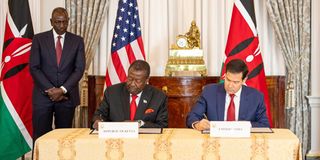
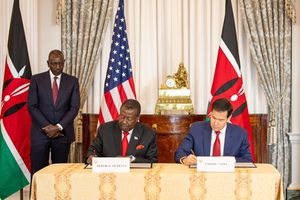
US Secretary of State Marco Rubio and Kenyan Foreign Cabinet Secretary Musalia Mudavadi sign the US-Kenya health pact as President William Ruto looks on.

The government has agreed to collaborate with America on surveillance and disease outbreak response efforts.
The Kenya National Public Health Institute is expected to lead the interventions.
In the highly privatised Kenya–US health framework seen by Nation, the funding will support the establishment of 10 of the health institute’s regional hubs and 20 County Emergency Operations Centers.
The money will also be used for the assessment of Kenya’s systems related to disease surveillance, border and migration health, and safety protocols for pathogen handling—including collection, transport, storage, testing and disposal.
In total, the US government will spend USD 22,531,800 (Sh2 billion) on Kenya’s surveillance and outbreak response. The US will allocate USD 4,506,360 (Sh582 million) annually to the programme from 2026 to 2030.
Crucially, the assessment must align with the Kenya Integrated Surveillance Strategy and support the national roadmap for multi-pathogen surveillance, integrating HIV, STIs, viral hepatitis and other epidemic-prone diseases.
To strengthen surveillance capacity, Kenya has committed to train existing health officials as well as 250 field epidemiologists. An additional 1,601 officers comprising public health emergency responders, logisticians, data scientists and laboratory professionals will also be trained.
The document shows that Kenya has agreed that the United States Food and Drug Administration’s (FDA) approval or Emergency Use Authorisation of medical countermeasures will be sufficient grounds to deploy such countermeasures during an outbreak, in accordance with applicable Kenyan laws.
Equipping laboratory systems
This means that if the FDA deems a product safe and effective for emergency use, Kenya will adopt it immediately during an outbreak without additional local regulatory delays.
The framework also includes the establishment and equipping of laboratory systems, the reinstatement of Kenya Medical Supplies Authority (Kemsa) as the national agency for procurement, warehousing, and distribution, the integration of US-funded healthcare workers into the national workforce, accelerated digital health reforms, and various strategic interventions.
Kenya plans to establish approximately 4,567 laboratories nationwide, all fully equipped to detect, identify and characterise pathogens with outbreak, epidemic, or pandemic potential, while ensuring blood safety. The laboratory system will be tiered across the county, national and regional levels.
At the national level, the system will include 12 public health surveillance laboratories, four research laboratories, two animal health laboratories, four level six referral laboratories, a national quality control laboratory, a Kemsa quality assurance laboratory and a national blood safety reference laboratory.
Additionally, Kenya will establish 4,542 county laboratories, 3,500 of which will be supported by the US government at a cost of USD 3,313,024 (about Sh428 million).
America will also continue providing USD 14,961,000 (approximately Sh1 billion) in laboratory commodities and will fund about 515 frontline laboratory workers, including technicians and quality assurance officers.
While the US will fully fund laboratory commodities in 2026, its support will decrease gradually, with Kenya expected to assume full financial responsibility by 2030. America will also fund the salaries of the 515 frontline lab workers until 2027, after which Kenya will absorb them onto the government payroll starting from 2028.
According to the framework: “The Government of Kenya intends to insure any lab commodity inventory both paid for by the US Government and distributed through Kenya Government-owned supply chains… Lab commodities include the actual cost of the commodities as well as related distribution costs, including warehousing, shipping, and trucking. These costs do not include data systems or technical assistance.”
Currently, the US Government provides USD 74,782,231 annually (an estimated Sh9 billion) for essential health commodities, HIV treatment, rapid tests for HIV and malaria, treatments for opportunistic infections, tuberculosis preventive therapy, malaria medicines, insecticide-treated nets, and limited maternal, newborn, and child health commodities.
The US plans to continue funding 100 per cent of these commodities in 2026, after which its support will decline gradually, with Kenya expected to assume full responsibility by the end of the framework period.
“The 2026 funding includes an additional one-time strategic investment in buffer stock for HIV treatment to support six-month dispensing for stable patients and HIV prevention to eliminate mother-to-child transmission,” the framework states.
US-funded commodities
Kemsa will distribute the supplies to enable timely detection and investigation of loss, diversion, or falsifications. Kenya must notify America within seven days of any such incidents involving US-funded commodities.
The US Government will also continue paying salaries and benefits for healthcare workers; nurses, clinical officers, laboratory workers, pharmacy staff, and HIV testing and counselling providers.
For its part, Kenya is committed to absorbing the healthcare workers by June 30, 2028. Their pay will match that of comparable government-employed workers. Other seasonal frontline workers—such as malaria programme staff, community health promoters, and mentor mothers—will be integrated into appropriate government cadres to ensure continuity.
Both the Kenyan and American governments have committed to accelerating digital health reforms to advance the Universal Health Coverage (UHC), guided by the Digital Health Act, 2023. The TaifaCare Hospital Management Information System (TaifaCare HMIS) serves as the backbone.
Having already deployed TaifaCare in 1,500 public facilities, Kenya plans to scale it up to 8,000 public and faith-based facilities by 2028—reaching 2,000 health centres in 2026, 4,000 in 2027, and 8,000 in 2028.
Follow our WhatsApp channel for breaking news updates and more stories like this.