The new Sh323 billion health deal, signed between Kenya and the United States on Thursday, requires Nairobi to adopt a system where it detects potential outbreak of diseases within seven days, inform Washington within a day, and provide complete early response action within seven days in a first-of-its-kind pact in the world since the overhaul of USAID and its funding model.
The five-year agreement, whose signing was witnessed by President William Ruto in Washington, will see the US provide up to Sh207 billion ($1.6 billion) to support health programmes, including maternal and child health, HIV/AIDS, tuberculosis (TB), malaria, polio eradication, disease surveillance, and infectious disease outbreak response and preparedness.
In addition, Sh2.9 billion ($ 22.5 million) has been allocated to surveillance and outbreak-response programmes, to be rolled out gradually between 2026 and 2030.
“The Government of Kenya intends to allow the United States Food and Drug Administration’s (FDA) approval or Emergency Use Authorisation of medical countermeasures to be a sufficient basis to use the medical countermeasures to respond to an outbreak in the country in accordance with applicable legislation in Kenya,” an excerpt from the cooperation framework reads.
Over time, the deal stipulates, Kenya will gradually take on more of the costs, increasing domestic expenditures by Sh111 billion ($850 million), as US financial support is reduced over the life of the programme. It is also expected that the government of Kenya will take responsibility to support health workers initially under US funding.
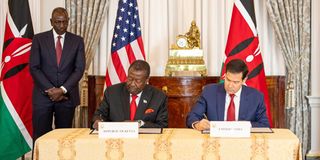
President Ruto witnessed the signing of the Framework, signed by Prime Cabinet Secretary Musalia Mudavadi and US Secretary of State Marco Rubio in Washington.
US Secretary of State Marco Rubio and Kenyan Foreign Cabinet Secretary Musalia Mudavadi sign the US-Kenya health pact as President William Ruto looks on.
Photo credit: PCS
The President stated that the agreement will enhance Kenya's capabilities in several key areas: achieving Universal Health Coverage (UHC), upgrading hospital equipment, effectively delivering services under the Social Health Authority, and improving disease surveillance and emergency preparedness.
“The framework we sign today adds momentum to my administration’s universal health coverage that is focused on supply of modern equipment to our hospitals, efficient and timely delivery of health commodities to our facilities, enhancement of our health workforce, and health insurance for all, and leaving no Kenyan behind,” he said.
“I assure you that every shilling and dollar will be spent efficiently, effectively and accountably,” President Ruto promised.
He noted that the partnership builds on Kenya’s long standing health relationship with the United States, backed by more than $7 billion (Sh910 billion) over 25 years, focused on building resilience, restoring hope, and supporting impactful institutions.
According to Secretary Rubio, the investment will be in combination, allowing the US to “leverage the private sector to create a sustainable US health assistance model around the world, and not just in Kenya”
“What that means is that money is not just going to be spent to provide medicine and care, it’s going to be spent to improve the healthcare infrastructure so that in five, or six, or seven, or eight years, countries will say we no longer need this much assistance,” he said.
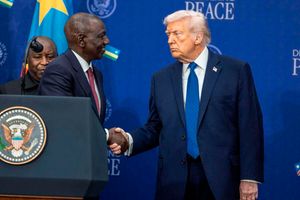
President William Ruto with US Secretary of State Marco Rubio.
Photo credit: PCS
Last year, the US spent at least Sh40.1 billion ($310 million) to support programmes tackling HIV/AIDS in Kenya. The funding came through donor programmes. However, with the new partnership, this will be government-to-government.
“The United States has spent billions of dollars over the years in helping with health strategies all across the world. What we learned over time is that oftentimes, what would happen is we would go to a country and say, ‘we’re going to help you with your healthcare needs. Then we would drive over to northern Virginia somewhere, find an NGO, one of these organisations, give them all the money, tell them to go to this country and do their healthcare program for them’,” he said.
“That NGO would then take about, you know, some percentage of that money for their overhead and administrative costs. And by the time it got down to it, the host country had very little influence. It was sort of imposed on them. And only a percentage of the overall money ever actually reached the patients and the people on the ground that we were trying to help because of these costs.”
In an interview with journalists in Nairobi to explain the deal, Susan Burns, Chargé d'Affaires of the United States Embassy in Kenya, explained that the five-year framework is a result of intense negotiations between both governments, which started in September 2025.
“We still have a lot of work to do on both sides on how we are going to implement this agreement, that’s really going to help strengthen not just the management of commodities and also the payments for health care workers, but also how were able to manage the systems that Kenya needs in order to manage its own health system as efficiently and as effectively as possible,” Ms Burns explained.
“So how do Americans benefit? The threats of HIV and tuberculosis and other communicable diseases are global challenges, and so strengthening Kenya’s health system also makes America safer. The investment that we’re making is in things like purchasing commodities, the salaries for our health care workers, as well as helping Kenya build a digital system of managing medical records and things so that Kenya is able to manage an effective health system at the end of the five years,” she added.
Kenya's health sovereignty
She emphasised that under this new agreement, the government of Kenya will continue to adhere to the privacy laws of its legal system, just as it always has.
"We are simply putting on paper the similar policies that we've followed for many, many years in this space," she explained.
The US diplomat stressed that any data shared moving forward will be aggregated data, meaning it will not include any personally identifiable information.
"It will be aggregate data so that we can collect information, like the 1.3 million people who are on antiretroviral treatment. There is no individual identifying data as a part of this agreement."
Brian Rettmann, the PEPFAR Country Coordinator at the US Embassy in Kenya, termed the framework as a "new way to think about development assistance."
He explained that the five-year strategy is focused on building Kenya's health sovereignty, allowing the US to eventually step back while ensuring the successes of previous programs like PEPFAR (President's Emergency Plan for AIDS Relief) and PMI (President's Malaria Initiative) are sustained.
“Kenya was chosen as the first country for this strategy due to its existing UHC focus and its level of economic development, which makes it well-positioned to implement the strategy,” he said.
Mr Rettmann argued this investment is not lopsided and the benefit to the US is that as Kenya achieves self-sufficiency, foreign assistance can eventually be redirected. The Framework of Cooperation, he noted, is non-binding. This is standard because government budgets (both US and Kenyan) are done annually. However, the five-year plan represents a projected financial commitment, giving Kenya an understanding of anticipated future support to help them plan for sustainability.
Mr Rettmann directly addressed concerns regarding data sharing, clarifying that the framework includes provisions for data systems and has a separate, sister data-sharing agreement.
“What we’re talking about with the data sharing is to be able to look at the top level, the identified information, to be able to report back to Congress that we are doing the programs that we have said that we are doing, but also really ensuring that the government is able to use that data to place their resources where they need to be. But it’s not about the U.S. government coming in and looking at peoples’ information. We can’t see that,” explained Mr Rettmann.
“We are abiding fully by all of the data laws that are in place within Kenya to ensure that privacy is there for every individual. And that when we do look at information, it’s really to de-identify it and hold up to a higher level to be able to ensure that our programs are successful, like having 1.3 million people living with HIV on treatment, having 2 million individuals with antimalarial drugs, getting bed nets out there, among others,” he added.
Mr Rettmann also clarified about specimen sharing agreement earlier alluded to in the Memorandum of understanding, noting that the final agreement only involves a specimen testing agreement.
“An earlier version that was leaked was talking about that. The final document is about specimen testing. The relationship that we’ve had with the government of Kenya is for when they are not able to test something because their lab system isn’t to that (required)level, we are able to take them within our labs, do that testing to get really specified information that we can then transparently share with the government. It’s not about us finding out information about individuals,” said Mr Rettmann.
“We are not trying to take specimens to do some weird testing. The specimens that we do testing on, is with agreement with the government. In those instances, where they need some assistance, then we do the testing, and we give the information,” he explained.
However, even though the cooperation document is for five years, the sister data-sharing agreement is for seven years to allow for two additional years of reporting on the programs' successes after the five-year work period concludes.
He explained that even though the funding is government to government, the money will not go directly to the Social Health Authority, but will focus on supporting digital framework within the country to make sure that things like the billing system works for all health facilities in the country.
“The element of SHA that we will be working on is building the essential benefits package with them to identify the needs of HIV, TB and malaria patients, and some other donor funded activities that have never been included in the benefits package before,” said Mr Rettmann.
He explained that due to the Helms Amendment, all US government funding for global health programs does not allow the funding of abortions or abortion care. This agreement does not change Kenya's laws regarding abortion but ensures US funds are not used for these activities.
In a press statement, Dr Ouma Oluga, the Medical Services Principal Secretary, welcomed the partnership, noting that the commitments in the framework are mutually beneficial.
“Kenya welcomes this partnership and the co-investment it represents. The Kenyan government is already expanding essential health services to all Kenyans and increasing domestic health financing through the Social Health Authority. Kenyan and United States commitments in the framework are thus fully aligned and mutually beneficial,” he said.