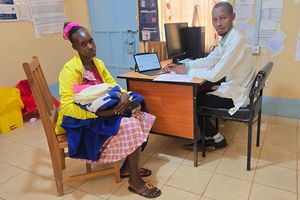
Sh3.15bn boost for referral hospitals as Kenya ramps up fight against maternal deaths

James Nyikal, chairperson of the National Assembly Departmental Committee on Health, said the allocation would support the implementation of health policies, regulation of the sector, management of referral facilities, and the provision of technical support to counties.

What you need to know:
- Kenya currently loses 15 mothers and 92 newborns every day to preventable causes.
- The maternal mortality ratio stands at 355 deaths per 100,000 live births, a figure that has barely changed in the last decade despite repeated policy commitments
The government has increased funding for referral hospitals and maternal and child health services by Sh3.15 billion in the financial year starting in July, giving a significant boost to some of Kenya’s most critical frontline health programmes.
According to the Budget and Appropriations Committee report, the largest increase was recorded under National Referral and Specialised Services, rising from Sh74.24 billion to Sh76.31 billion. Meanwhile, Reproductive, Maternal, Newborn, Child and Adolescent Health (RMNCAH) registered one of the largest gains across the health sector, increasing from Sh18.44 billion to Sh19.52 billion.
The overall health budget is shared between two state departments. The State Department for Medical Services, which oversees referral hospitals, curative care, and RMNCAH programmes, saw its allocation rise from Sh132.97 billion to Sh134.65 billion, a net increase of Sh1.68 billion. The State Department for Public Health and Professional Standards received an increase of Sh247 million, rising from Sh42.56 billion.
Together, the two departments account for a combined total of Sh177.46 billion, an increase of Sh1.93 billion.
Dr James Nyikal, chairperson of the National Assembly Departmental Committee on Health, said the allocation would support the implementation of health policies, regulation of the sector, management of referral facilities, and the provision of technical support to counties.
“The health sector's allocation for the 2026/27 financial year will enable the implementation of health policy and regulations, the management of national referral health facilities, and the provision of technical assistance to counties,” said Dr Nyikal.
These increases come just one week after President William Ruto launched the ‘Every Woman Every Newborn Everywhere (EWENE) Acceleration Plan 2026–2028’, presenting it as Kenya’s key strategy for reducing preventable maternal and newborn deaths.
At the launch, President Ruto emphasised the urgent need to address maternal mortality, challenging the country to treat maternal deaths as a national development issue rather than a routine health statistic.
“No nation can truly call itself progressive when women continue to lose their lives while giving birth. Every maternal death is a profound tragedy, especially since the vast majority of these deaths are preventable,” he said.
“Together, EWENE and the Maternal and Newborn Health Rapid Results Initiative signal a shift from commitment to execution, from intention to results. What gets measured gets done, and what gets done saves lives,” said Aden Duale, Health CS.
EWENE aims to reduce preventable maternal and newborn deaths by 15 per cent within six months through a Maternal and Newborn Health Rapid Results Initiative running until November 2026. The longer-term goal is to lower maternal mortality to 140 deaths per 100,000 live births by 2028.
The plan is backed by Sh7.5 billion in domestic financing, including Sh4 billion through the Social Health Authority to cover premiums for pregnant women, Sh1 billion to the Kenya Medical Supplies Authority for maternal and newborn commodities, and Sh2.5 billion for family planning supplies.
The plan also includes the recruitment and deployment of 5,000 nurses and midwives nationwide. Modern medical equipment has already been distributed to the 25 counties with the highest rates of maternal and newborn deaths.
Despite these investments, the challenge remains. Kenya currently loses 15 mothers and 92 newborns every day to preventable causes. The maternal mortality ratio stands at 355 deaths per 100,000 live births, a figure that has barely changed in the last decade despite repeated policy commitments. Postpartum haemorrhage remains the leading direct cause of maternal deaths, even as the government targets a reduction to 70 deaths per 100,000 live births.
Meanwhile, the gains made in referral services reinforce this approach to planning. The National Referral and Specialised Services department finances Kenyatta National Hospital, Moi Teaching and Referral Hospital, Kenyatta University Teaching, Referral and Research Hospital, and other national facilities that manage the country’s most complex medical cases, including obstetric emergencies.
These institutions occupy a central place in the EWENE strategy, which identifies weak referral systems as one of three critical factors contributing to preventable maternal deaths alongside delays in seeking care and delays in receiving timely treatment after reaching a health facility.
The Sh2.07 billion increase in referral services is therefore intended to strengthen a critical link in the maternal healthcare chain.
To finance these increases, Parliament reduced administrative spending within the Ministry of Health. Within the State Department for Medical Services, General Administration, which funds operations at the ministry’s headquarters, including senior management, planning, policy coordination, financial management, human resources, and intergovernmental liaison, was reduced by Sh1.43 billion to Sh34.86 billion. Administrative spending under the Public Health department was further reduced by Sh20 million.