How Kenya connected over 2,300 clinics through a single health records network
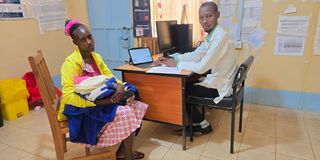
Elizabeth Mumbi speaks to clinical officer Daniel Kisavi at Kyambele Level Four Hospital in Ilima Ward, Makueni County, when she visited the facility for treatment on May 12, 2026.

What you need to know:
- By replacing fragmented paper records with a nationally connected digital system, the country has shortened the time between diagnosis and treatment from hours to seconds, particularly for patients managing chronic illnesses where delays can directly affect survival outcomes.
- The impact is most visible in busy referral hospitals and rural clinics alike, where clinicians no longer lose critical time searching for missing files, repeating laboratory tests, or reconstructing patient histories from memory.
- Instead, treatment decisions can now happen in real time, even in facilities operating with unstable internet connectivity
Elizabeth Mumbi alights from a boda boda at Makueni’s Kyambeke Level Four Hospital limping, her four-month-old baby strapped to her back. Earlier that morning while tending her crops, she cut her leg deeply with a hoe.
Overnight, she tells Healthy Nation, her baby had developed a fever and flu symptoms, forcing her to seek treatment for them both. “I could barely walk because of the pain, and my baby cried throughout the night because of the fever,” Elizabeth says softly as she adjusts the baby on her back. “I decided I had to come early before the condition became worse for both of us.”
She is assisted to the hospital’s triage area. This hospital is located 23 kilometres from Sultan Hamud.
Inside the outpatient clinic, Daniel Kisavi, a clinical officer, taps Elizabeth’s name on a tablet. Within seconds, her medical history appears on the screen, including previous visits, antenatal records and prescriptions issued during her pregnancy.
Kisavi first examines the baby, placing a thermometer under the infant’s arm before listening carefully to her breathing with a stethoscope. He asks Elizabeth about feeding patterns, coughs and whether the child has been sleeping normally. After noting mild respiratory symptoms and a fever, he prescribes medication and advises the mother to keep the baby hydrated and return immediately if the breathing worsens.
He then turns to Elizabeth’s injured leg. After removing the cloth wrapped tightly around the wound, a nurse cleans the cut with saline solution while Kisavi studies the depth of the injury under the bright clinic light. He orders a tetanus shot and antibiotics to prevent infection before the wound is disinfected and dressed with fresh bandages.
As the consultation continues, Kisavi updates both records on the tablet in real time, logging prescriptions, treatment notes and follow-up instructions before electronically sending the files to the pharmacy, laboratory and accounts departments across the corridor.
The internet connection is stable, but three years ago, none of this would have been possible. “To get full medical care, it used to take me the whole day,” Elizabeth, a mother of two, says. “Today, I only spent one hour despite having two cases of treatment.”
The clinic is one of thousands of facilities that rely on Kenya Electric Medical Record (KenyaEMR 3, commonly called TaifaCare), the national electronic medical records system now running in more than 2,300 health facilities across Kenya and covering all disease management. It gives clinicians what paper records could never do; provide a complete, longitudinal view of a patient that follows them across different facilities and across years.
“We started using this system last September. It records all patient data from triage, consultation, lab, prescription, pharmacy and accounts automatically,” Kisavi tells Healthy Nation. “This means there is seamless sharing of data between departments and this saves time. What would take us 10 minutes of paper work initially is now only taking three minutes.” That allows the facility, which handles 50-80 patients per day, to give faster medical care.
Dr Onesmus Kimanthi, the medical superintendent at the hospital, explains that despite only 12 tablets being available for use at the facility by various departments, the system can also be operated from a smartphone.
To him, the biggest impact he has seen has been the fast consolidation of data every month. “It is an effective healthcare system since it integrates all data at all stages of patient treatment. Besides saving time, it helps us with medical reporting at the end of the month,” Dr Kimanthi notes. “Initially it would take us three days to consolidate monthly reports but now it is just one click and we have the report in seconds.”
New files
A patient registered at one department can now move through an entire hospital system, from outpatient care to the laboratory and pharmacy, without repeatedly opening new files or retelling their medical history. At each stage, clinicians can access the same longitudinal record through KenyaEMR, the electronic medical records platform now linked directly to the country’s national health data warehouse.
The system allows health indicators from individual facilities to flow to national reporting systems in near real time, while keeping patient-level records at the health facility itself. In principle, it gives Kenya’s Ministry of Health something many public health systems across Africa have struggled to achieve for decades: a unified national view of patients moving through fragmented healthcare networks.
But building that kind of visibility across more than 3,600 health facilities spread across all 47 counties has exposed the deeper structural tensions shaping Africa’s digital transformation. Many facilities operate with unstable internet connections, intermittent electricity and shortages of trained technical staff. Governments, meanwhile, are becoming increasingly assertive about where sensitive national health data is physically stored and who ultimately controls it.
The economics are equally difficult. Maintaining large-scale digital infrastructure within constrained public health budgets has historically forced many governments to rely heavily on external vendors or overseas cloud infrastructure, raising concerns about both cost and sovereignty.
That is the environment in which Palladium has spent years operating. Its deployment of an Amazon Web Services Outpost in Kenya is designed to address precisely those constraints by bringing cloud infrastructure physically inside the country rather than routing critical health data abroad.
An AWS Outpost is a fully managed infrastructure solution delivered as physical hardware and software installed directly at a local facility, fully integrated with the global AWS cloud network. It runs the same hardware, software, application programming interfaces, and operational model as AWS data regions worldwide.
“AWS Outposts allow institutions to bring the cloud physically closer to where critical data and services operate.
It is a model that combines the innovation of global cloud infrastructure with the sovereignty and performance requirements of local digital economies,” expounds Teddy Berihun, vice president of digital technology and delivery at Palladium.
The distinction matters because cloud adoption in Africa has often involved a trade-off between technological sophistication and local control. Data frequently leaves national borders the moment it enters global cloud environments, creating legal, political and operational anxieties for governments handling sensitive information such as health records.
Palladium’s deployment changes that calculation. KenyaEMR and KeHMIS III, the Kenya Health Management Information Systems platform that aggregates data from thousands of facilities into a national warehouse, now operate on infrastructure that is physically hosted in Kenya, governed under Kenyan law and close enough to clinicians to reduce delays in accessing patient records.
“With AWS Outposts, you can run AWS services in Kenya and seamlessly connect to a broad range of services available in your nearest AWS Region for management and operations,” says Jyoti Ball, general manager for Sub-Saharan Africa. “You can run applications and workloads using familiar AWS services, tools, and APIs with the same reliability and stability as customers benefiting from regional services. Outposts support your workloads and devices requiring low latency, local data processing, data residency, and application migration with local system interdependencies.”
The technical implications are significant. The national data warehouse can process surveillance and routine service data more quickly because requests no longer need to travel thousands of kilometers to overseas cloud servers. Facilities operating with inconsistent internet connectivity can continue accessing and updating patient files because much of the computing power is now local.
For patients, the consequences are less abstract. A pregnant woman referred from a rural clinic in Turkana County to a hospital in Nairobi can arrive with her treatment history already visible to the receiving clinician. A tuberculosis patient moving between counties no longer necessarily becomes an anonymous case entering a blank file.
At scale, interoperability becomes more than an efficiency tool. It determines whether a health system can follow patients across geography and time, which public health experts increasingly view as essential for managing chronic disease, maternal care and infectious disease surveillance in rapidly growing populations.
The concentration of millions of patient records inside a national system, however, introduces another layer of vulnerability: security. “Patient information is encrypted at every stage, access is restricted to authorized personnel, and every interaction with the system is logged and audited, Berihun explains.
Those protections rely partly on AWS’s broader global security architecture, which continuously updates and monitors the outpost infrastructure using the same systems deployed across AWS networks internationally. Palladium says the architecture complies with Kenya’s Data Protection Act of 2019, one of the continent’s more comprehensive digital privacy laws.
The Kenyan deployment is also intended as a regional proof of concept. “The same hybrid architecture that works for Kenya’s national health data warehouse can be adapted in any country in Africa. The same governance and security model can be applied across sectors within a single country,” Mr Berihun notes.
The broader ambition, he says, is a new model of digital sovereignty for African governments: one that avoids forcing countries to choose between modern cloud infrastructure and domestic control over national data systems.
“By combining Palladium's deep development expertise with AWS's secure, scalable cloud infrastructure, we're enabling governments and organizations to modernize systems, improve service delivery, and drive measurable impact for communities,” Ball says.
Back at Kyambeke Level Four Hospital, Elizabeth sits quietly as a nurse secures the final bandage around her leg. Her baby, now calmer after medication, sleeps against her back as the morning rush in the outpatient wing continues around her.