Teacher’s cancer war, study calls for end to stigma
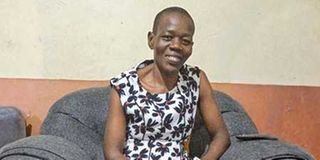
Elizabeth Kisiangani, a cervical cancer warrior during an interview.

Elizabeth “Sitawa” Kisiangani’s cervical cancer journey began in early 2020 with what seemed like a minor, embarrassing inconvenience: a persistent itch and an unusual discharge.
As a mother and teacher, she initially dismissed the symptoms, relying on sanitary towels and over-the-counter remedies.
But what she believed was a recurrent infection was, in fact, the first sign of a much more serious illness. After enduring weeks of silent struggle, she found the courage to see a gynaecologist, where a life-altering diagnosis awaited her: cervical cancer, already at stage two.
The discovery shattered her world and marked the beginning of a long and a harrowing battle.
“Those words broke me into pieces. The only comfort was that it was still at stage two. At that moment, I never thought it would become such a tough battle in the years to come,” she recalls.
Following treatment, the symptoms subsided, and she returned to her life, keeping the diagnosis a closely guarded secret.
“No one knew what I was going through. I chose silence and leaned on God. I thanked Him every day for giving me the strength to carry on, even when the future appeared uncertain,” she says.
“What I didn’t know then was that the real battle had only just begun. I thought I had won at first. The medication seemed to work, the discharge disappeared, and I carried on with life as though nothing had happened.”
Unfortunately, it was the calm before the storm. The symptoms were back in late 2021.
“My body began to change in ways I could not explain. Strange pains would come and go, sometimes sharp enough to bring tears to my eyes. Fatigue became my shadow, always there, no matter how much rest I took. The truth started to sink in – it was not going to be a short journey. Cancer is not something you can wish away after a few tablets. It demands strength, patience, faith and courage I wasn’t sure I had,” she recalls.
“There were days I looked in the mirror and hardly recognised the woman staring back at me. The smile was there, but behind it was fear – fear of what tomorrow held, fear of telling my loved ones and the fear of walking this road alone. Yet deep inside, something whispered to me: ‘keep going, your story is not over’. That whisper became my driver, even when the battle grew tougher than I imagined.”
A hysterectomy seemed to offer another chance at a cure, and she took it.
In March 2023 while on holiday, the pains returned. A doctor’s visit brought a devastating new diagnosis: ovarian cancer, stage 3b.
The news plunged her into a spiral of denial, despair and desperation. The teacher abandoned conventional medicine, spending millions of shillings on traditional drugs, concoctions and even went to a sorcerer, all in a desperate search for a miracle.
Loans piling
She was given four months to live. For Ms Kisiangani, that was a death sentence.
“I was now sure I was going to die. I wept daily and never thought of anything else but death. I believed my life was over, and even made a photo my son would carry as my body was escorted to the grave. When my body couldn’t hold it any longer, I went for treatment,” she says.
The teacher withdrew from the world, deactivated her social media accounts and went into isolation.
Her savings were gone, assets sold and loans were piling. Still, she kept the tragedy to herself, afraid of sharing the news with anyone, including her children, who were in boarding school.
One morning during school holidays, a tuft of hair on Ms Kisiangani’s pillow made her daughter suspicious.
“Mum, who shaved you?” the girl asked.
“My son was there too. I was too weak to get out of bed and my eyes were bloodshot due to a migraine and crying. I had to break the news to my children,” she says.
“I explained the diagnosis, telling them it was the reason for my hair was falling off. My son, Kinyanjui, immediately started googling to know more about cancer, and read that it kills. My daughter cried. Kinyanjui acted strong but I could feel the heaviness in his heart. I decided to seek psychological help.”
The teacher’s best friend, who knew about her struggles, convinced her to share the diagnosis, assuring her that she would get help.
Strangers and friends rallied around her, providing emotional and financial support. The outpouring of kindness transformed Ms Kisiangani’s outlook.
“I am on chemo but I look good. Let me live positively,” she told herself, a shift in mindset that marked the beginning of a new chapter.
Her children have cared for her through her weakest moments. They groom their mother as they crack jokes about her body changes.
Inspired by her struggles, Ms Kisiangani has now established the The Elizabeth Sitawa Cancer Community-Based Organisation, which is dedicated to giving hope to others battling the disease.
The journey has taught her to listen to her body and break the silence surrounding women’s health. It has also shown her the profound power of community.
Psychological burden
Friends from the US have even stepped in to sponsor her children’s education.
“Your health should be your first responsibility,” her boss at the school once advised her, a piece of wisdom that now defines Ms Kisiangani’s life.
Though the cancer has spread to her lungs and throat and teaching has become challenging, Ms Kisiangani continues to fight, hope and hold on for her sake and that of her children.
Her journey is reflected in a new study that reveals the profound psychological burden that affects cancer patients.
The research, conducted by Amref International University and Moi Teaching and Referral Hospital, paints a picture of high rates of anxiety, depression and stigma among those battling the illness.
According to the study, which sampled 200 adult cancer patients from leading treatment centres in Nairobi, the psychological distress is alarmingly high.
The overall prevalence of anxiety was 68 per cent and depression 55 per cent, with 18 per cent of patients reporting suicidal thoughts.
These figures are considerably higher than global averages and highlight a critical gap in cancer care in Kenya and the region.
The research found that patients with advanced-stage cancer (stages III and IV) are disproportionately affected, with anxiety and depression rates soaring to 78 and 64 per cent respectively.
This means that as the disease progresses, the psychological burden intensifies too.
The study noted a troubling gender disparity, with female patients being more likely to report suicidal ideation (22 per cent) compared to male (13 per cent).
One of the most important findings is the role of stigma. Sixty per cent of participants said fear of social rejection and discrimination associated with cancer and mental illness was a key barrier to seeking support.
This fear often leads to patients suffering in silence, relying on informal coping mechanisms rather than professional help.
Only 12 per cent of patients reported accessing professional psychological services, and a majority of these (75 per cent) were in private facilities.
In public hospitals, the situation is dire. The average waiting period for psychological services exceeds three weeks, and these facilities face a significant shortage of trained mental health professionals.
The study found that 62 per cent of patients identified the lack of trained staff as a key obstacle, and 54 per cent were unaware that such services were even available. This creates a two-tiered system of care, where those with higher income and education levels are far more likely to receive the support they need.
While the need for formal support is clear, patients aren’t without their own strategies. The research revealed that patients predominantly rely on religious faith (70 per cent) and family support (65 per cent) to cope. While these community-based networks are vital, they are often insufficient for managing severe psychological symptoms.
The study’s authors argue that caring for a patient’s mind is just as critical as treating their body. They recommend immediate changes to make mental health support a standard part of cancer care, especially in public hospitals.