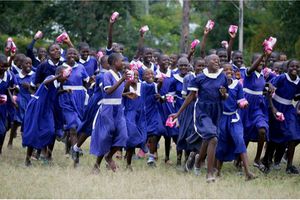
Teenage pregnancy: The postcode that shapes a girl's future

A 17-year-old Form Three student, eight months pregnant, has had her education interrupted. Nationally, 11.9 per cent of girls aged 15 to 19 have ever been pregnant.

What you need to know:
- Kenya’s teenage pregnancy rate has fallen from 14.8 per cent in 2022 to 11.9 per cent.
- West Pokot sits at 24.5 per cent against Makueni’s 3.7 per cent, driven by poverty, early marriage, strong cultural norms and low contraceptive use.
Across Kenya, a teenage girl today has better odds than her peers did four years ago.
Fewer are becoming mothers. Teenage pregnancy has fallen from 14.8 per cent in 2022 to 11.9 per cent in the 2025-26 Kenya Mini Demographic and Health Survey by the Kenya National Bureau of Statistics. The adolescent birth rate has dropped from 73 to 63 per 1,000 girls.
Yet the national numbers paint a comforting picture. At county level, it breaks apart. A girl's chance of becoming a mother still depends heavily on where she was born. In Makueni, 3.7 per cent of girls aged 15 to 19 have ever been pregnant. In West Pokot, the worst-hit county, it is 24.5 per cent.
Picture a girl turning 15 in West Pokot. Call her Chebet.
Chebet is not a real person, but the numbers around her are real. She lives in a county where 24.5 per cent of girls aged 15 to 19, nearly one in four, have already been pregnant. And 23.1 per cent have already given birth.
Nothing about Chebet's intellect or potential would change if she lived in Makueni. Only her chances would. While the national figures offer hope to thousands of teenagers, Chebet is nearly seven times more likely than a girl in Makueni to be pregnant before she turns 20.
What the survey found
Among the 3,916 girls aged 15 to 19 interviewed, 9.4 per cent have given birth, 2.7 per cent are pregnant now and 1.0 per cent have lost a pregnancy. In all, 11.9 per cent have ever been pregnant. Most of these pregnancies ended in a live birth.
For some girls, the story starts very early. About one in 20 girls aged 15 to 19 (5.1 per cent) said they had sex before the age of 15. About one in 70 (1.4 per cent) had been pregnant before 15, and about one in 140 (0.7 per cent) had given birth before that age. Put another way, roughly one in eight girls aged 15 to 19 who have ever been pregnant was first pregnant before turning 15.
Where the gaps are widest
West Pokot has the highest rate at 24.5 per cent, followed by Migori at 23.3 per cent. Next are Kajiado (19.6), Turkana (19.0), Embu (18.6), Kisii (17.6) and Narok (16.2). Nakuru and Homa Bay stand at 15.8 per cent each, Kakamega at 15.5 and Samburu at 15.0. In all, 23 of the 47 counties are above the national average.
At the lower end are Makueni (3.7 per cent), Garissa (4.8), Laikipia (4.9), Murang'a (5.0), Kilifi and Siaya (5.4 each), and Kiambu and Elgeyo-Marakwet (5.6 each). West Pokot's rate is six to seven times that of Makueni.
Some counties show unusual patterns. In Embu, 18.6 per cent of girls have been pregnant, but only 6.8 per cent have given birth. Some 8.2 per cent are pregnant now and 5.4 per cent have lost a pregnancy. Embu has the highest rate of both in Kenya. Migori has the second-highest share of current pregnancies at 6.5 per cent. Kajiado (4.4 per cent) and Kakamega (4.1 per cent) follow Embu on pregnancy loss.
Some figures have shifted since 2022. That survey put Migori at 23 per cent, Homa Bay at 22.9, Siaya at 20, and Kisumu at 11.6. Migori has barely moved, at 23.3 per cent now. Homa Bay has fallen to 15.8 per cent and Siaya to 5.4 per cent. Kisumu has risen to 14.2 per cent.
Poverty and family planning gaps
The survey report says huge gaps remain, driven by poverty and poor access to reproductive health services. Girls from poor families face a much higher risk of becoming pregnant than those from wealthier homes.
Access to family planning makes it worse. Modern contraceptive use nationally has stayed flat at 57 per cent since 2022. High-performing counties such as Murang'a, at 76 per cent, sit far above hard-to-reach areas.
The gap between teenagers and older women is also wide. Only about one in 12 girls aged 15 to 19 uses any method of contraception. Among women aged 20 to 24, about four in 10 do. Among teenagers, the main methods are implants (one in 36) and male condoms (one in 50). Very few use injectables, pills or emergency contraception.
Among married teenagers aged 15 to 19, 41.9 per cent use a method and 39.9 per cent use a modern one, mostly implants (20.6 per cent) and injectables (13.2 per cent). Still, this is the lowest use of any group of married women, except those aged 45 to 49. It is far below the 57.2 to 66.1 per cent seen among married women aged 20 to 44.
Sexually active unmarried teenagers use different methods. Male condoms are used by 16.9 per cent, implants by 8.5 per cent and injectables by 2.9 per cent. Another 2.2 per cent have used emergency contraception. Traditional methods, namely the rhythm method (9.8 per cent) and withdrawal (3.1 per cent), account for 12.9 per cent. In all, 47.3 per cent use a method. That leaves 52.7 per cent, more than half, using nothing at all.
Life in West Pokot
In West Pokot, local health workers continue to battle female genital mutilation (FGM) and early marriage. Both keep young women out of school and out of work.
West Pokot still leads the country at 24.5 per cent. But the rate has dropped by more than 10 percentage points from 36 per cent in 2022. Local health leaders say this shows their efforts are working. Old traditions and late clinic visits, they add, keep the numbers high.
Dr Solomon Kokwo, the West Pokot County Director for Health, welcomed the drop.
"I'm glad that it's come down, really. Initially, out of every ten women, there were four who were teenagers or underage."
He credited government agencies working together, the use of the Children Act to stop child marriage, and local chiefs who report defilement cases to the police.
"The government's insistence that pregnant girls stay in school has also helped. Even those who become pregnant, they deliver, and they go back. So that has really helped to reduce and empower the girl child."
Still, enforcing the law in small villages is difficult when traditions run deep.
"Even so, strong cultural norms in some areas make cases hard to prosecute. Most of the community have accepted that as part of their norms, culturally."
This acceptance of early marriage creates deep fear among young girls. Many know their pregnancies are the result of an illegal act, so they hide away and avoid health centres.
"First of all, they know whatever is happening is illegal, so they try to buy their time. Mostly they go for home deliveries, and they rarely come for antenatal care. Sometimes they give birth and develop complications at home, and so we end up losing them."
When teenagers do come to hospital, health workers focus on helping them rather than scaring them away.
"Usually, when we see the teenagers when they come to the hospital, we also try to link with the relevant departments, especially the Children's Department, so that they can follow up on the cases. Not necessarily to fight the culprits, but also for counselling purposes and support.
"The priority is to keep them coming back. It is already something happening in the community, so you want to be very careful about how to approach it. Otherwise, they will never come to the hospital."
Low contraceptive use makes the problem worse, driven by a strong desire for large families. In West Pokot, the average home has six or more children, and some have up to 10. High bride prices paid in cows put pressure on young wives to have many children quickly.
"Early marriage compounds the problem. Once they get married, while they're still teenagers, all that the man wants to see are children. Dowry plays a role as well. The community pays a hefty dowry because somebody wants to see children. A large number of children also ties the girls down, and they are unable to leave the marriage."
To tackle this, the county is building better partnerships. Dr Kokwo said discussions with partners such as World Vision focus on forming a technical team to handle teenage pregnancy directly.
"We have to sit down regularly to look at what kind of information is coming from the communities. The group would work with traditional leaders and security agencies. We sit with the Pokot Council of Elders so that they can go talk to the people. We involve the NGAO, the prosecutors, the police officers and the security departments in a more structured way."
He also called for research to understand what caused the drop since 2022, so the county can put more money into what works.
The policy question in Nairobi
In Nairobi, national health leaders see the progress, but they work within strict legal rules when helping young people.
Dr Edward Serem, Head of the Division of Reproductive, Maternal, Newborn, Child and Adolescent Health at the Ministry of Health, said the country has made "tremendous improvements" since 2014, when Samburu had the highest rate in Kenya. After public awareness work, Samburu's rate has dropped to 15.0 per cent, although that figure rests on a small sample of 22 girls.
"Looking ahead, we still need to intensify the provision of information to teenage girls, and more so in primary and secondary schools. The intervention for preventing teenage pregnancy is the provision of information to school-going girls, and equipping the community health promoters (CHPs) to provide the information to those who don't go to school."
"The ministry has shared a policy guide with the Ministry of Education and distributed a booklet titled Understanding Adolescence to some counties and schools to help teachers teach life skills to students, so that they learn how to prevent pregnancies."
Also read: The girls whose dreams ended with pregnancy
However, giving contraceptives to girls under 18 remains restricted. The Constitution guarantees everyone the right to health. Yet the National Reproductive Health Policy (2020/2030) states that children under 18 must get permission from a parent or guardian before getting contraceptives.
Dr Serem said the ministry must follow the set policies.
"We cannot provide contraceptives to children. It is a policy question. We are policy drivers, and once the policies have been given, then you implement. You cannot implement something outside the policy. So, if we are to give them contraceptives, it means we need to go back and review the reproductive health policies, which requires a total overhaul of the policy."
The policy has sparked strong debate. Human rights groups, lawyers and county health workers argue that denying confidential contraceptives to teenagers violates their right to health and ignores the reality of early pregnancies.
In cities, officials talk policy and law. In West Pokot, Chebet wakes up to another ordinary day. The national numbers show Kenya is improving. For a girl like her, the national average feels far away.
Growing up there remains a daily challenge shaped by where she was born.