The blacklist : Duale, Mwangangi hand over 1,188 files on fraudulent health facilities to DCI
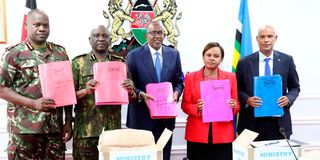
Health Cabinet Secretary Aden Duale (Centre) during the handover of 1,188 files from the Social Health Authority (SHA) and Kenya Medical Practitioners and Dentists Council (KMPDC) on September 1, 2025 at the Ministry of Health. With him are SHA CEO, Dr Mercy Mwangangi (2nd right), Inspector-General of Police Douglas Kanja (2nd left), his deputy Gilbert Masengeli (left), and Director of Criminal Investigations Mohamed Ibrahim Amin.

Health Cabinet Secretary Aden Duale and Social Health Authority (SHA) Chief Executive, Dr Mercy Mwangangi, on Monday delivered 1,188 files and supporting evidence to the Directorate of Criminal Investigations, marking a decisive escalation in the government's battle against healthcare fraud that has cost taxpayers billions of shillings.
The handover represents the culmination of extensive investigations that have uncovered fraudulent claims totalling Sh10.6 billion since the rollout of the SHA system. The files target healthcare facilities and individuals involved in systematic defrauding of public funds through sophisticated schemes designed to exploit Kenya's healthcare financing system.
Speaking during the official ceremony, Mr Duale revealed that SHA has suspended 1,188 health facilities for fraudulent activities to allow for investigations, with rigorous forensic audits and digital systems uncovering what he described as "deeply troubling patterns of fraud that directly harm the public and deplete monies meant for patients."
The fraudulent practices identified include upcoding, where facilities bill for more expensive procedures than those actually performed; falsification of medical records through submission of altered or false documents; illegal conversion of outpatient visits to inpatient admissions for billing purposes; and phantom billing, where claims are submitted for services provided to non-existent patients.
The handover follows last week's gazette notice by Dr Mwangangi suspending an additional 45 health facilities from receiving SHA benefits, bringing the total number of suspended facilities to 85 last month alone. This action came after the Kenya Medical Practitioners and Dentists Council (KMPDC) closed 728 non-compliant facilities and downgraded approximately 301 others, rendering all of them ineligible for SHA benefits.
The files submitted represent a collaborative effort between multiple agencies. SHA contributed 190 files categorised into three groups: 24 facilities with concluded evidence of fraud (Category 1), 61 facilities with ongoing investigations (Category 2), and 105 facilities closed by KMPDC that also held SHA contracts (Category 3). The KMPDC submitted 998 files covering facilities operating in violation of the law.
Mr Duale explained that KMPDC's extensive inspections resulted in the closure of 544 health facilities for operating without registration or licences, while 454 facilities had their operating licences revoked due to various violations including operating below required standards, employing unlicensed practitioners, and lacking critical infrastructure that posed direct threats to patient health.
The CS emphasised that criminal prosecution targets both fraudulent and non-compliant healthcare facilities and individuals, representing a critical milestone in protecting public funds and safeguarding Kenya's healthcare system integrity. He highlighted that SHA has already withdrawn user rights for 12 healthcare professionals implicated in criminal schemes and will be surcharging facilities to recover monies paid based on fraudulent claims.
Legal penalties for healthcare fraud are substantial under existing legislation, CS Duale reminded the gathering. He cited Section 48(5) of the Social Health Insurance Act, 2023, which provides for fines of up to Sh2 million, suspension, and removal from the register of empanelled providers for facilities that knowingly or fraudulently alter information to defraud the Authority.
The Health CS also referenced Section 22(4) and (5) of the Medical Practitioners and Dentists Council Act, CAP 253, which prescribes fines of up to Sh10 million or imprisonment for terms not exceeding five years for facilities operating unlicensed premises or employing unregistered practitioners.
Mr Duale revealed that for the first time, the government has deployed a comprehensive digital system built on artificial intelligence (AI) and a big data fraud engine. Since the rollout of Taifa Care over the past year, the SHA system has collected vast amounts of data, enabling real-time detection, pattern analysis, and prevention of fraudulent transactions.
"Every transaction made by patients, doctors, or facilities is recorded in the system in real time," Mr Duale explained, adding that the multi-agency collaboration will see DCI investigators work alongside SHA, KMPDC, Ministry of Health, and Digital Health Agency officers to prosecute those responsible.
Receiving the files, DCI Director Mohammed Amin lauded the Ministry of Health's efforts in addressing fraud proactively and promised comprehensive investigations to bring culprits to justice. "We can confirm and verify that we have received 1,188 files from SHA. We will now take over and let you know how we proceed in due time," he stated.
Inspector General of Police Douglas Kanja emphasised that defeating corruption requires consolidated effort, including vigilant members of the public who must report suspicious activities to authorities. The government has established a toll-free number, 147, for Kenyans to report concerns or information regarding fraudulent activities to SHA.
Mr Duale warned that any facility, doctor, or patient involved in fraud now falls under the jurisdiction of the criminal justice system and will be prosecuted to the fullest extent of the law. He announced that he would distance himself from the independent investigations and would no longer comment on the ongoing probe, directing future inquiries to DCI offices along Kiambu Road.