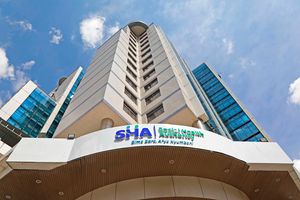
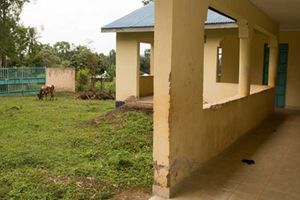
A review of reports by the Auditor-General and Controller of Budget (CoB) has revealed how billions of shillings continue to be looted through salaries for non-existent workers, especially in the counties, capitation funds wired to non-existent schools and reimbursements to fake hospitals.
Despite financial safeguards imposed by the Public Finance Management Act, Public Audit Act and National Treasury, among others, the theft of public funds continues. The latest scandal has led to sanctions against over 1, 000 hospitals involved in fraud.
Health Cabinet Secretary Aden Duale during a press briefing at Afya House in Nairobi on August 25, 2025.
Photo credit: Lucy Wanjiru | Nation Media Group
Health Cabinet Secretary Aden Duale said that “fraud is a major threat to health insurance, both public and private”. Implementation of a digital system to process hospital claims, he explained, has “helped identify fake facilities that we have closed and removed from SHA”.
“So far more than 1,000, this work is still in progress. Any facility paid, then investigation shows it was fraud, we will prosecute and charge the facility to refund,” Mr Duale told Nation last Sunday prior to the press briefing the following Monday, when he revealed the extent of the attempted theft.
The fraudulent practices involved multiple billing and ghost patients, collusion between SHA officers and some non-existent health facilities, claiming for more expensive procedures than those performed and submission of altered medical information to inflate claims, among others.
In 2023, an audit commissioned by the National Health Insurance Fund (NHIF), which was replaced by SHA, exposed how health facilities used fraudulent means to siphon hundreds of millions of public funds in fictitious claims after allegedly administering treatment to unsuspecting older people with NHIF cards.
The audit covering the 2022 and 2023 period showed how some health facilities engaged in fraudulent practices by altering and falsifying information in collusion with some rogue NHIF officials and cardholders to pocket close to Sh1 billion.
CS Duale: SHA chairman Abdi Mohamed used to own Ladnan Hospital, there's no conflict of interest
While some of the hospitals filed claims and got paid for patients they claimed to have admitted for treatment, records from the employers indicated that the said patients were at work during the period of the alleged admission.
Some patients denied being treated by the hospitals, with some saying they were not aware of the facilities.
To curb fraud, Mr Duale said the Ministry of Health has created “a single source of truth that shows the licensed facilities’ digitised records”.
“We have also geofenced the facility and made it impossible for a doctor to authorise procedures when they are not at the facility. We have introduced biometrics identification to enable the unique identification of patients at facilities,” Mr Duale explained.
After review of claims, those with poor documentation are being rejected and files detailing fraud are being investigated for prosecution, the CS added.
Meanwhile, a recent special audit on the capitation and infrastructure grants to public schools between the 2020/21 and 2023/24 financial years revealed that over Sh20 million was sent to 14 ghost schools.
Presenting the special audit findings before the Public Accounts Committee of the National Assembly, Mr Justus Okumu, the director in charge of audit at the Office of the Auditor-General, said they could not locate the schools during inspection.
Kenneth Kemboi Murwes, a resident of Kaptiony village in Baringo North Constituency, walks through the gate of the non-existent Kaptiony Girls High School on April 24.
Photo credit: Jared Nyataya | Nation
“The ghost schools are the ones in the system but when we got to the ground, we did not find them,” said Mr Okumu. “The schools are getting the capitation fees but the education officers could not show us where they exist.”
Mr Okumu further told the committee that a fact-finding mission to schools established that there was no infrastructure in the purported institutions. They only existed on paper, with bank accounts through which they receive the capitation.
Notably, six schools had ceased operations but received capitation amounting to Sh889,348 during the years under review.
The special audit established that there were instances where schools withdrew cash or transferred funds from tuition accounts, contrary to the guidelines issued by the State Department for Basic Education.
The special audit dismissed the capitation model used to disburse the public funds saying that it is not equitable, an indication that undeserving learners may have benefited.
This even as it emerged that public schools are underfunded to the tune of Sh117 billion. Secondary schools are the most underfunded at Sh71 billion, followed by junior schools (Sh31.98 billion), primary schools (Sh14 billion) and secondary schools’ special needs education (Sh67.1 million).
Education Cabinet Secretary Julius Ogamba before the National Assembly Committee on Implementation at Bunge Tower, Nairobi, on August 19, 2025.
Photo credit: Dennis Onsongo | Nation Media Group
Tinderet MP Julius Melly, who chairs the National Assembly’s Education committee, told the Nation that they have summoned Education Cabinet Secretary Migos Ogamba over the weaknesses in the disbursement of capitation for public schools.
“We have planned a meeting with the Ministry of Education officials led by the CS. They should tell us what they are doing to address these capitation issues,” said Mr Melly.
Inflated student enrolment figures are another way schools steal public money. In 2020, then Education Cabinet Secretary George Magoha put the money lost yearly through manipulation of student numbers at over Sh750 million.
On Saturday, Education Cabinet Secretary Julius Ogamba said the ministry had delayed disbursement of funds to schools as it cleans its data to weed out ghost schools.
“A team at the ministry is working on the release of the money. We have to be more careful than before. We must verify and confirm the number of learners and schools,” he said.
According to the Public Financial Management Reforms Secretariat based in the National Treasury, the problem of ghost workers on payroll is “a pandemic” for many counties.
“Billions of taxpayer money is pumped out annually from the government to pay non-existent employees who have been fraudulently placed on the payroll systems of most county governments,” the secretariat says in a report on the Treasury’s website.
The county ghost worker, the secretariat explains, is one who is listed in the payroll—and is paid—but does not work for the county government.
“Ghost workers on payroll may be a real person who, knowingly or not, is put on a payroll, or a fictional person invented by a fraudster,” the report explains.
The secretariat further explains that the ghost worker problem is not limited to salaries, but also extends to pension payments, as many of the ghost workers naturally graduate to the pension scheme, while others are added by managers.
“Ghost jobs are a massive drain on county finances as hundreds of billions of shillings are spent paying salaries and pension entitlements to non-existent workers, and in many instances, to people who have no excuses to receive those wages other than the fact that they knew someone who could easily add their names to the payroll,” the report states.
It cited the case of Nyamira County where the county leadership was pressed by Senators to explain how the devolved unit lost Sh2.8 billion in salaries allegedly paid to ghost workers in the 2018/2019 financial year.
The report also cites an audit report of the human resources department in Vihiga County that showed ghost workers were earning Sh32 million. The report by the Vihiga County Public Service Board showed about 426 employees could not be traced at their duty stations during the audit.
In Kericho County, Auditor-General Nancy Gathungu flagged the possibility of ghost workers since 1,955 employees had not been allocated personal numbers and were being paid outside the Integrated Personnel and Payroll Database (IPPD). The auditor noted that lack of personal numbers may lead to loss of funds through ghost workers.
Another human resource audit report of 2022 revealed that ghost workers have been on Lamu County’s payroll for years.
A review of the county governments’ budget implementation report for the first nine months of the 2024/25 financial year before Parliament revealed that 22 of the 47 devolved units spent Sh6.5 billion on workers outside the payroll.
This is largely executed through the manual payroll, with Nairobi City County paying the highest amount—Sh629.63 million—in salaries outside the electronic system, according to the CoB.
The manual payrolls comprise of salaries for staff yet to be onboarded into the Government Human Resource Information System, salaries for casual staff, top-up allowance for security personnel, gratuity remittances to pension schemes for staff on contract, and Laptrust/Lapfund pension contributions.
The CoB report reveals that the counties’ use of manual payrolls creates opportunities for the theft of public funds. This includes irregular recruitment practices, employment of casual labourers beyond legal limits, and improper compensation, such as overpayment of allowances.
Controller of Budget Margaret Nyakang'o.
Photo credit: Jared Nyataya | Nation Media Group
“Manual payroll is prone to abuse and may lead to the loss of public funds where proper controls are lacking,” CoB Margaret Nyakang’o says in the budget implementation report.
The failure by counties to maintain accurate payrolls has led to a wage bill crisis. A report of the County Public Accounts Committee of the Senate on the audited accounts of the counties for the financial year 2023/24 shows that 11 counties complied with the 35 per cent wage bill ceiling, while 16 counties spent more than 50 per cent of their revenues on wages. The report notes that this “severely constrained operational and development budgets”.
The failure to maintain accurate payrolls led to unsupported employee compensation totalling Sh4.2 billion.
Nairobi’s Sh629.63 million processed through manual payrolls accounted for 4.9 per cent of the total personal emolument cost.
Busia County had Sh569.91 million processed through manual payrolls, which accounted for 21 per cent of the total personal emolument cost. In Uasin Gishu County, Sh493.6 million was processed through manual payrolls, which accounted for 14 percent of the total.
Wajir County processed Sh453.74 million through manual payrolls, Elgeyo-Marakwet County (Sh391.31 million), Marsabit (Sh382.81 million), Nyeri (Sh358.54 million), Siaya (Sh352.98), Kitui (Sh346.45 million), Laikipia (Sh296.35 million), Bungoma (Sh250.69 million), Mombasa (Sh227.87 million) and Kisumu (Sh217.16 million).