The hidden cost of plastic: A Sh193.8 trillion global health crisis
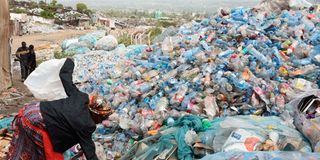
Susan Wangui 60 collecting plastics bottle waste for the purpose of recycling and selling at Gioto dumpsite in Nakuru city on July 16, 2022.

What you need to know:
- A new study published in the scientific journal Lancet Countdown reveals that the world loses $1.5 trillion annually (Sh193.8 trillion) to diseases linked to plastic use and exposure. This amount is approximately 93 times larger than Kenya's annual budget
- The scientists found that these impacts disproportionately affect people from low-income countries and vulnerable populations, particularly children
In Geneva, Switzerland
You are probably reading this story on a device that contains plastic components, even those you cannot see. Harmless, you may presume. Useful, you certainly would agree.
Beyond its beauty, convenience, and ubiquitous nature, scientists have now quantified how much plastic's health-related impacts cost the world.
A new study published in the scientific journal Lancet Countdown reveals that the world loses $1.5 trillion annually (Sh193.8 trillion) to diseases linked to plastic use and exposure. This amount is approximately 93 times larger than Kenya's annual budget.
The scientists found that these impacts disproportionately affect people from low-income countries and vulnerable populations, particularly children.
"Plastics are a grave, growing, and under-recognised danger to human and planetary health. Plastics cause disease and death from infancy to old age," the study warns.
The researchers explain that when people are exposed to plastics early in life, they are likely to experience reduced fertility and increased predisposition to diseases such as cancer, diabetes, and heart-related complications as they age.
"Early-life exposures to plastics and plastic chemicals are linked to increased risks of miscarriage, prematurity, stillbirth, low birth weight, and birth defects of the reproductive organs, neurodevelopmental impairment, impaired lung growth, and childhood cancer," the study shows.
Plastic production, which has been a highly contentious issue in ongoing negotiations in Geneva, is also linked to climate change that puts people's health at risk.
"Plastic production is highly energy-intensive and releases more than 2gigatonnes of carbon dioxide equivalent and other climate-forcing greenhouse gases into the atmosphere each year," the researchers explain.
Other reports show that despite plastic's dire effects on human and planetary health, plastic production continues to increase annually. Current production stands at approximately 435 million tonnes, and this figure could exceed 700 million tonnes by 2040 if existing conditions persist.
"Current patterns of plastic production, use, and disposal are unsustainable and socially and environmentally unjust. Plastic-associated harms disproportionately damage disempowered and marginalised populations," the study explains.
Tiny plastic particles invisible to the human eye (scientifically known as micro-plastics and nanoplastics) have recently been discovered by scientists throughout our bodies—in blood, breast milk, liver, kidneys, colon, placenta, lungs, spleen, brain, and heart.
Underestimated cost
On the side-lines of ongoing negotiations in Geneva, Nation spoke with Emerita Professor Sarah Dunlop, director of plastics and human health at the Minderoo Foundation. She says that despite the high cost of plastics on human health quoted in the study, the figure actually represents an underestimation.
Their study analysed data from 39 countries globally, including Tanzania, Uganda, and Cameroon.
"It is worrying," she tells Nation.
She explained that this analysis was based on three chemicals used in plastic manufacturing: Bisphenol A (BPA), used in making epoxy resins; DEHP (di (2-ethylhexyl) phthalate), which makes plastics flexible; and polybrominated diphenyl ethers (PBDE), mostly used in electronics manufacturing.
"Plastic is a flawed material because the chemicals that go into it leak out of plastic products and enter our bodies," she explains.
"We know this happens because we can measure the metabolites in our urine and blood. This means we can estimate exposure levels and link them to health impacts," she adds.
In the study, Professor Sarah told Nation that BPA, for instance, was linked to heart diseases like stroke and heart attack. They analysed all causes of death linked to DEHP chemicals, while PBDE exposure contributed to the loss of Intelligence Quotient (IQ) points in children.
"Exposure during pregnancy is serious. It is changing what it means to be human," she says.
"There are many other chemicals and many other health impacts, so this represents the absolute minimal baseline," she adds.
To put the cost into context, Professor Sarah explains that the money lost to plastic's health impacts could fund vaccinations for every new-born for the next 200 years or solve world hunger until 2065.
"It's a concerning way we are operating, really not understanding the true cost of our actions," she says.
She explained that as part of the *Lancet Countdown*, scientists identified four areas they will scrutinise to assess plastic's impact: production, emissions, health impacts (both direct and indirect), and ecosystems, including the marine environment.
Regarding the African continent, Professor Sarah said that plastic's impact on human health knows no boundaries.
"Africa faces a larger plastic waste management problem than anywhere else in the world. This is unacceptable. Africa needs support to address this issue," she says.
"The truth is, when you consider the treaty's context, we are all exposed. This is a global problem requiring a global solution," she adds.