The HIV clinics that disappeared when American aid stopped
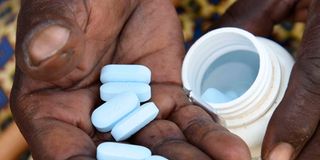
A person living with HIV taking ARVs.


What you need to know:
- The abrupt USAid stop-work order left a Sh31 billion hole in Kenya's HIV response, which one county government says the national government must now fill.
There was a time when a teenager in Laikipia could collect antiretroviral drugs from a clinic built specifically so no one would know why they were there. That clinic is gone. So is the money that built it.
Leon Mwangi has seen that world fall apart. At 23, he is the Operation Triple Zero (OTZ) champion for Laikipia County, a peer leader supporting young people living with HIV through the stigma, isolation and self-doubt that so often accompany the diagnosis. OTZ is an asset-based health initiative that empowers adolescents and young people living with HIV to take charge of their treatment and reach viral suppression.
He was not always aware of what he was carrying. Mwangi was diagnosed with HIV as a child and put on medication, but he did not fully understand what that meant until he was in Class Six; he had spent years believing he was being treated for a chronic chest problem.
For years, American funding backed his work as a peer leader. Now, it survives largely on his own goodwill.
"I can only afford to do what I have in my own facility, to talk to them, without expecting anything. I'm doing it out of goodwill, which not many people can do," Mwangi says.
The support group he once ran for young people in Laikipia has effectively collapsed. Before, Mwangi could travel to meet a struggling peer, sit with them, and talk them back from the edge of abandoning treatment, trips funded with transport and lunch allowances under a US-backed programme called the USAid Tujenge Jamii Programme. That funding is gone. So, in most cases, the outreach is too.
"No one is giving me that transport," he says simply, of why he now reaches far fewer people.
The clinics themselves have changed too. HIV services for young people in Laikipia used to run from a dedicated clinic space, separate from the general hospital. This small design choice mattered enormously to teenagers wary of being seen collecting antiretroviral drugs.
"If you tell someone to come, even if he comes for medicine, he won't feel it. Now, that privacy is gone; HIV care has now been folded into general hospital services, so some people are likely to hesitate to go in for fear of their status being divulged," says Mwangi.
Drug supply has also become less predictable. Mwangi says that before the funding cuts, patients on stable treatment could be given up to five or six months of medication at a time. At the height of the crisis, that shrank to a single month's supply. It has since been restored to five months, he says, but the disruption briefly turned routine treatment into a monthly scramble.
For years, in various counties, small, low-profile HIV clinics operated almost like a separate world within Kenya's health system, funded not by the National Treasury but by the United States government, and built, deliberately, to keep a distance from the stigma that still surrounds an HIV diagnosis in many communities. Patients would sometimes travel for hours, picking up their antiretroviral drugs in a different town from where they lived, precisely so that no one at home would know. Community "link assistants" ferried medication to households too afraid to be seen at a facility at all.
That system, largely funded through USAid and the US President's Emergency Plan for Aids Relief (Pepfar), has now been dismantled through a slow, uneven absorption into Kenya's mainstream public health system that front-line workers say has left patients with less privacy, less time and, in some cases, no clear programme to belong to at all.
"We used to get more funding than what our government would give. The US government had, for years, carried a larger share of the financial burden for HIV and TB programmes than the Kenyan government. It became an implementer and a contributor to that funding, not merely a recipient," says Dennis Odhiambo, an HIV and tuberculosis (TB) clinician who has worked in HIV and TB care in Siaya and Busia counties since 2019.
The funding, notes Odhiambo, also helped support construction of clinics, installation of items like solar panels in facilities that were not connected to electricity, staffing, and supply of commodities and equipment.
"Under the US-funded model, care followed a cascade. Patients were screened for HIV risk, tested, initiated onto antiretroviral therapy, followed up regularly, and monitored for viral load suppression. To curb stigma, which was very high then, their clinics were often situated within the same compound as a health facility. Those days, people would even travel from Nairobi to Eldoret to collect their antiretroviral drugs to avoid stigma. In the facilities, there were link assistants who would take the drugs from the facility and take them to the patients' homes to curb stigma," says the clinician.
When the funding cut came, the government needed to cut its coat according to its cloth. It proceeded to integrate the clinics with its primary healthcare clinics and started analysing which staff it could absorb and comfortably sustain.
"The link assistants who used to go to different households to take drugs and check on patients for adherence and mental health challenges were reduced. If there were five in a clinic, they were cut down to two, which increased their workload and reduced their reach because one would only want to reach those who were nearer to them.
"We had clinical officers, nurses, lab technicians, clerks, and others, some of whom were laid off. I was one of them. We were two clinicians, and one remained," says Odhiambo, adding that he had to move to a different location as a volunteer to continue offering the same services.
"With reduced funds for commodities, those commodities also reduced. Initially, we would give a patient six months' worth of drugs. That came down to about a month's worth because the future was uncertain," says Odhiambo.
He explains that even though the integration with normal primary healthcare clinics was understandable, it also impacted patients' quality of care. HIV patients would be seen by clinicians who were already on a heavy workload seeing other patients and did not have much time to further probe HIV patients on their personal challenges, as they needed to attend to other patients.
"In the funded clinics, link assistants and nurses would take their time to understand what patients were going through. Clinical forms were filled to evaluate them for other issues like gender-based violence, drug adherence, co-infections such as tuberculosis, and mental health problems. In the current setup, those forms don't exist. The patient comes, describes what they need for the day, and moves on to the next step. There is no time for a longer interaction," Odhiambo explains.
"I know the integration is still a work in progress, but I think it is an eye-opener to our policymakers and the government to put programmes that can sustain themselves so that patients do not have to suffer when there are cuts in funding. The service and continuity of care must be continuous and uninterrupted.
"My concerns extend beyond HIV. There are TB, malaria, and polio. I worry that if we don't do anything about it, we risk a surge in HIV infection cases. We've done so much already, but we still need to do much more, especially in terms of prevention. If we don't do anything to make sure HIV doesn't spread, we have a problem," he says.
"This means renewed attention to people who fell out of the programme when funding was cut. Do they know their status? If they don't, they should. If they know, we have to initiate treatment. And if someone tests negative, we have to tell them about prevention methods. There's a condom shortage currently, but during the funding period, patients would get unlimited access to condoms, which are also critical to groups like discordant couples," he explains.
According to a joint 2025 assessment by the Council of Governors (CoG), the Ministry of Health, the National Treasury, Nascop and the National Syndemic Diseases Control Council (NSDCC), the abrupt USAid stop-work order left a Sh31 billion hole in Kenya's HIV response, which one county government says the national government must now fill.
The gap spans nearly every layer of the system, including Sh12.26 billion in HIV, tuberculosis and malaria health products; Sh5.8 billion for the salaries of health workers delivering HIV services across 40 counties; Sh3.7 billion for other essentials, including medical oxygen and cervical cancer services; and Sh2.26 billion in distribution costs for US-supported commodities. Data systems, blood products, family planning, nutrition programmes and vaccines were all affected as well.
The human toll behind those figures is stark. The US government had been directly supporting 40,608 health workers across 40 counties, all but seven, which include Isiolo, Garissa, Mandera, Lamu, Tana River, Marsabit and Wajir. Their withdrawal is expected to affect 1.4 million people living with HIV nationwide, with total losses exceeding Sh20 billion.
Nairobi absorbed the heaviest blow, losing 8,803 funded staff positions worth Sh3.915 billion. Kisumu (3,759 staff, Sh1.651 billion), Homa Bay (3,282 staff, Sh1.419 billion) and Siaya (2,490 staff, Sh1.092 billion) followed. Migori, Mombasa and Kiambu also recorded steep losses. Kisumu, Homa Bay and Migori, counties that carry Kenya's highest HIV burden, together account for 351,339 affected patients and a further Sh5.27 billion funding need, prompting those counties to press the national government for increased allocations.
In response, a joint meeting of the CoG, the Ministry of Health, the National Syndemic Disease Control Council (NSDCC), the National Aids and STI Control Programme (Nascop) and the National Assembly Health Committee resolved to release Sh5.24 billion in emergency funds in 2025, with a further Sh13.54 billion earmarked for 2025/2026. The money was meant to distribute Pepfar-procured commodities, retain 11,059 frontline health workers, and maintain the data systems that track patients like those Mwangi counsels.
Kenya's strain mirrors a global one. According to a joint report by UNAids and KFF released this July at the International Aids Conference (Aids 2026) in Rio de Janeiro, donor government funding for the global HIV response fell 25 per cent in 2025, the steepest single-year decline since international funding began scaling up in 2002, driven almost entirely by cuts and delays tied to changes in US global health policy.
Worldwide, a second report by UNAids found that domestic HIV financing in affected countries rose four per cent to cover nearly 60 per cent of total funding. However, on the downside, the world recorded 1.2 million new HIV acquisitions and 570,000 Aids-related deaths last year, as it fell short of its global AIDS targets.
"Never has donor funding fallen so far, so fast, and those most vulnerable are already paying the price. Donor countries are choosing to walk away while many high-burden countries remain shackled by debt they cannot escape. We must rethink outdated models, rebuild what has been broken, and rise to ensure the response gets the resources it needs," said Beatriz Grinsztejn, president of the International Aids Society, at the conference.
New HIV acquisitions are rising in many countries, including Brazil, Pakistan, the Philippines and Madagascar. At the same time, countries such as Kenya, Lesotho, Rwanda, Zimbabwe and Eswatini continue to make progress towards the 2030 targets despite an increasingly difficult funding environment.
Taken together, the two reports show a global HIV response under more severe strain than at any point since the funding scale-up began in 2002.
"The era of relying on international aid is over. Countries cannot wait, and they cannot go backwards. The world must urgently fix the broken global financial system and accelerate debt restructuring so governments can invest in what matters most: the health, education and futures of their people," said Winnie Byanyima, UNAids executive director.
Nelson Otwoma, director of the National Empowerment Network for People Living with HIV/Aids in Kenya (Nephak), says that when healthcare workers who specialised in HIV management were laid off, it affected some of the people who worked with them. He says there were other special cadres too, like adherence counsellors, nurse aides and pharmacy assistants.
"Why that is a problem is that they had specialised knowledge on HIV and HIV-related co-infections," he says.
The official says that in response to that gap, the Health ministry transitioned integrated HIV clinics to the outpatient department and moved away from the comprehensive care clinics that specifically dealt with HIV-related clients.
"They assume that every medical officer understands HIV and how to manage it. We have seen a big gap, especially on stigma in these integrated clinics," he says.
"Those who have braved stigma can still go and join other patients in the queue. We have noticed that young people and adolescents and some key populations are not taking up care. They are being reported as lost to follow-up, which is worrying," adds Nelson.
In the last two months, Nelson says, people living with HIV have not been able to get laboratory testing for their viral loads or CD4 counts, which are used to monitor how a person is doing on their treatment.
"That's a challenge because we may not know how a person is doing in terms of their viral suppression," he says.
Head of the National Aids and STI Control Programme (Nascop), Dr Andrew Mulwa, agrees that there was a disruption to viral load testing, but says it was confined to the last two months, July and August, and has since been stabilised, with testing kits now back in the country. He explains that the delay was caused by a procurement shift, with the US government now using the Global Fund's online procurement system known as Wambo.
"It was not really zero; it was a precautionary measure so that we don't run out of kits. Clients who were stable and did not require a viral load could not get it. Anyone who needed viral load testing from a clinical perspective, or a new diagnosis, would still get their tests done," he says.
Dr Mulwa says there is a new transition underway, after Kenya inked a deal with the United States government using a government-to-government cooperation model.
"They are now supporting more than they were supporting before. The difference is that everything now goes through government and not using non-governmental organisations for delivery," he tells Nation.
"What will happen in the next five years is that the government will handle more in terms of drug delivery and human resources who will be part of the government payroll, but the US government is giving bigger support," he adds.
He says that out of the $1.6 billion grant, 43 per cent will support health systems beyond HIV programmes alone.
Dr Mulwa acknowledges that the integration model may have had a few challenges, but he believes it is a good thing for the future of HIV care.
"We want to see HIV patients seen in all healthcare facilities that we have in the country," he says.
Through his community at Nephak, Nelson says they have also noticed that mother-to-child transmissions are likely to spike.
Data from the National Syndemic Disease Control Council, released this year, shows that even though these transmissions have reduced, the overall rate remains above the national target of below five per cent, which Nelson attributes largely to drop-offs from antiretroviral therapy.
He says that for mothers, especially teenage mothers living with HIV, giving those drugs and telling them to take them is not enough.
"When you want to help mothers, you have to discuss; there has to be dialogue. What is missing is the conversation, which explains to the mothers the need for adherence, exclusive breastfeeding and such conversations," he says.
Kenya's HIV funding crisis at a glance
Indicator Figure
Funding gap after USAid stop-work order Sh31 billion
People living with HIV affected 1.4 million
Counties previously supported 40
Health workers supported by US funding 40,608
Emergency funds approved Sh5.24 billion
Additional funding for 2025/26 Sh13.54 billion
Breakdown of the Sh31 billion funding gap
Category Amount
HIV, TB and malaria commodities Sh12.26 billion
Salaries for HIV health workers Sh5.8 billion
Medical oxygen, cervical cancer and other essentials Sh3.7 billion
Distribution of US-supported commodities Sh2.26 billion
Counties hardest hit
County Health workers lost Funding loss
Nairobi 8,803 Sh3.915 billion
Kisumu 3,759 Sh1.651 billion
Homa Bay 3,282 Sh1.419 billion
Siaya 2,490 Sh1.092 billion
Source: Joint 2025 assessment by CoG, Ministry of Health, National Treasury, Nascop and NSDCC; UNAids & KFF (2026)