The Sh100 bottle that could kill you: Inside Kenya's festive season crackdown on alcohol
Alcohol abuse. The festive season is when smugglers see their biggest returns. In border communities where alcohol flows freely at social gatherings, the appetite for cheap liquor creates opportunity—and peril.

What you need to know:
- A multi-agency raid by National Authority for the Campaign Against Alcohol and Drug Abuse has uncovered thousands of bottles of illicit alcohol smuggled from Uganda and stored in residential homes. Health experts warn the cheap liquor poses an immediate risk of poisoning, blindness and death.
- Medical specialists say illicit alcohol often contains dangerously high alcohol concentrations or methanol, a toxic chemical linked to organ failure and delayed-onset symptoms. Victims may appear fine for up to 24 hours before rapidly deteriorating, making early medical intervention critical.
- As Kenya enters the festive season, authorities are urging consumers to protect themselves by scanning Kenya Revenue Authority stamps using the Soma Label app.
The bottle costs less than a packet of flour. At Sh100, the Ugandan coffee-flavoured vodka tucked away in a quiet residential house in Maai Mahiu seems like a bargain. But health experts warn that what looks like a cheap festive treat could leave you blind, comatose, or dead within hours.
A recent multi-agency operation by the National Authority for the Campaign Against Alcohol and Drug Abuse (Nacada) has exposed a shadowy network flooding Kenyan markets with illicit alcohol smuggled from Uganda—just as the country enters its peak drinking season.
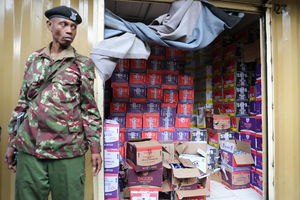
The raids in Maai Mahiu and Kijabe led to the recovery of 2,526 plastic bottles, each containing 200ml of alcohol. Officers arrested a woman selling the contraband from her home in Maai Mahiu and apprehended a man in Kijabe believed to be her supplier.
The seizure offers a glimpse into how smugglers have adapted their tactics. Authorities say the trade now relies heavily on "Panya" routes—unofficial border crossings that bypass customs checks. Once the products enter Kenya, distributors avoid commercial warehouses, instead converting ordinary homes in quiet neighbourhoods into secret storage facilities, invisible to industrial inspectors.
The 200ml packaging itself is a giveaway. Kenyan law, following years of battling the "sachet culture" that once flooded schools and low-income communities, mandates that spirit containers hold a minimum of 250ml. Any bottle smaller than that is automatically contraband, regardless of what is inside.
But the greater danger lies in the liquid itself.
Dr Kiplangat Ng'etich, a pharmacist at Kenyatta University Teaching and Referral Hospital, explains that illicit alcohol lacks the quality controls that keep legal products safe.
"Legally produced spirits have a standardised alcohol by volume. In illicit production, one batch might be 40 per cent, while the next is 80 per cent," he says. "This leads to accidental alcohol poisoning, where the body's automatic functions—breathing and heart rate—shut down."
Studies confirm that illicit producers often add methanol to increase potency or stretch their supply. The chemical can cause blindness, liver damage, organ failure, and death. Unhygienic production conditions introduce further contaminants.
What makes methanol particularly treacherous is its delayed effect.
"Symptoms often take between 12 and 24 hours to manifest," Dr Ng'etich warns. "They include blurred vision, severe confusion, seizures, loss of coordination, extreme abdominal pain, vomiting, and cold, clammy skin."
He emphasises that alcohol poisoning is a medical emergency requiring immediate action. "Call 911 or your local emergency services immediately. If the person is unconscious or lying down, roll them onto their side and tilt their head back slightly to keep the airway open. This prevents them from choking if they vomit," he advises.
"Stay with them and monitor their breathing. If they stop breathing, be prepared to perform CPR. Cover them with a blanket or coat to prevent hypothermia, since alcohol lowers body temperature."
For those still conscious, the instinct to help can sometimes cause harm. "If they are awake, try to keep them talking and sitting upright. Do not give them food or fluids. Do not force them to vomit. Do not let them sleep it off," Dr Ng'etich cautions. "That is how most alcohol-related deaths occur."
Protection strategy
Nacada CEO Anthony Omerikwa says the festive season crackdown is part of a broader strategy to protect Kenyans from the medical and social consequences of illicit drinking. The authority has increased border surveillance and deployed joint task forces across the country.
"We are working closely with security agencies to seal loopholes along our borders," Dr Omerikwa says. "Anyone attempting to profit from harmful substances at the expense of public safety will be decisively dealt with."
He has put manufacturers and distributors on notice. "Licences will be cancelled immediately for anyone found flouting the law. Those involved will be prosecuted without exception," he declares.
Nacada acknowledges that criminals often attempt to rebrand or use proxies after losing a licence, but notes that physical inspections typically expose such schemes. Changing the name on paper cannot hide a physical facility.
For consumers, the first line of defence fits in a pocket. Authorities are urging Kenyans to download the Soma Label app and scan the QR codes on Kenya Revenue Authority stamps affixed to bottles. A quick scan can distinguish a legitimate product from a potentially lethal counterfeit—a layer of protection that goes beyond what the eye can see.
Current research indicates that even moderate alcohol consumption carries health risks, including endocrine disruption, gut damage, heart problems, liver inflammation, and cancer. But when the bottle in your hand was mixed in someone's backyard with chemicals meant for industrial use, the danger is not long-term. It is immediate.
The festive season is when smugglers see their biggest returns. In border communities where alcohol flows freely at social gatherings, the appetite for cheap liquor creates opportunity—and peril.
That Sh100 bottle may be the last bargain you ever chase.