The unseen link between climate change and cervical cancer
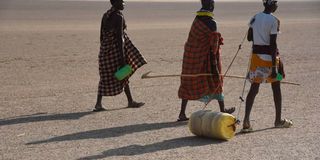
Women heading to Ngipai borehole in Lolupe village, Turkana Central on February 12, 2026.

What you need to know:
- As climate shocks ravage the Kakuma Refugee Camp, a new, hidden health crisis is emerging.
- For women living on the frontlines of displacement, the intersection of environmental disaster and fractured healthcare systems is turning a preventable disease into a death sentence.
When Sudi Noor speaks about the women and girls in her community, her voice trembles with emotion. As the director of the Girl Power Action Initiative at Kakuma Refugee Camp, she confronts women’s health crises daily; from cervical cancer to the insidious ways climate change compounds their suffering.
Delivering the Annual Lecture on Climate Change as Lived Experience: Women’s Health, Bodies, and Displacement at Aga Khan University, Noor highlighted a glaring data void: African women bearing the brunt of these intersecting crises remain uncounted.
Also read: 250 million children face triple climate threat as schools, vaccines, and water supplies collapse
“Women and children are always invisible when it comes to data,” she said. “But in Kakuma, we know their names, we know their faces, and we know their stories, yet they are never captured in global statistics.”
In an interview with Healthy Nation, she asserted that global leaders must redefine climate resilience. “It should not mean mere survival,” she said. “It means investing in communities so they, too, can thrive.”
Academic literature offers scant research on the direct links between climate change and cervical cancer, and such studies are nearly absent in Africa. Yet, Noor has buried neighbours who died from the disease, deaths she believes were preventable had the environment and health systems been adequate.
Despite bearing the harshest blows of climate-induced droughts and floods, Kakuma’s health infrastructure remains fractured. “A stronger health system would go a long way in ensuring early screening for cervical cancer. We don’t have that here,” she lamented.
A glimmer of hope came in 2023, when Noor attended a conference on displacement in Ghana. There, she met an immunologist discussing HPV testing kits. “I remembered my neighbour who died of cervical cancer because of a late diagnosis,” she recalled. “I asked the scientist if they could extend support to Kakuma, and he graciously agreed to distribute 200 HPV kits.”
But those kits never reached the refugee camp. “The health system here depends entirely on humanitarian aid,” she explained. “I approached the organisations, and they all declined. They said they lacked funds to treat anyone who might test positive.” As a result, women in her community receive late-stage diagnoses, and when climate shocks hit, their already fragile health collapses.
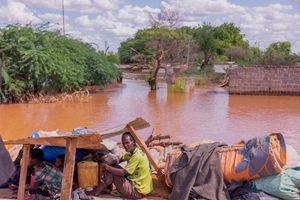
Martin Muchangi, pogramme director for Public Health and Environment at Amref Health Africa, told Healthy Nation that while the link between climate change and cervical cancer is indirect, its impact is profound. He described an environmental pathway: during droughts, women are forced to fetch water from rivers and ponds, exposing themselves to schistosomiasis (bilharzia). This can lead to female genital schistosomiasis, which affects the reproductive system, including the cervix.
Muchangi also pointed to a social dimension in this relationship. When climate change strains resources, he explained, women become more vulnerable to Sexual and Gender-Based Violence (SGBV), and that, in turn, elevates their cancer risk.
"They will likely have unsafe sex, mostly when they are assaulted, and with multiple sexual partners. That is a driver of cervical cancer," he explained.
He urged global leaders to take seriously the call to cut emissions, thereby curbing the climate impacts that disproportionately harm women's health. He added that adaptation strategies must include women's economic empowerment, giving them pathways out of the challenges they face.
"We need to invest in education systems that will empower these women, and we should also finance climate action at the local level," he said.
Scientific evidence supports these concerns. A study published in Frontiers in Public Health, conducted in the Middle East, found that climate variables, including rising temperature, affect the social determinants of cancer like the availability and quality of clean air, water, and housing. The study also noted that fragile healthcare infrastructure hinders women from accessing timely cancer screening and treatment.
"Prolonged exposure to a combination of rising ambient temperatures and traffic-related air pollution has been associated with an increased risk of gynecological cancers, including cervical, endometrial, and ovarian cancers," the study reported.
Disruptions in health services, the researchers explained, can compromise access to contraceptives, maternal and child care, HIV testing and treatment, counselling, psychosocial support, abortion services, and post-abortion care for crisis-affected communities. Left untreated, the resulting rise in sexually transmitted infections can have long-term health implications for women, including cervical cancer.
Another study, published in the Journal of Climate Change and Health, analysed existing literature linking cancer and climate, and similarly identified service disruption as a primary impact.
"There are unique aspects to cancer care delivery that make it especially vulnerable to climate change-related events. These include the resource-intensive nature of the treatment modalities, the multidisciplinary aspect of care, and the need for longitudinal follow-up," the study noted.
The researchers acknowledged, however, that the relationship remains incompletely understood. They also observed that climate-induced shifts in vector-borne diseases such as malaria worsen outcomes for cancer patients, whose immunity is already compromised.
"Given the adverse impacts of extreme weather events on cancer care delivery, emergency preparedness is crucial to mitigating negative effects," the study recommended.
The review also identified significant gaps in the published literature. Most research, the authors found, has concentrated on understanding cancer risk, with limited data addressing how climate affects cancer outcomes and the delivery of care.
"There is a need for more research using direct population incidence data rather than modeling to better understand climate change impacts on cancer risk," the study concluded.