Think you have Ebola? Why experts want you to stay put, call 719 and wait for health team
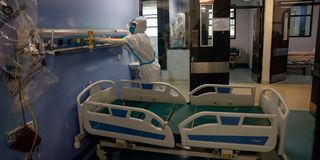
A nurse in protective gear in a ward at Nairobi Hospital where an Ebola patient from the Democratic Republic of Congo was isolated and treated shortly after arrival. The patient later died.

Think you have Ebola or are exhibiting Ebola-like symptoms? Do not go to hospital. Stay where you are and call 719.
Health experts say a health team will come to you, assess you safely and, if necessary, take you to the appropriate facility. Until it arrives, keep away from other people.
For most illnesses, Kenyans are advised to visit the nearest health facility if symptoms persist. For Ebola, the advice is different. This guidance comes from health experts and the Kenya National Public Health Institute’s Ebola portal.
Ebola begins with symptoms such as fever, severe headache and muscle pain. The disease can then progress to vomiting and diarrhoea and, in severe cases, damage to the liver and kidneys, followed by unexplained bleeding. The risk is particularly concerning after contact with a sick person or travel to an affected area.
“Anyone worried they may have Ebola, or that someone they know may have it, should not go to a hospital or clinic. They should stay where they are and call 719, so health officials can come to them for a safe assessment and, if needed, a safe evacuation to the right facility,” said Dr Ahmed Kalebi, independent consultant pathologist.
He added: “Walking into an ordinary clinic, laboratory or hospital is the worst thing a suspected case can do.”

Cabinet Secretary for Health Aden Duale addresses journalists at Afya House in Nairobi on October 6, 2026, following Kenya’s first Ebola death.
Health Cabinet Secretary Aden Duale says that when a call is made, the response team acts immediately because it has several officers on standby.
“The number to call is 719, the Ministry of Health’s toll-free line. When a call is received, the officers act immediately. That is why directions will be given after a series of questions have been asked. That is why it is being manned by experts,” Mr Duale said.
The country’s first imported Ebola patient travelled from the airport to a hospital in a private car, and 21 healthcare workers who attended to him have since been quarantined.
Dr Kalebi told the Daily Nation that an unprepared health facility can spread Ebola faster than a home can.
“Unprepared medical facilities act as amplification hubs. In the community, one patient usually infects a small circle of family and caregivers. In a hospital that is not screening for Ebola, the same patient meets other sick people, shared equipment and staff who must touch them. That person can pass the virus to several nurses, doctors and neighbouring patients before anyone realises what they are dealing with,” Dr Kalebi said.
He said the virus behaves differently from those Kenyans are more familiar with.
“Ebola does not behave like flu or Covid-19. Those viruses often spread before a person feels very ill. With Ebola, the amount of virus in blood and body fluids rises as the patient gets sicker.”
By the time a patient reaches a hospital, he said, a millilitre of blood can contain millions of viral particles. Inserting a drip, drawing blood, giving an injection or cleaning vomit and diarrhoea can therefore become dangerous.
“Without the right protective equipment and isolation, bedsheets, floors and shared equipment are easily contaminated. Staff who are infected but not yet sick can carry the virus to dozens of other patients on later shifts,” he said.
Dr Kalebi cited the 2013–2016 epidemic, referring to a World Health Organization analysis that found health workers, depending on their jobs, were 21 to 32 times more likely to be infected than other adults.
In Guinea in 2014, the US Centers for Disease Control and Prevention estimated that health workers were infected at about 42 times the rate of other adults. They accounted for less than 1 per cent of the population but 7.9 per cent of adult cases.
In Sierra Leone, the gap was about 100-fold, and health workers accounted for 5.2 per cent of confirmed cases. By the end of March 2015, the WHO had recorded 815 confirmed and probable infections among health workers in Guinea, Liberia and Sierra Leone. More than 500 health workers died.
Among those whose outcomes were known, the death rate often exceeded 50 per cent, according to WHO figures. The organisation also reported that about two-thirds of those infected in medical facilities died.
“An unprepared hospital is the next danger because it can keep generating new chains day after day until triage and isolation are in place,” he said.
“The rule for the public is simple. Do not go to a regular clinic or hospital for help. Don’t use public transport. Stay put wherever you are. Call 719. Let the relevant health officials come to you for further assistance,” Dr Kalebi said.
Follow our WhatsApp channel for breaking news updates and more stories like this.