Ebola meets El Niño: Kenya’s looming twin-disaster
Kenya is entering the October-to-December rainy season with its first Ebola case only five days old.


What you need to know:
- Kenya is entering the October-to-December rainy season with its first Ebola case only five days old.
- The rains are expected to start in many areas in the second and third weeks of October.
Kenya’s ability to respond to a serious infectious disease outbreak could be severely tested if an Ebola outbreak coincides with an El Niño-driven disaster.
Floods could disrupt roads, health facilities, water systems, supply chains and disease surveillance while increasing population displacement.
Kenya is entering the October-to-December rainy season with its first Ebola case only five days old. Public health officers responsible for tracing contacts and ensuring safety protocols are followed have been on strike for the past three months.
The Ministry’s own planning documents warn that floods could displace thousands of people into crowded camps and cut off access to health facilities.
The Ministry of Health on Friday said that it would begin distributing support supplies that afternoon to facilities designated to handle Ebola cases.
Can Kenya’s emergency systems can cope with the two crises at once?
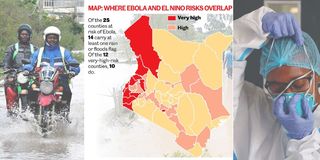
Kenya has named 25 counties at high risk of Ebola. The Kenya Meteorological Department forecasts enhanced rainfall across about 80 per cent of the country during the short rains. The rains are expected to start in many areas in the second and third weeks of October, with the earliest rainfall expected in western Kenya and Nairobi.
Ten counties on the Ebola risk list are also expected to receive rain early: Nairobi, Busia, Bungoma, Siaya, Trans Nzoia, Uasin Gishu, Kakamega, Vihiga, Nandi and Nakuru.
The National Disaster Operations Centre has flagged Nairobi, Mombasa and Kisumu as high-risk urban centres.
It has also identified the Lake Basin counties of Kisumu, Busia, Siaya, Homa Bay and Migori as being at risk of flooding, landslides, disease outbreaks and displacement.
These counties are classified as being at very high risk of Ebola because of their proximity to borders, major trade routes or high levels of population movement.
Estimates of the number of people at risk vary.
The Kenya Red Cross says more than two million people in 46 of the 47 counties face severe flood and displacement risks. The Kenya Meteorological Department estimates that about 1.5 million people could be affected.
The overlap is what concerns responders. Ebola spreads through contact with the bodily fluids of sick people and the bodies of those who have died from the disease. An effective response depends on identifying suspected cases quickly and keeping them separate from others.
Floods can force families into schools, churches and crowded camps. That is where Ebola surveillance faces its hardest test. Contacts must be monitored for 21 days, but displaced people move from place to place. Early Ebola symptoms can resemble those of malaria, while rumours can spread quickly. The last El Niño displaced more than 500,000 people across 43 counties.
Camps bring large numbers of people into close proximity, often with shared water and sanitation facilities. Contact tracing becomes harder when families are scattered or cut off.
Mr Brown Ashira, national secretary-general and chief executive officer of the Kenya Environmental Health and Public Health Practitioners Union (KEHPHPU), put the practical question this way: “Even if someone, a suspected case with Ebola, is in a flooded area, how should health workers identify them, separate them, and then transport them from a flooded or overcrowded area to a different place? Most areas marked as high risk are the riverine areas, the mountainous areas, and the areas that are prone to floods.”

State Department for Public Health Principal Secretary, Mary Muthoni, inspects the screening point at the Jomo Kenyatta International Airport.
Mr Ashira described the situation as a triple threat – Ebola, the coming rains and the work boycott.
“Contact tracing, traveller screening and case identification fall to public health officers. Our absence weakens all three,” he said.
The Ministry of Health counts five designated Ebola facilities with 244 beds. The Kenya National Public Health Institute (KNPHI) dashboard listed 62.
Health Cabinet Secretary Aden Duale named the five facilities as Kenyatta National Hospital, with eight beds; Moi Teaching and Referral Hospital, with 50; the National Police Service Hospital, with 49; Port Reitz Hospital in Mombasa, with four; and The Nairobi Hospital, with 133, of which close to 45 are high-dependency and intensive care beds. The figures he gave total 244.
“The capacity in all these hospitals will increase as we are making sure that public, private and faith-based facilities increase their capacity in the event the situation evolves,” he said.
The Ministry says Kenya has 15 isolation and treatment units and plans to expand this number to 22, prioritising high-risk counties.
Mary Muthoni, the Principal Secretary for Public Health and Professional Standards, told the Saturday Nation that health officers across the country had been activated to respond to suspected cases.
Capacity to quarantine or isolate
Prof Shem Otoi, an infectious disease modelling expert, said Kenyatta National Hospital had only eight beds for Ebola patients requiring critical care, with four doctors and about 20 nurses able to handle such cases.
“We do not have the capacity if this becomes an explosion,” he said.
Dr Ahmed Kalebi, an independent consultant pathologist, distinguished imported cases from local transmission.
“Our level of preparedness is enough to deal with just one or two imported cases, a few isolated cases that are suspected, but if we are to get local transmission under such, similar to what happened in Uganda, for example, before they contained it, I don't think we are prepared,” he said.
The number of beds the ministry is talking about are very few,” he said.
Mr Ashira said the country lacked adequate capacity to quarantine or isolate all cases. He added that, with the two threats coinciding, more hospitals could be overwhelmed by diseases including waterborne and diarrhoeal illnesses, malaria and other vector-borne diseases.
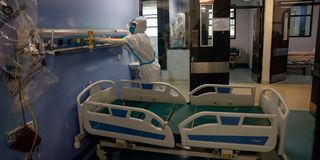
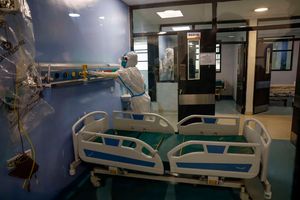
A nurse in protective gear in a ward at Nairobi Hospital where an Ebola patient from the Democratic Republic of Congo was isolated and treated shortly after arrival. The patient later died.
The Ministry says 4,971 health workers have been trained. However, Prof Otoi said training was different from protecting frontline workers, adding that their protection determines how far the virus spreads.
“Protecting healthcare workers is not only about protecting them individually. It protects the entire health system from becoming a transmission network,” he said.
Prof Omu Anzala, a virologist and member of the National Task Force for Ebola, said response teams should be ready before a case appears.
“We should have teams, you know, that are ready so that if there is a suspected case, this team quickly mobilises and goes there to ensure that the cases are handled by highly trained people because healthcare workers are the most exposed,” he said.
The World Health Organization has supplied 1,000 sets of protective equipment, while India has donated 6,000. At the onset of the Ebola outbreak, the Ministry said its test kits and protective gear would cover only the first 200 suspected cases and that it needed an emergency Sh2.68 billion.
“PPEs have been a challenge,” Prof Otoi said. “We need information from the government on the distribution of PPEs and essential medicines for Ebola care in the country, and whether we have enough supplies,” he said.
At an Ebola task force meeting on Friday morning, Principal Secretary Mary Muthoni assured the country that the Ministry was coordinating all levels of government and private partners to ensure the disease was contained.
Ms Muthoni said the country has so far received support worth Sh171 million in laboratory equipment and protective gear, which would be distributed to facilities in high-risk areas.
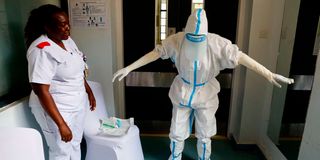
A nurse in protective gear at Nairobi Hospital where an Ebola patient from the Democratic Republic of Congo was isolated and treated shortly after arrival. The patient later died.
She called on other development partners to support the effort to prevent the virus from spreading beyond the reported imported case.
Five laboratories are testing samples, with a turnaround time of about six to 12 hours. Dr Kalebi told the Nation that supplies were sufficient for now.
“We have sufficient reagents to test currently. But if you’re going to get a serious outbreak, I think we’ll be strained,” he said.
The Ministry has 66 people in quarantine, and Mr Duale says the figure will continue to rise.
Dr Kalebi said the system lacks the capacity for wider contact tracing.
“We don’t have the full capacity to do a wider contact tracing,” he said.
Mr Aggrey Aluso, executive director of the Resilience Action Network Africa (RANA) and Africa director and global policy lead for Resilience Action Network International (RANI), said that while the two challenges were not directly related, they could intersect if Kenya experienced an active outbreak.
“In a context where people face an environmental disaster which leads to displacement, for example, it will most likely push people to stay in close proximity. That creates a conducive environment for spread because people are living in camps,” he explained.
“People forced to live in close proximity in a humanitarian setting face external threats and sometimes do not pay attention to other public health issues because it’s about survival,” he added.
He said such scenarios required proactive, strategic action to provide infrastructure that would help isolate people and deliver information at the community level.
“The best line of defence here would be working very closely with communities, because the effectiveness of public health responses depends on how well people trust and use the system,” he said.
Mr Aluso advised the government to prioritise resource allocation and build both physical infrastructure and functional isolation centres.
He added that expanding clinical care capacity was crucial, given that there were no approved therapeutics and vaccines remained in the trial stage.
“The quality of clinical care is what enhances people’s chances of survival. These need to be ramped up, like we did during COVID time, and get these capacities spread out in strategic counties.”
Follow our WhatsApp channel for breaking news updates and more stories like this.