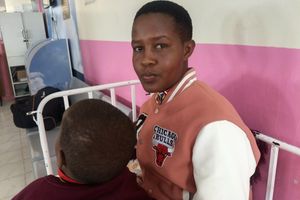
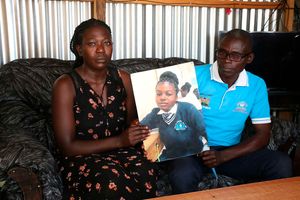
Treated for TB three times, malaria once, but the real disease went undiagnosed for years

Damaris Nduku, who endured four years of multiple misdiagnoses before finally receiving a correct diagnosis in India.

What you need to know:
- She travelled to India with her mother in mid-2025. Doctors there repeated the same diagnostic procedures she had already been through in Nairobi.
- This time, the result was different: a fungal infection, left to spread for years, which she says by then had cost her much of her hearing and a dramatic amount of weight.
Damaris Nduku still remembers the nights she would wake up drenched, strip off her soaked clothes, and try to fall back asleep; twice a night, for months on end.
"I was sweating so much I had to change my clothes twice at night, and even the bedding. There was a day I ironed the bedding so that I could sleep," says Nduku.
Alongside the sweats came a persistent abdominal pain on the right side, and then, gradually, everything else.
Also read: The bathroom fall that cost Sh4.5m: A doctor's story of surviving antimicrobial resistance
It would be nearly four years before anyone told her what was actually wrong. In that time, she was treated for latent malaria, three times for tuberculosis, and for pneumonia, before a hospital in India finally identified the real cause: an untreated fungal infection that, by the time it was caught, had spread through her body, damaged her hearing, and left her fighting to regain weight she should never have lost.
"The first time I fell ill was in 2022, a few days after travelling back from Mombasa, where my friends and I had gone on vacation. We all fell sick. At the hospital, I was told I had latent malaria. This occurs when malaria parasites stay dormant in the liver, hidden, causing no symptoms for months or years before waking up to trigger a relapse."
Soon after, she developed severe abdominal pain on the right side, with a CT scan showing fluid in her lungs. At one of the private hospitals in Nairobi, she was admitted, subjected to several tests, and released.
"They said they couldn't find what was ailing me," says Nduku.
By the time she presented to the second hospital, she had developed jaundice and a hernia. Due to the night sweats and weakness, which forced her to use a wheelchair, the hospital told her she was exhibiting symptoms of tuberculosis. Even though tests for the disease came back negative, she was put on a six-month course of medication for it anyway.
"I took the medication but did not improve. When I finished that course, a private doctor I consulted for a second opinion told me I should not have been treated for TB because the diagnosis was negative."
An X-ray at that visit showed something new;traces of fluid in her chest, and she was told it might be pneumonia, for which she was treated. While on pneumonia medication, her phlegm was sent to an advanced lab for testing. Then, without having finished ruling anything out, she was put back on a second full six-month course of TB medication, even as she kept working at a bank between hospital stays, cycling through weeks of treatment and a handful of days back at her desk before being pulled out sick again.
"The private doctor I was seeing often told me that he didn't really know what he was treating because the lab tests were not bringing up positive results for any disease. He was just managing the symptoms," says Nduku.
Somewhere in that stretch of drug-switching, she says, she was also tested for hepatitis and arthritis. None of it explained why she kept getting sicker, thinner, and more exhausted.
Long before anyone mentioned travelling abroad, the cost of chasing a diagnosis at home had already outstripped what her insurance would cover. Her initial medical cover, she says, sat at around Sh500,000. Against that, one hospital bill alone came to about Sh672,000. She was told she would need to settle the difference before she could be discharged.
That gap is what brought her colleagues in.
"My colleagues, they did a very good job. They fundraised close to Sh500,000 to cover the balance. There were also multiple blood drives conducted because at some point I became anaemic," she says.
It was a client at her workplace, in 2024, over a year since she had fallen sick, who first suggested she seek treatment outside Kenya, after finding her still on TB medication and clearly not improving.
"I think you need to go to India," he told her, by her account. She still believed at the time that finishing the drugs would resolve things. It didn't.
She travelled to India with her mother in mid-2025. Doctors there repeated the same diagnostic procedures she had already been through in Nairobi. This time, the result was different: a fungal infection, left to spread for years, which she says by then had cost her much of her hearing and a dramatic amount of weight.
The first two weeks in India went not to treating the infection itself but to stabilising her. Every organ but her heart had been affected, she says, and doctors spent that period on detox and recovery, particularly for her liver, before antifungal treatment could safely begin.
"They did not give me any painkillers," she says of that stretch. She was prescribed a six-month antifungal course but returned to Kenya after four, having lost a significant amount of weight over the course of treatment.
The India trip was, by her account, an entirely different financial proposition, and this time, notably, there was no public appeal for help. The figure she cites for the full cost of treatment in India runs into the millions of shillings, but it was absorbed by an insurance policy tied to her employment.
Getting that cover approved for travel wasn't automatic, either. She says her original treating doctor in Kenya initially refused to sign the authorisation her insurer required before she could travel for treatment abroad. It was her brother, a pharmacist, who intervened, connecting her through a doctor contact willing to approve the paperwork instead.
Once in India, she notes a structural difference in how care is billed there that shaped her costs. Patients aren't typically admitted and kept for extended stays unless undergoing a specific procedure, and even then hospital stays are capped at around two days. Her four months of treatment were spent largely outside inpatient care, but the overall bill, she says, was still substantial.
She lost her job in the process. Her employer had told her, before she left, that a position would be kept open if she returned well enough to resume work. When she came back in August 2025, she chose not to return to that workplace at all. She is now involved in a wholesale phone business to fend for herself and her family.
"Some losses don't show up on an insurance claim. I lost my hair, I lost my friends. I lost so much." The hair loss wasn't from treatment directly, it was a decision she made herself, shaving her head rather than continuing to manage night sweats she no longer had the strength for. "I just need to get better," she says of that choice.
Nduku's account traces a data point rarely quantified in Kenya's health discourse: what a wrong diagnosis actually costs, twice over. First, an informal, community-funded top-up of roughly half a million shillings to cover a shortfall from treatment for a disease she didn't have. Then, a formally insured, multi-million-shilling trip abroad to correctly diagnose and treat the disease she did have, a trip that very nearly didn't happen because the doctor responsible for her original misdiagnosis was reluctant to authorise it.