UNGA: President pledges billions as contraceptives shortage bites
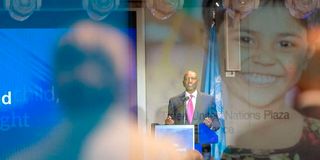
President William Ruto makes his presentation at UNGA.

What you need to know:
In New York
As the world observes World Contraception Day on September 26, 2026, women in the country have lacked access to the methods they truly desire to have for nearly a year.
Behind them sits a government that has pledged millions on a UN stage in New York, while quietly defaulting on the very fund built to multiply that money at home.
The gap between what has been promised and what has been paid is now the story of Kenya's family planning programme.
In a stock check by the Nation, over 13 key family planning commodities tracked at the Kenya Medical Supplies Authority had zero months of stock.
The combined oral contraceptive pill. The progestin-only pill. The three-year levonorgestrel implant. The DMPA injectable, the method most Kenyan women rely on, with zero units against average monthly consumption of nearly 100,000 vials. The emergency contraceptive pill. The condoms too are out of stock.
For those in stock, including levonorgestrel IUD, it is below the required 16-month buffer, in stockout, or edging toward one. The single-rod implant favoured by young women had less than half a month's supply left against demand. The five-year implant had less than a month.
Kenya is not short of women who need these commodities. It is short of the commodities themselves, and has been for almost a year.
In Kilifi County, healthcare provider Millicent Navinywa has lived that shortage daily for six months. "I feel bad that I have to send women to buy contraceptives when they don't have the money.
“The only option I can offer is a five year non hormonal implant, but most women prefer the short-term methods, which I don't have," she said. Women are coming pleading but I have nothing to offer them.”
In February, she ordered 7,000 units of contraceptives and received 1,500, which ran out fast. "Women are getting pregnant because they cannot access contraceptives. I fear that come next year, many women might die from unsafe abortions while the number of young girls getting pregnant might also increase," she said.
The 2026 Kenya Economic Survey shows the retreat is already visible in the numbers. Combined oral contraceptive pill uptake dropped 29.9 percent among new clients, the steepest decline of any method tracked. Injections fell 10.9 percent.
Progestin-only pills fell 15 percent. Female sterilisation dropped 13.9 percent. The projected toll of the stockout: 1.2 million unintended pregnancies, 290,000 unsafe abortions, 4,000 maternal deaths, and an additional Sh11.2 billion in healthcare costs. Kenya now lags behind Uganda, Rwanda and Zimbabwe.
Nelly Munyasia, executive director of the Reproductive Health Network Kenya, said the consequence is women forced into decisions they should never have to make.
“We are celebrating WCD, yet what we have instead are woman with choices that they ought not to carry because they missed their methods. Why are we even celebrating this day yet our shelves are empty? I am pained, and this is a conversation that we should put more emphasis on as a country.
Kenya has quietly fallen behind its obligation, one designed specifically to multiply whatever it does manage to pay. The country has stopped honouring a matching-fund pact with the UN Population Fund, and repeated requests to release the money have gone nowhere.
At stake are two outstanding sums: $618,473 owed for the 2025 financial year and $2,061,578 for 2026, both earmarked for contraceptive commodities. Kenya did pay its share in 2023 and 2024, totalling $517,800, but has since defaulted.
The arrangement, signed in May 2024, exists to reward exactly this kind of investment. Under UNFPA's Supplies Match Fund, Kenya receives $2 in donated commodities for every $1 it pays in. Honouring the $618,473 owed for 2025 alone would unlock $1,236,946 in matched supplies.
However, UNFPA has been forced to spend up to three times its planned annual budget for Kenya just to keep the pipeline moving, commodities the country has now completely exhausted.
“A fund built to reward ownership is instead rewarding absence.” Says the source.
A Ministry of Health source, unauthorised to speak publicly admitted to the Nation on the sidelines of UNGA just how tight that path has become.
"Something happened that delayed in the payment of the monies to UNFPA, we are paying our first payment. The 20 percent that we were supposed to do will be around 60 to 80 million," the source said.
They did not dress up last year's failure either. "Last year the pressure was too much and somethings did not happen, mistakes happen and we have to move out of this and we are now committed to doing this and is already structured in the law," he said, adding that the government has pencilled in roughly Sh2.5 billion for 2026 to 2027, though even Sh1.5 billion of that "we will be happy" to receive given how badly the country is struggling.
Of the Sh250 million already allocated, the source was candid: "which is not enough."
"We have never been this low with the supplies but good thing we are not at zero stocks," the source said, describing an instruction to counties to pool whatever stock they have left so no woman is turned away entirely, with fresh supply expected within two months. The retreat of American support was named as the trigger.
"Americans have walked out of FP and that's why we need to increase our domestic funding on FP," the source said.
Against that backdrop, President Ruto on the sidelines of UNGA made a promise: Sh3.2 billion ( $25 million) for contraceptives, and a further Sh6.2 billion ($50 million) for women's health. It was a headline commitment on a global stage, delivered while Kenyan women back home were going without the very commodities the money is meant to buy.
The reaction from those closest to the crisis was measured, not celebratory. "Our humble prayer is that this announcement translates to actual disbursements."
Ruto's commitment now becomes the target every advocate in that room will hold him to, not the announcement itself, but whether the money clears the distance between State House and Kemsa's warehouse floor.
"The gap between allocation and disbursement is not a technical matter; it is a governance failure of the highest order," Ms Munyasia said.
Follow our WhatsApp channel for breaking news updates and more stories like this.