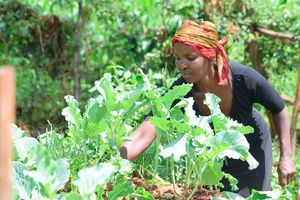
University graduate revolutionises farming in Mbooni through innovative soil testing
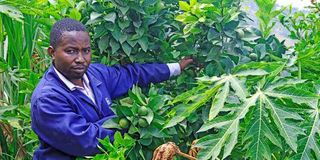
Martin Muoki, 34, is an agronomist and the founder of Farmers Senta Agrovet. Photo| POOL

What you need to know:
- Martin Muoki, a Horticulture graduate from the Jomo Kenyatta University of Agriculture and Technology, is leading an agricultural revolution that is transforming how thousands of farmers’ approach crop production.
- The farm runs as an integrated system: azolla is cultivated to feed fish, and the same plant also supplements the diet of cattle and poultry
In the arid landscapes of Mbooni sub-county, where soil acidity has long plagued farmers and forced many to abandon their agricultural dreams, one university graduate is writing a different story. Martin Muoki, a Horticulture graduate from the Jomo Kenyatta University of Agriculture and Technology, is leading an agricultural revolution that is transforming how thousands of farmers’ approach crop production.
Muoki's journey began with his own farming failures. After leaving formal employment to venture into agriculture, his initial attempts at vegetable farming on his two-acre plot yielded disappointing results. Rather than give up, he turned to science.
“I was in employment but later resigned. I started farming without the use of any technology. Loss after loss, I got into the use of technology to cut costs and aid the smooth running of the things I am doing,” Muoki explains.
His transformation began with soil testing in partnership with the Kenya Agricultural and Livestock Research Organisation (KALRO). Through detailed soil analysis, Muoki discovered the specific deficiencies plaguing local farms and developed targeted solutions that address not just nutrient deficiency but also bacterial problems that cause root rot and bacterial wilt.
What started as a personal solution has grown into a movement. Muoki now leads a network of more than 3,000 farmers across three wards in Mbooni sub-county, maintaining contact through phone calls and WhatsApp groups. His farm is a model for other farmers in the region.
“Through soil analysis, we have been able to recommend to farmers the fertilisers and products which would aid in unlocking the nutrients and evade problems like suppressing the bacteria causing the root node and the bacterial wilt, hence making their growth practical,” Muoki told Climate Action.
Muoki's success lies in his integration of modern technology with traditional farming wisdom. On his farm, biogas generated from cow dung powers water pumps for irrigation and runs equipment like chaff cutters. This closed-loop system significantly reduces production costs while maintaining environmental sustainability.
The farm runs as an integrated system: azolla is cultivated to feed fish, and the same plant also supplements the diet of cattle and poultry. This circular approach has created employment for six workers on a full-time basis and provides weekly income opportunities for approximately 200 women who harvest and sell produce in local markets.
According to Dr Anne Bakilana, World Bank operations manager for Kenya, Rwanda, Uganda, and Somalia, over 65 per cent of farmland in the region is considered degraded due to insufficient soil fertility, poor nutrient management, erosion, and acidification.
"Soil is the cornerstone of agricultural systems, essential for food production and ecosystem services. This decline in soil health is closely linked to the region's productivity challenges," Dr Bakilana noted during the recent Data for Soil Health and Scale Summit in Nairobi.
The problem is compounded by climate change, which significantly impacts soil quality. Ms Marisa Soares, senior vice president for innovation and impact at Yara International Limited, emphasises that Kenya's widespread soil acidification requires systematic pH balance correction.
"Correcting the soils after every season by understanding what is wrong and then giving at the right hour soil vitamins, putting organic matter back into the soils and using the right fertiliser nutrients for the right soil type," she explains.